Turkey Rub: Five Flavors and How Much for Your Bird
Turkey rub goes salt-free on a brined bird, light on sugar above 300°F, and about ½ cup per 10 pounds, or less for a lighter coat.
Last updated: November 10, 2026 · Originally published November 4, 2026
Food safety note. USDA says to cook all poultry to 165°F measured with a food thermometer, checked in the thickest part of the breast and the innermost thigh and wing, and to keep the smoker between 225°F and 300°F. Wash your hands, utensils and anything else raw turkey touches with soap and water, and never dip a hand that has touched the bird back into the rub jar.
A good turkey rub is one of the easiest ways to build deep, well-rounded flavor before the bird ever hits the smoker or oven. Rather than relying on the turkey alone, a simple blend of salt, herbs, spices, and sometimes a touch of sugar or citrus zest seasons the meat all the way to the bone while also helping the skin brown and crisp. For many home cooks, applying a rub has become a standard step, especially when smoking, because it turns an ordinary turkey into something noticeably more savory and complex with very little extra work.
The best part is that you don’t need a complicated recipe or hard-to-find ingredients. Most effective turkey rubs use pantry staples you already have, and once you know a few reliable flavor combinations, you can match the rub to the wood you’re smoking with or the sides you’re serving. Whether you prefer something classic and herby, a little sweet and smoky, or bright with citrus and spice, the right rub (and the right amount for your bird’s size) makes a clear difference in the finished turkey and is simple enough for even first-time cooks to master.
Planning the sides too? Our Thanksgiving dinner planner lines up every dish around the turkey and builds the shopping list.
The parts that matter
- Salt: leave it out of the rub if the turkey was wet brined, dry brined or sold with an added salt solution.
- Sugar: table sugar starts to caramelize at 320°F, per grill maker Napoleon. Keep sweet rubs for low smoker temperatures or put them on late.
- How much: our house rule is about ½ cup per 10 pounds. McCormick’s turkey rub uses 5¼ tablespoons for a 12- to 14-pound bird, a much lighter coat.
- Where it goes: McCormick and La Tienda both put rub under the skin and over it, with oil brushed on first.
- Wood: our wood guide pairs turkey with apple, cherry or maple, and calls hickory and mesquite too strong.
Five Turkey Rub Flavors, Side by Side
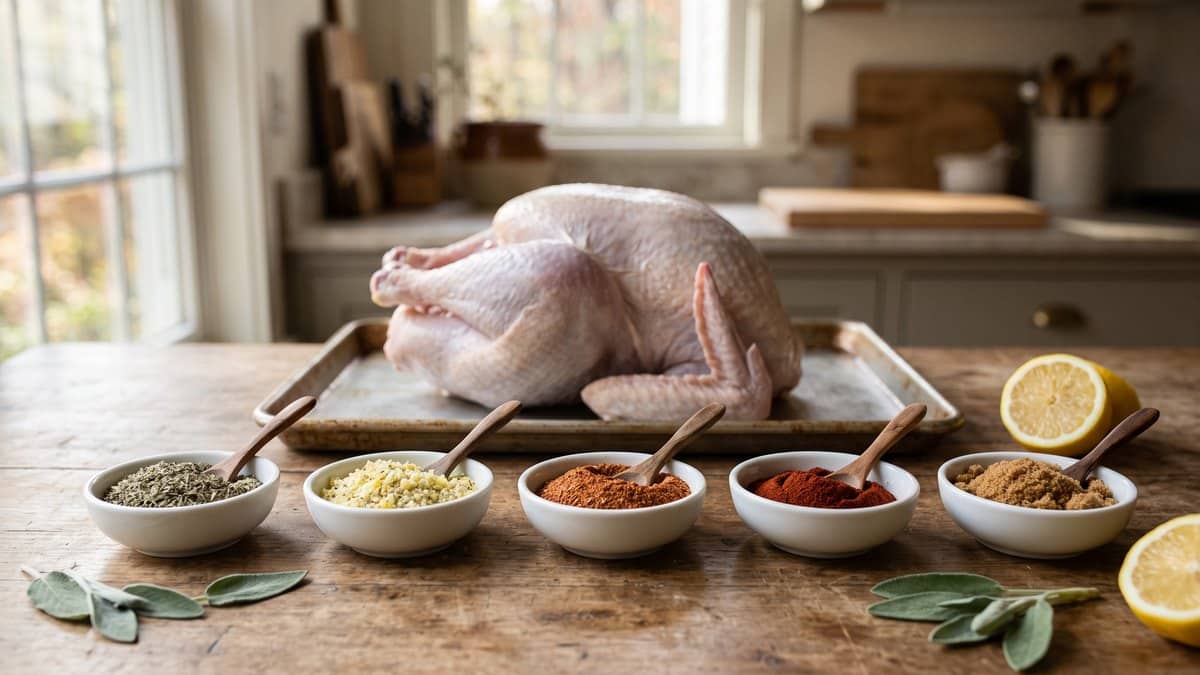
Choosing the right turkey rub comes down to the flavor profile you want to highlight, and these five popular options cover most tastes while pairing well with smoked poultry. A classic herb rub built on salt, black pepper, garlic, rosemary, thyme, and sage delivers clean, traditional Thanksgiving flavor that lets the turkey shine. A sweet-and-smoky rub adds brown sugar, paprika, and a touch of chili powder for deeper color and a gentle caramelized crust that complements fruit woods. Bright citrus-herb blends use lemon or orange zest with garlic and parsley for a fresher, lighter taste that cuts through richer sides. For something bolder, a Cajun-style rub brings paprika, cayenne, onion, and oregano for noticeable heat and savory depth. Finally, a simple peppery garlic rub, heavy on cracked black pepper, granulated garlic, and salt, keeps things straightforward and works especially well when you want the smoke itself to be the star. Each of these can be mixed in minutes and scaled to your bird, giving you a clear side-by-side choice depending on whether you prefer classic, sweet, bright, spicy, or boldly savory results.
| Flavor | What is in it, salt-free | Sugar? | Salt in the published recipe | Wood that suits it |
|---|---|---|---|---|
| Herb and sage | 2 Tbsp poultry seasoning or rubbed sage, 1 Tbsp paprika, 2 tsp garlic powder, 1 tsp black pepper, ¾ tsp ground nutmeg | None | 1 Tbsp seasoned salt, McCormick | Apple |
| Lemon pepper and herb | 1 Tbsp lemon zest, 2 tsp black pepper, 2 Tbsp minced onion, 1 Tbsp parsley flakes, 2 tsp each rubbed sage, thyme leaves and garlic powder | None | 4 tsp kosher salt, McCormick | Alder |
| Cajun | 2 Tbsp smoked paprika, 2 tsp each onion powder, garlic powder and cayenne, 1½ tsp white pepper, 1 tsp each ground thyme and dried oregano, ½ tsp black pepper | None | 2 tsp kosher salt, Traeger | Pecan |
| Smoky paprika | 3 Tbsp sweet smoked paprika, 3 tsp black pepper, 4 tsp granulated sugar, 2 tsp each onion powder, garlic powder, dried thyme and dried oregano, 1 tsp ground mustard, ¼ tsp cayenne | A little: 4 tsp | 3 tsp salt, La Tienda | Cherry |
| Brown sugar | ¼ cup packed light brown sugar, 2 tsp each white pepper, rubbed sage, garlic powder, onion powder, dried rosemary and dried thyme | Yes: ¼ cup | 1 Tbsp kosher salt, Butterball | Maple |
Each blend is its maker’s published recipe with the salt taken out: McCormick’s Savory Turkey Rub and Smoked Turkey, Traeger’s Cajun Turkey, La Tienda’s Smoked Paprika Rub for Turkey and Butterball’s Make-Ahead Turkey Dry Rub. The salt column shows what each maker used, for a bird that was not brined. Wood picks come from the poultry woods in our wood pairing guide.
The batches are not the same size, and that is worth knowing before you mix. Without its salt, the herb and sage blend comes to about 4¼ tablespoons and McCormick wrote it for a 12- to 14-pound turkey. The lemon blend makes about 6⅔ tablespoons for a turkey of about 14 pounds, and the Cajun makes about 5⅓ tablespoons, which Traeger built around a 12-pound bird. La Tienda’s smoky paprika comes to about 8½ tablespoons for a 12- to 15-pound turkey, and Butterball’s brown sugar rub makes ½ cup without giving a bird size at all.
Brined Bird? Leave Out the Salt
Was the bird brined? If the answer is yes, the rub goes on salt-free, full stop. A wet brine from our turkey brine for smoking guide or a measured dry brine has already put the salt where it needs to be, and every pinch in the rub adds to that. Our dry brining guide covers how much salt a bird needs by weight and why the brand of salt changes the answer, so I will not repeat the math here.
Store-bought birds can be pre-seasoned too. USDA’s Food Safety and Inspection Service says a bone-in turkey injected or marinated with a solution of butter or other fat plus broth, water, spices or flavor enhancers has to be labeled “basted” or “self-basted,” and the label has to list what is in that solution. Read it at the store. If salt is on the list, treat that turkey as brined and use the salt-free blend.
An unbrined turkey is the one case where the salt in the published recipe belongs. Use the maker’s amount from the table and stop there. It is easy to add salt at the table and IMPOSSIBLE to take it back out of the skin.
Sugar and Smoker Temperature
Napoleon, the grill maker, puts the caramelization point of sucrose, plain table sugar, at 320°F. USDA tells you to run the smoker between 225°F and 300°F for meat and poultry, so a sweet rub on a bird held low and slow stays under that line, and the brown sugar blend is a fine choice at 225°F to 275°F.
The trouble starts when you finish hot. Traeger’s Cajun turkey smokes at 225°F for 2 hours and then goes up to 350°F until the breast reads 165°F, and that Cajun blend has no sugar in it. If your plan ends above 300°F, pick one of the three sugar-free rubs, or hold the sweet one back and put it on for the last stretch of the cook, the way our dry brining guide says to add sweet rubs late. The smoky paprika blend sits in between, with 4 teaspoons of sugar spread through about 8½ tablespoons of rub.
How Much Turkey Rub for Your Bird
Our BBQ rub guide uses about half a cup of rub per 10 pounds of meat. The turkey recipes from the makers in our table run lighter than that, and McCormick’s savory rub is the clearest example: 5¼ tablespoons of seasoning, salt included, for a 12- to 14-pound bird, which works out to about 0.4 tablespoon a pound. Find your bird’s weight and read across.
| Whole turkey | Our rule, ½ cup per 10 lb | Lighter coat, McCormick’s ratio |
|---|---|---|
| 10 to 12 lb | 8 to 9½ Tbsp | 4 to 5 Tbsp |
| 12 to 14 lb | 9½ to 11 Tbsp | 5¼ Tbsp, McCormick’s own amount |
| 14 to 16 lb | 11 to 13 Tbsp | 5½ to 6½ Tbsp |
| 16 to 18 lb | 13 to 14½ Tbsp | 6½ to 7¼ Tbsp |
| 18 to 20 lb | 14½ to 16 Tbsp | 7¼ to 8 Tbsp |
| 20 to 22 lb | 16 to 17½ Tbsp, about 1 cup | 8 to 9 Tbsp |
Our rule is 0.8 tablespoon per pound, from half a cup, or 8 tablespoons, per 10 pounds in our BBQ rub guide. The lighter coat scales McCormick’s 5¼ tablespoons for a 12- to 14-pound turkey at about 0.4 tablespoon per pound. Amounts are rounded to the nearest quarter or half tablespoon; 16 tablespoons make 1 cup.

Which column would I use? On a turkey, the lighter one. Turkey skin is thin, a big bird has a lot of it, and poultry seasoning and sage get loud fast, so I would start with McCormick’s ratio and keep the rest of the jar for the table. Use our heavier rule when you want a thick, dark crust from the smoky paprika or Cajun blend, and mix a little extra either way, because rub that has never touched the bird can go back in the cabinet.

Under the Skin and Over It
McCormick and La Tienda put rub in the same three places: some in the cavity, some under the skin and the rest over the outside. McCormick puts about half its blend inside the bird, while La Tienda uses only about a tablespoon in the cavity and saves the rest for the meat. I side with La Tienda here, because seasoning inside the cavity flavors very little you will eat.
Oil goes on first. McCormick brushes the breast with a tablespoon of vegetable oil, and La Tienda brushes the whole turkey with ⅓ cup of olive oil before the rub, which gives the spice something to hold onto. Our BBQ rub guide uses mustard or oil as a binder and says to press the rub on rather than sprinkle it.
- Pat the thawed turkey dry with paper towels. Our brine guide says not to rinse a brined bird, because USDA warns rinsing raw poultry spreads bacteria around the kitchen.
- Pour the rub you plan to use into a small bowl, so your raw-turkey hands never go near the jar.
- Loosen the breast skin with your fingers and work a share of the rub directly onto the meat.
- Brush oil over the outside, then press the rest of the rub onto the skin, wings and legs.
- Wash your hands, the bowl and the counter with soap and water, the way USDA says to after handling raw turkey.
Wood for a Rubbed Turkey
Turkey is easy to over-smoke, and our wood pairing guide is blunt about it: apple, maple or cherry for turkey, with hickory and mesquite marked as woods to avoid. It also lists pecan and alder as good on poultry. Our smoked turkey guide adds that turkey takes smoke well but can turn bitter with too much, and calls apple and pecan together a reliable favorite.
The wood column in the table is my pairing from that list. Apple is mild enough to let sage and nutmeg do the talking, alder stays out of the way of lemon, pecan has the richer, nutty note that stands up to cayenne, cherry adds color to a red paprika crust, and maple is the mild, slightly sweet smoke our wood guide pairs with poultry, which suits a brown sugar rub. Mix and match all you like, as long as the hickory stays in the bag.
Herb and Sage Rub Recipe
If you only make one, make this one. It is McCormick’s Savory Turkey Rub with the seasoned salt left out for a brined bird, and it tastes like the Thanksgiving your grandmother made.
Yield: about 4¼ tablespoons, enough for one 12- to 14-pound turkey, per McCormick. Time: McCormick lists 20 minutes of prep for the whole turkey, rub included.
Ingredients
- 2 tablespoons poultry seasoning, or rubbed sage
- 1 tablespoon paprika
- 2 teaspoons garlic powder
- 1 teaspoon black pepper
- ¾ teaspoon ground nutmeg
- 1 tablespoon seasoned salt, only if the turkey was not brined
- 1 tablespoon vegetable oil, for brushing
Steps
- Stir the poultry seasoning, paprika, garlic powder, pepper and nutmeg together in a small bowl, adding the seasoned salt only for an unbrined bird.
- Pat the thawed turkey dry and brush the breast with the oil.
- Rub the mixture under the breast skin and over the whole surface, with a little in the cavity if you like.
- Smoke between 225°F and 300°F until the thickest part of the breast and the innermost thigh and wing read 165°F on a food thermometer.
- Rest the turkey 20 minutes before carving.
Timing depends on weight and smoker temperature, and our turkey cook time guide lists smoker rates from 30 to 35 minutes a pound at 225°F down to 20 to 25 minutes a pound at 275°F. Our meat thermometer guide shows exactly where those three probe spots are.
Half of you are feeding fewer than 8 this Thanksgiving.
Frequently Asked Questions
Should I put rub on a turkey the night before?
You can. McCormick’s smoked turkey recipe rubs the bird and refrigerates it uncovered on a wire rack for at least 8 hours and up to 24. That recipe includes kosher salt, so on a brined bird use the salt-free version.
Do you put turkey rub under the skin?
Yes. McCormick and La Tienda both work rub under the skin as well as over it, so the seasoning sits on the meat as well as the skin.
Do you put oil on a turkey before the rub?
Yes. McCormick brushes the breast with a tablespoon of vegetable oil and La Tienda uses ⅓ cup of olive oil over the whole bird, so the rub sticks instead of falling into the drip pan.
How long does homemade turkey rub keep?
Butterball says its make-ahead turkey rub keeps up to 2 months in an airtight container, and our BBQ rub guide gives a dry rub about six months of potency in a glass jar kept cool and dark. McCormick mixes its lemon blend, fresh zest and all, right before it goes on the bird.
Can I use a sweet rub on a smoked turkey?
Yes, at 225°F to 275°F. Table sugar begins to caramelize at 320°F per Napoleon, so if you finish the bird above 300°F to crisp the skin, add a sugar rub late or choose a sugar-free blend.
Pick your flavor, check the salt, match the wood, and let the thermometer have the last word. The turkey does not care which rub you chose, but your aunt who brined it will notice if you salted it twice.
Sources: McCormick, “Savory Turkey Rub”; McCormick, “Smoked Turkey”; Traeger, “Cajun Turkey”; La Tienda, “Smoked Paprika Rub for Turkey”; Butterball, “Make-Ahead Turkey Dry Rub”; USDA Food Safety and Inspection Service, “Smoking Meat and Poultry”; USDA Food Safety and Inspection Service, “Let’s Talk Turkey Roasting”; USDA Food Safety and Inspection Service, “Turkey from Farm to Table,” copy hosted by University of Tennessee Extension; Napoleon, “The Science of BBQ – Caramelization”.
Weekend Pitmaster Want more detail? Read Turkey Brine for Smoking: Ratio, Time and Cooler Method
Reader Favorites
- Creative BBQ Recipes: Fire Up A Unique BBQ Menu Now
- How To Master a Homemade Barbecue Sauce Recipe Best
- How to Make the Perfect Pineapple Chipotle BBQ Sauce
- Chestnut Butter Recipe: How to Make the Perfect Fall Spread
- Chow Chow Relish: Southern BBQ History in a Jar, Make it Now
- The Ultimate Chicken Marinade Collection is Here
BBQ Temperature Charts & Guides
Four quick-reference tools every cook bookmarks — target temps, pull temps, and how long leftovers keep, plus the full BBQ glossary.
| Cut | Pull | Time |
|---|---|---|
| Brisket | 203°F | 12–16h |
| Spare ribs | 195–203°F | ~6h |
| Pork butt | 203°F | 12–14h |
Target temps & times for 17 cuts, sortable by meat, weight and doneness.
View full chart →| Doneness | Target |
|---|---|
| Rare | 125–130°F |
| Medium-rare | 130–135°F |
| Well-done | 160°F+ |
Rare to well-done, burger safety (160°F) and resting times.
View full chart →| Food | Fridge | Freezer |
|---|---|---|
| Brisket, ribs | 3–4 days | 2–3 mo |
| Smoked sausage | 1 week | 1–2 mo |
| Potato salad | 3–4 days | no freeze |
How long smoked meats & sides keep — fridge and freezer, USDA-based.
View full chart →Every pit term decoded — cooking methods, gear, cuts, wood, and technique, A to Z.
Open the glossary →