Meat Smoking Calculator: When to Start for Dinner on Time
Pick a cut and a dinner time to see when the fire has to be lit.
Data updated September 2026.
Work backward from dinner, not forward from the fire. Take the published cook time for your cut, add a stall buffer for anything collagen-heavy, add rest, add 30 minutes of cushion, and count back from the hour you plan to slice. A 12-pound brisket at 225 degrees F sliced at 6:00 PM Saturday has to go on the pit at 8:00 PM Friday.
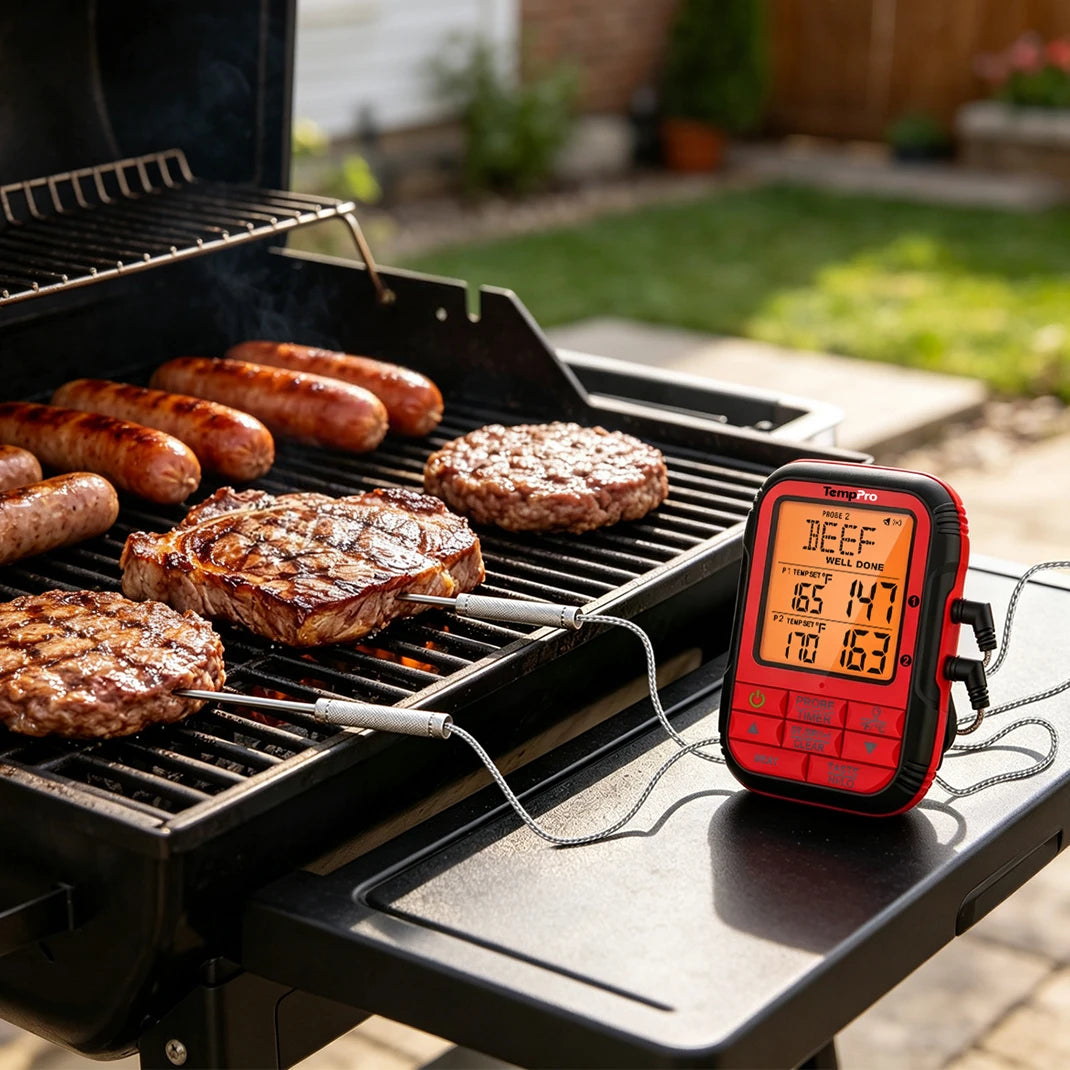
Smoke time, wrap point, pull temperature and rest
This is the whole planner in one table. Times and temperatures are from our own smoking times and temperatures chart. The stall buffer and the rest window are our planning allowances, and they are marked as such.
| Cut | Pit | Cook time | Wrap at | Pull at | Stall buffer | Rest |
|---|---|---|---|---|---|---|
| Brisket, whole packer | 225 to 250 F | 1 to 1.5 hr per lb | 150 F internal | 200 to 205 F | 2 hr | 1.5 hr |
| Pork butt or shoulder | 225 to 250 F | About 1.5 hr per lb | 160 F internal | 195 to 205 F | 2 hr | 1.5 hr |
| Chuck roast, pulled beef | 225 to 250 F | 8 to 10 hr | 160 F internal | 195 to 205 F | 2 hr | 1 hr |
| Beef short ribs | 225 to 250 F | 6 to 8 hr | Optional | 190 to 200 F | 1 hr | 30 min |
| Spare ribs | 225 to 250 F | 5 to 7 hr | About 3 hr in | 180 to 195 F | None | 15 min |
| Baby back ribs | 225 to 250 F | About 5 hr | About 2.5 hr in | 180 to 195 F | None | 15 min |
| Whole turkey | 225 to 275 F | 25 to 30 min per lb | Do not wrap | 165 F breast, 170 to 175 F thigh | None | 20 min |
| Whole chicken | 250 to 325 F | 2 to 4 hr | Do not wrap | 165 F breast, 170 to 175 F thigh | None | 15 min |
| Pork loin | 225 to 250 F | About 4 hr | Do not wrap | 145 to 150 F | None | 10 min |
| Prime rib | 225 to 250 F | About 15 min per lb | Do not wrap | 130 to 135 F | None | 20 min |
| Tri-tip | 225 to 250 F | 2 to 3 hr | Do not wrap | 130 to 140 F | None | 10 min |
| Salmon fillet | 200 to 220 F | About 1 hr | Do not wrap | 135 to 145 F | None | None |
Pull temperature is not the same thing as the safe temperature. USDA sets 145 degrees F plus a 3-minute rest for whole cuts of beef, pork and lamb, 160 degrees F for ground meat, and 165 degrees F for all poultry. Brisket and pork butt go far past the safe minimum on purpose, because that is where the connective tissue gives up.
How the planner does the math
Starting at the hour you slice and counting backward:
- Rest. Big cuts rest an hour or more, ribs about 15 minutes. Hold anything resting at 140 degrees F or above. Below that you are inside the danger zone, and the clock starts.
- Cook. The published time for your cut at your pit temperature. Where a cut has one published range across several pit temperatures, such as a whole turkey at 25 to 30 minutes per pound, the planner reads across that range: the slow end at the lowest pit temperature, the fast end at the highest. It never goes outside the published range.
- Stall buffer. Two hours for brisket, pork butt and chuck roast, one hour for beef short ribs, nothing for cuts that do not stall. This is our allowance, not a published figure.
- Cushion. Another 30 minutes, because pits run cold and lids get opened.
- Fire. Light 30 minutes before the meat goes on so the pit is settled and the smoke is clean.
Finishing early is a solved problem: wrapped, in a dry cooler, above 140 degrees F, a brisket holds for hours and gets better. Finishing late is not a solved problem.
A worked example, done by hand
A 12-pound packer brisket at 225 degrees F, sliced at 6:00 PM on Saturday, September 19.
- Cook time at 1.5 hours per pound: 12 times 1.5 is 18 hours.
- Rest 1 hour 30 minutes, so it comes off the pit at 4:30 PM Saturday.
- Add the stall buffer and the cushion: 18 plus 2 plus 0.5 is 20 hours 30 minutes.
- Counting back 20 hours 30 minutes from 4:30 PM Saturday: the meat goes on at 8:00 PM Friday, and the pit is lit at 7:30 PM Friday.
- Wrap marker at 55 percent of the cook, about 5:54 AM Saturday. Wrap by temperature, not by that clock.
- Start probing when the 18-hour estimate runs out, about 2:00 PM Saturday.

Questions people actually ask
What is the brisket stall?
Somewhere around 150 to 170 degrees F the internal temperature stops climbing, sometimes for hours. Moisture evaporating off the surface cools the meat as fast as the pit heats it. Nothing is wrong. You either wait it out or wrap to stop the evaporation.
When should I wrap?
By temperature: about 150 degrees F for brisket, about 160 degrees F for pork butt. The planner gives you a clock time for that, but treat it as a marker. The thermometer decides.
How long should a brisket rest?
An hour at the very least, and two to four is better if you can hold it above 140 degrees F. A wrapped brisket in a dry cooler will sit there most of an afternoon.
What if the cook runs long?
That is what the stall buffer and the 30-minute cushion are for. If you are past both, wrap it and raise the pit. Serving late is worse than a slightly tighter bark.
Can I smoke a brisket overnight?
That is exactly what the 8:00 PM start in the worked example is. Long cooks are overnight cooks. The planner will tell you when you have booked yourself one.
Does per-pound math work for ribs?
No. Ribs, poultry pieces and small roasts do not scale by weight in any useful way. The planner uses the published time window for those cuts and leaves the weight box alone.
More planning tools on Popular BBQ
- Smoking times and temperatures chart — the full table this planner reads from, every cut on one page.
- Turkey planner — thaw, brine, cook and carve, back-planned to the hour.
- BBQ meat calculator — how much raw meat to buy for your headcount.
- All Popular BBQ tools — every calculator, planner and chart in one place.
Sources
- Cook times, pit temperatures, wrap points and pull temperatures from our own smoking times and temperatures chart, compiled from ThermoWorks, Smoked BBQ Source, Smoking-Meat.com and Hey Grill Hey.
- USDA, safe minimum internal temperature chart. Retrieved September 15, 2026.
- FDA, handling food safely, for the 40 to 140 degrees F danger zone, holding hot food at or above 140 degrees F, and the 2-hour rule. Retrieved September 15, 2026.
Data updated September 2026. Every time here is an estimate. Temperature and probe feel decide when meat is done, never the clock.