
Drum Smokers in 2026: Why More Backyard Pitmasters Are Going UDS
By James Nicholas · Published April 24, 2026 · 7 min read
Last updated: September 21, 2026 · Originally published April 25, 2026
Short answer: The UDS — Ugly Drum Smoker, 55-gallon vertical charcoal smoker — is having its biggest year since 2018. The 2026 BBQ trend forecasts all flag drum smokers as the surprise comeback rig: simpler than offsets, more flavor than pellets, longer burns than kettles, and cheap enough that more pitmasters are running them as their primary smoker. A new commercial UDS runs $300–600. A DIY build runs $60–120 in food-safe components. Both deliver 12+ hour burns on a single charcoal load and lock down at 250°F with surprisingly little babysitting once you learn the vent settings.
Why Drum Smokers Are the 2026 Comeback Story
Pellet grills won the last decade, and they earned it. They’re idiot-proof, they hold temperature within ±5°F, and the app on your phone tells you when the brisket hits 165. They also cost $700–1500, depend on electricity, and produce a smoke flavor that hardcore pitmasters describe as “thin.” The drum is what you buy when that trade stops feeling worth it.
The forecasts all landed on the same reason this year: people want charcoal flavor without taking on the size, the fuel bill and the learning curve of an offset. The drum is the middle path. Real charcoal and wood smoke, almost nothing to operate, and it takes up about as much room as a kitchen bin.
The Five Things a UDS Does Better Than Anything Else
1. Sustained burn time
A properly loaded charcoal basket — 10–14 lb of lump or briquettes, with wood chunks layered in — runs 12 to 18 hours unattended. That’s a full overnight brisket on one fuel load. No offset smoker hits that without midnight tending. Pellet grills technically can, but you’re feeding them dry pellets, not real fire.
2. Real charcoal-wood flavor
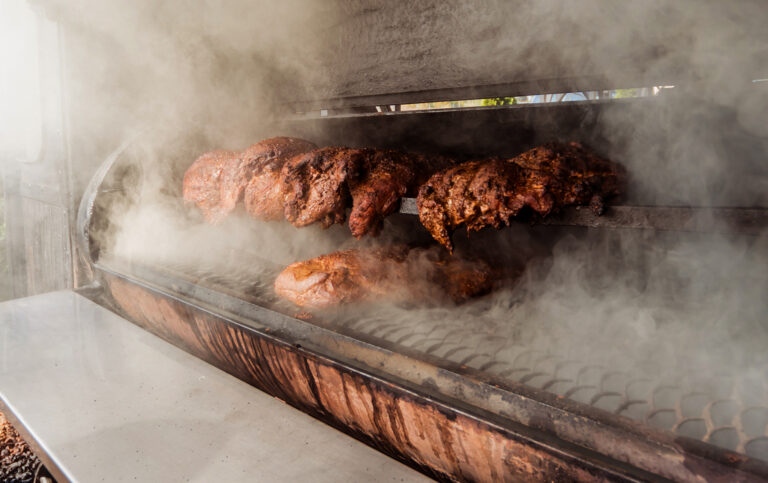
The drum’s vertical airflow pulls smoke through the meat at low velocity, which deposits more flavor compounds without overdoing the bitter creosote you get on tight pellet smokers. Side-by-side blind tastes from competition pitmasters consistently rate UDS-cooked ribs and pork butt above pellet equivalents.
3. Footprint
A 55-gallon drum stands 36″ tall and 22″ in diameter. It fits on a balcony, a small patio, anywhere a kettle fits. Compare to a backyard offset that needs a dedicated 6-foot patio space and sometimes a trailer.
4. Simplicity
The diagram above is the entire machine. Lid with thermometer, two grates, basket, vents. There’s nothing to break. There’s no electricity required. There’s no app, no firmware update, no proprietary pellet brand to chase. Open the vents, add fire, close the lid, smoke meat.
5. Price-to-flavor ratio
A new commercial UDS — Pit Barrel Cooker Junior, Gateway Drum, Big Poppa Drum — runs $300–600 retail. A DIY build using a food-safe 55-gallon drum (look for a “blue drum” used for food-grade liquids; under $50 on Craigslist or industrial supply) plus $40 of hardware (basket, vents, thermometer, grates) totals under $120. There is no other smoker in BBQ that hits this flavor-per-dollar ratio.
The Three UDS Models Worth Buying in 2026
| Model | Price | Build Quality | Best For |
|---|---|---|---|
| Pit Barrel Cooker Classic | ~$400 | Painted steel, hook-rod system, lifetime cult following | First-time UDS buyers; the no-brainer entry |
| Gateway Drum 55G | ~$650 | Heavier gauge steel, multiple grate levels, comp-circuit favorite | Serious pitmasters who plan to compete |
| Big Poppa’s Smokers Drum Kit | ~$240 (you supply drum) | Hardware-only kit; you find a food-safe drum locally | DIY builders who want the savings without sourcing every part |
Three Things to Get Right on Your First UDS Cook
1. Source a food-safe drum (DIY only)
If you’re building from scratch, the drum sourcing is the only step that matters. Drums that previously held petroleum products, solvents, or unknown chemicals are not usable, ever, no matter how well you burn them out. Look for “blue drums” labeled for food-grade liquids: olive oil, vinegar, juice. Industrial supply houses, Craigslist, and food-co-op disposals are the typical sources. Inspect the data plate for product code; verify online before buying.
2. Burn-in before first cook
Even a brand-new commercial UDS gets a 90-minute burn-in at 400°F to clear paint outgassing. DIY builds need a longer 2–3 hour burn-in to scorch any residue from the original drum contents. Burn empty, vents fully open, until the steel changes color slightly and the smoke runs clear.
3. Learn the vents before you cook
UDS temperature is controlled entirely by the three intake vents at the base. Two closed + one ¼ open = 225°F. Two closed + one ½ open = 250°F. All three open = 350°F+. Keep a notebook. Your specific drum will have a personality. After 3–4 cooks you’ll have a vent map memorized.
More than two out of three of you are putting the turkey on the smoker this year.
Frequently Asked Questions
Can I use a UDS for hot-and-fast cooks too, or just low-and-slow?
Both. Open all three intake vents and the drum will hit 400°F+ for chicken, vegetables, and direct-grill steaks. Most owners run hot for chicken (1 hour) and low-and-slow for ribs/pork/brisket (8–14 hours) on the same rig.
Do I need to season a UDS like cast iron?
Sort of. After burn-in, run a fatty cook (pork butt or brisket trimmings) for 4–5 hours to coat the interior with rendered fat. That coating is your seasoning, and it builds with every subsequent cook. Don’t scrub the inside. Just brush the grates.
How much fuel does a UDS use compared to a pellet grill?
For a 12-hour cook: UDS burns about 12 lb of lump charcoal (~$15) plus 4–6 wood chunks ($3). A pellet grill burns roughly 8 lb of pellets (~$8). The UDS is more expensive per cook, but the flavor difference for many pitmasters justifies the upcharge.
What’s the failure mode if a UDS gets it wrong?
The most common failure: temperature creeps up overnight as ash builds up under the basket and chokes airflow. Solution: a basket with a raised bottom (1–2″ clearance) so ash falls clear. Almost every drum-cook problem comes back to airflow.
Further Reading
Reader Favorites
- Essential BBQ Tools: Get The Tools Pros Recommend Now
- Cleaning Your Gas Grill Cooking Grate: Make it Great Again
- Stainless Steel BBQ Grill Cleaning: Master Maintenance Now
- Grill Baskets: Smoky Veggies & Fish Made Easy
- How to Grill Pizza: Stone or Grates? Tips & Tricks
- The Best Way to Use a Pizza Oven for Amazing Results
BBQ Temperature Charts & Guides
Four quick-reference tools every cook bookmarks — target temps, pull temps, and how long leftovers keep, plus the full BBQ glossary.
| Cut | Pull | Time |
|---|---|---|
| Brisket | 203°F | 12–16h |
| Spare ribs | 195–203°F | ~6h |
| Pork butt | 203°F | 12–14h |
Target temps & times for 17 cuts, sortable by meat, weight and doneness.
View full chart →| Doneness | Target |
|---|---|
| Rare | 125–130°F |
| Medium-rare | 130–135°F |
| Well-done | 160°F+ |
Rare to well-done, burger safety (160°F) and resting times.
View full chart →| Food | Fridge | Freezer |
|---|---|---|
| Brisket, ribs | 3–4 days | 2–3 mo |
| Smoked sausage | 1 week | 1–2 mo |
| Potato salad | 3–4 days | no freeze |
How long smoked meats & sides keep — fridge and freezer, USDA-based.
View full chart →Every pit term decoded — cooking methods, gear, cuts, wood, and technique, A to Z.
Open the glossary →