Smoked Tri-Tip Is the 2-Hour Brisket Move: A Pitmaster’s Reverse-Sear Guide for 2026
Last updated: October 10, 2026 · Originally published May 30, 2026
Smoked tri-tip is a 2-to-3-pound triangular cut from the bottom sirloin, smoked low at 225°F until the internal temperature hits 115°F, then reverse-seared over 500°F-plus heat for 60 to 90 seconds per side. The result is brisket-style smoke flavor and a deeply browned crust in roughly two hours, not twelve.
That is the cut every pitmaster is reaching for in summer 2026, and the technique that earns it.
Updated May 30, 2026 · By James Nicholas
Why tri-tip went mainstream in 2026
Brisket has been the headline cut of American barbecue for fifteen years. It is also a fourteen-hour commitment, a $9-a-pound wholesale problem at retail, and a notoriously unforgiving lesson in stall management. According to the USDA Agricultural Marketing Service National Weekly Boxed Beef Cuts report dated May 18, 2026, sirloin tri-tip (IMPS 185D) traded at an average of $905.65 per hundredweight on prime product reports the same week brisket primal kept setting new ceilings. The math is not subtle. Tri-tip delivers a comparable smoke ring, comparable bark, and comparable beefy depth at a fraction of the cost and a sixth of the cook time.
That is why search interest in smoked tri-tip is up across every measurable signal this spring, and why the smoked tri-tip cluster has moved from regional curiosity to national mainstay in roughly 18 months. Pellet-grill manufacturers are featuring it. Authority pitmasters from Matt Pittman at Meat Church to the engineering team at ThermoWorks have published definitive method pieces in the last sixty days. And the cut has finally escaped California, where it was the regional secret of the Santa Maria Valley for seventy years.
The Santa Maria origin most cookbooks skip
Tri-tip cooking traces to the Santa Maria Valley on California’s central coast, where ranch communities in the 1950s were cooking the bottom-sirloin triangle over red-oak coals at the rancho-style barbacoas that ran every weekend through the spring branding season. The Santa Maria style is salt, pepper, garlic powder, red oak, and time. Period. Everything else in the modern tri-tip canon is a remix of that template.
The cut crossed the Sierra Nevada slowly. It did not appear on a national grocery chain’s standard cut list until well into the 2000s, and most pitmasters in Texas, Memphis, the Carolinas, and Kansas City still treated it as a curiosity through the mid-2010s. What changed in 2025 and 2026 is two things: brisket got expensive enough that home cooks started looking for alternatives, and pellet-grill technology matured to the point where the precise, two-stage temperature management a reverse sear requires is now a Saturday-afternoon task instead of a weekend project.
What USDA wholesale data actually says
The wholesale price gap between brisket and tri-tip is now wide enough that the substitution argument writes itself. The May 18, 2026 USDA boxed-beef report logged 20 trades of IMPS 185D sirloin tri-tip totaling 7,874 pounds, with prices running from $849.00 to $940.70 per hundredweight and a volume-weighted average of $905.65. Brisket primal in the same window traded above that ceiling, and the spread at retail is wider still once trim and packaging are factored in. For a backyard cook feeding eight people from a single piece of meat, that translates into a real difference in what shows up on the receipt.


What is tri-tip?
Tri-tip is the triangular muscle (anatomically, the tensor fasciae latae) cut from the bottom sirloin primal. A whole tri-tip weighs between 1.5 and 3.5 pounds, runs about 2 to 2.5 inches thick at its widest point, and tapers to a thinner tail at one end. The cut is sometimes labeled bottom sirloin butt, Santa Maria steak, California cut, or — by pitmasters who have figured out what it can do — the poor man’s brisket. None of those names show up consistently on grocery labels east of the Rockies, so if your local butcher counter does not stock it by name, ask for a 2-to-3-pound triangular bottom-sirloin roast and you will get the right piece.
How to buy a tri-tip that smokes well
Grade, fat cap, weight
Look for USDA Choice as your floor and Prime when you can find it. The cut has good intramuscular marbling by nature, so Select grade is workable but will not reward the technique the way Choice does. A 2-to-3-pound roast is the sweet spot — large enough to feed six to eight, small enough to finish in under two hours total cook time. The fat cap should be present but thin: a quarter inch is plenty. If your tri-tip came from the case fully trimmed, that is fine; the cut is naturally well-marbled enough that an external fat cap is helpful but not necessary.
The grain-direction problem
The defining feature of tri-tip — and the single most common reason a perfectly smoked one eats tough — is that the muscle has two distinct grain directions running through it. The grain pivots roughly at the geometric center of the triangle. If you slice the entire roast in one direction, half of it will eat like steak and half will eat like jerky. Before you put the meat on the smoker, look at it from above and identify where the grain changes direction. Some cooks score the fat cap lightly along the grain-pivot line so the cut line is visible after smoking. We recommend it.
The rub: Santa Maria simple vs. coffee-pepper modern
The Santa Maria template is one teaspoon kosher salt, one teaspoon coarse black pepper, and three-quarters teaspoon granulated garlic per pound of meat. That is the whole recipe and it does not need help. The modern coffee-pepper variant — popularized by competition cooks who wanted a darker bark and a slightly bitter top note to balance the cut’s natural sweetness — adds one teaspoon finely ground coffee and a half teaspoon smoked paprika per pound. Use whichever you prefer. Both rubs are at home on red oak, post oak, hickory, or pecan smoke. Avoid mesquite unless you intend to push hard, fast smoke; this is not the cut for it.
Apply the rub at least 45 minutes before the meat goes on the smoker so the salt has time to draw moisture to the surface and dry out the exterior. A dry exterior is what gives you bark. If you have the time, season the meat the night before, return it uncovered to the refrigerator on a wire rack, and put it on the smoker straight from the cold. That overnight drying step is what separates a good crust from a great one.
Smoking temperature, wood, and time
Why 225°F is the floor, not the ceiling
The conventional advice for smoked tri-tip is 225°F start to finish until the meat hits 115°F internal, then sear. That works. It is also conservative. A 2-pound tri-tip at 225°F will hit 115°F in about 60 to 75 minutes. A 3-pound tri-tip at the same temperature will need closer to 90 minutes. If you are short on time, 250°F is a safe upper bound that will pull 10 to 15 minutes off the smoke stage without meaningfully thinning the smoke ring or hurting the bark. Below 225°F is wasted time on a cut this size; the meat will pick up no additional smoke worth tasting after the first hour because the surface is already past the 140°F smoke-uptake threshold.
The wood pairings that actually work
Red oak is the historically correct answer and a fine one — clean, mid-weight smoke with a faintly sweet edge. Post oak (the wood that won central-Texas brisket its reputation) is functionally interchangeable for tri-tip and easier to source. Hickory pushes harder and is the right move when you want a smokier finish or when you are running a small-firebox pellet grill that struggles to keep oak burning cleanly. Pecan splits the difference and forgives small fire-management mistakes. Cherry adds color but very little measurable flavor; use it as a 25% addition to one of the above rather than as the primary wood.
The reverse-sear, step by step
Pull at 115°F, not 120°F
The single biggest mistake home cooks make on smoked tri-tip is letting the smoke phase run too long. The reverse sear adds 15 to 20 degrees of internal temperature in 90 to 120 seconds of contact time. If you pull at 120°F internal expecting a medium-rare 130°F finish, you will overshoot to medium and lose the edge-to-edge pink center that is the whole point. Pull at 115°F. Rest the meat under loose foil for 10 minutes while the cast iron heats. Then sear.
The 60-second cast-iron rule
Get a cast-iron skillet, a carbon-steel pan, or a fully preheated grill grate as hot as it will go. Smoking pan oil — beef tallow, refined avocado, or grapeseed — to the point where it shimmers and just begins to send up the first wisp of smoke. Lay the tri-tip down. Do not move it for 60 seconds. Flip. Sixty seconds on the second side. Stand the roast up on its edges for 20 seconds each to sear the side faces. Pull. Rest 10 more minutes under loose foil before slicing. The total sear should run under three minutes from first contact to final pull.
Internal temperature chart
| Doneness | Pull temp (smoke stage) | Final temp after sear & rest |
|---|---|---|
| Rare | 105°F | 120°F |
| Medium-rare (recommended) | 115°F | 130°F |
| Medium | 125°F | 140°F |
| Medium-well | 135°F | 150°F |
| Well-done (not recommended for this cut) | 145°F | 160°F+ |
USDA’s published safe-handling temperature for whole-muscle beef is 145°F with a three-minute rest. Medium-rare doneness sits below that line, which is the standard for whole-muscle steaks and roasts cooked to order — the same standard applied at every steakhouse in the country. Use a calibrated instant-read probe; ThermoWorks engineering data is the closest thing the category has to a benchmark.
Slicing across the grain — the two-grain trap
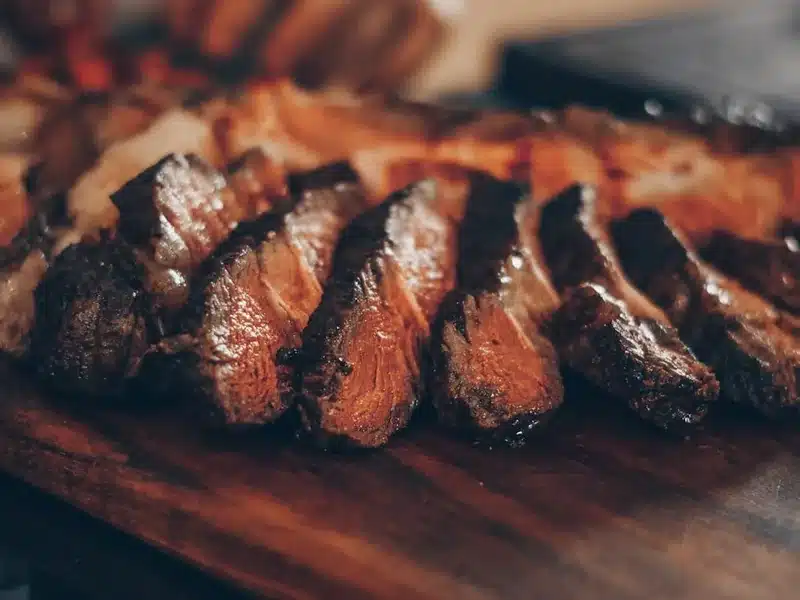
Identify the grain-pivot line you marked earlier. Cut the rested roast in half along that line first, separating the two grain sections. Then slice each half against its own grain at an angle just off perpendicular — about 80 degrees rather than a strict 90 — and keep slices between a quarter and three-eighths of an inch thick. Thinner than that and the slices fall apart on the cutting board. Thicker than that and the cut eats chewier than it should.
This step is the difference between people at the table saying “this is good steak” and people at the table saying “this is the best steak I’ve had at a backyard cookout.” The cooking is forgiving. The slicing is not.
Tri-tip vs. brisket: what the math actually says
A 12-pound packer brisket at recent wholesale pricing runs north of $8.50 per pound at retail in most U.S. metros and demands 14 to 16 hours of active smoking, a stall to manage, a wrap decision to make, and an overnight rest before slicing. Total project window from prep to plate: 18 to 24 hours.
A 3-pound tri-tip at recent wholesale pricing — extrapolated from the May 18, 2026 USDA boxed-beef average — runs roughly $14 to $16 per pound at retail and demands 90 minutes of smoke, 3 minutes of sear, and 20 minutes of rest. Total project window from prep to plate: under three hours.
For a holiday cook feeding 14 people, brisket still wins on per-pound cost and total-yield economics. For a Saturday cook feeding six to eight, tri-tip wins on every other axis: time, ease, consistency, and (frankly) eating quality on the first slice. The math is why this cut is on every backyard pellet grill in America this summer.
Frequently asked questions
How long does it take to smoke a tri-tip?
A 2-pound tri-tip at 225°F takes 60 to 75 minutes to reach a 115°F internal pull temperature. A 3-pound tri-tip needs 80 to 95 minutes at the same temperature. Add 3 minutes of reverse sear and a 10-minute rest, and the total cook window runs from 75 minutes to two hours, end to end, regardless of which size you started with.
What internal temperature is best for smoked tri-tip?
Pull from the smoker at 115°F for medium-rare. Sear over 500°F-plus heat for 60 to 90 seconds per side. Final internal temperature after the sear and a 10-minute rest will land at 130°F, the steakhouse standard for medium-rare. Use a calibrated instant-read probe and pull on temperature, not time — every smoker runs slightly differently.
What is the best wood for smoking tri-tip?
Red oak is the Santa Maria tradition and a clean, mid-weight smoke. Post oak is functionally interchangeable and easier to source east of the Rockies. Hickory and pecan are both excellent on this cut. Avoid mesquite as the primary wood — the smoke profile is too aggressive for tri-tip’s mild flavor and can read acrid when the cook stretches past an hour.
Should I trim the fat cap on a tri-tip?
Trim the fat cap to roughly a quarter inch. Less than that and you lose the basting effect during the smoke stage. More than that and the cap does not fully render in the short cook time, which leaves chewy fat on the finished slice. If the cut came from the case fully trimmed, leave it; tri-tip is well-marbled enough internally that no external cap is required.
Can I smoke tri-tip on a pellet grill?
Yes — the pellet grill is arguably the ideal smoker for this cut. The set-and-forget temperature control at 225°F removes the firebox-management variable, and most modern pellet grills will hold a clean burn for the 90 minutes the smoke stage requires. Sear on the same grill at its top temperature or move to a cast-iron skillet for the reverse sear stage if your grill caps below 500°F.
Why does my tri-tip eat tough?
Two reasons, in order of frequency: you sliced with the grain instead of against it, or you overshot medium-rare and finished above 140°F internal. Tri-tip is a lean, well-exercised muscle. It tolerates one mistake. It does not tolerate two. Pull at 115°F, sear briefly, rest 10 minutes, identify the grain-pivot line, and slice each half against its own grain.
The smoked tri-tip kicker
The first smoked tri-tip you cook at home will not be your best one. The fourth one will. By Labor Day you will be cooking this cut every other weekend and wondering, like every other pitmaster who finally took it seriously, what the brisket conversation was ever really about.
Methodology & sources: Wholesale beef pricing pulled from the USDA Agricultural Marketing Service National Weekly Boxed Beef Cuts report dated May 18, 2026 (IMPS 185D, sirloin tri-tip, prime product). Temperature and timing data cross-referenced against ThermoWorks engineering benchmarks and Meat Church reverse-sear procedure. Santa Maria origin verified against historical Santa Maria Valley Chamber of Commerce records. Photos used under royalty-free editorial license with attribution in figure captions and article footer.
Related reading on PopularBBQ.com: Big Green Egg Pork Butt: How to Prep, Smoke, and Pull It · How to Read a Memorial Day Grill Sale · What a Brisket Actually Costs This Memorial Day Weekend. Across the BAM network: PopularOutdoorsman.com on field-dressing and venison-loin reverse-sear for hunters who want this technique on wild game.

Reader Favorites
BBQ Temperature Charts & Guides
Four quick-reference tools every cook bookmarks — target temps, pull temps, and how long leftovers keep, plus the full BBQ glossary.
| Cut | Pull | Time |
|---|---|---|
| Brisket | 203°F | 12–16h |
| Spare ribs | 195–203°F | ~6h |
| Pork butt | 203°F | 12–14h |
Target temps & times for 17 cuts, sortable by meat, weight and doneness.
View full chart →| Doneness | Target |
|---|---|
| Rare | 125–130°F |
| Medium-rare | 130–135°F |
| Well-done | 160°F+ |
Rare to well-done, burger safety (160°F) and resting times.
View full chart →| Food | Fridge | Freezer |
|---|---|---|
| Brisket, ribs | 3–4 days | 2–3 mo |
| Smoked sausage | 1 week | 1–2 mo |
| Potato salad | 3–4 days | no freeze |
How long smoked meats & sides keep — fridge and freezer, USDA-based.
View full chart →Every pit term decoded — cooking methods, gear, cuts, wood, and technique, A to Z.
Open the glossary →