
Equilibrium Brine Calculator: Exact Salt by Weight
Morton coarse kosher salt weighs 4.8 grams a teaspoon and Diamond Crystal 3.0, so a brine measured by volume is wrong before you start.
Weigh this out
Optional, one field, and your numbers are already on screen either way.
Morton Coarse Kosher Salt weighs 4.8 grams per teaspoon. Diamond Crystal Kosher Salt weighs 3.0 grams per teaspoon. Both numbers come from the manufacturers, both products are chemically identical sodium chloride, and swapping one for the other spoon-for-spoon changes the salt in your brine by 60 percent. That single fact is why equilibrium brining exists and why this calculator answers in grams first. Give it a meat weight, a water weight and a target salt percentage, and it returns the exact salt to weigh out, how long the meat actually needs to equilibrate based on measured diffusion coefficients from three peer-reviewed studies, and — if you are curing — the cure weight that lands inside the federal ingoing-nitrite limits.
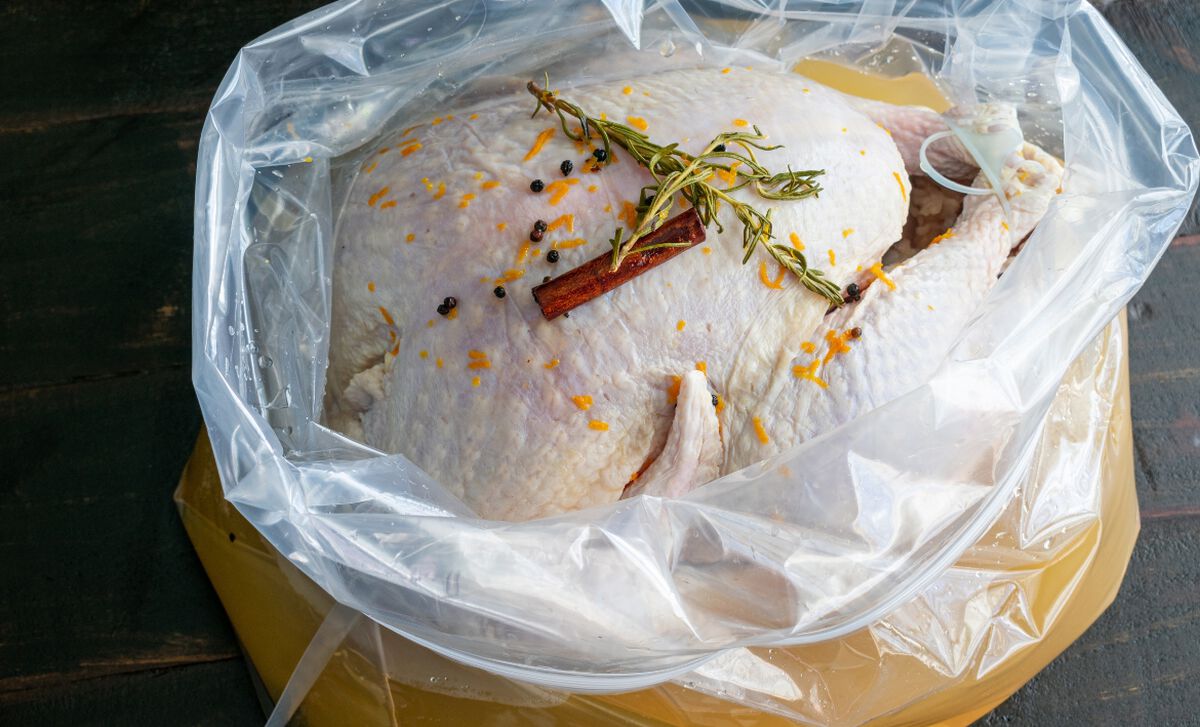
What equilibrium brining actually is
A traditional brine is a strong salt solution and a stopwatch. You put the meat in, you guess how long, and you pull it before it gets too salty. Miss the window and dinner is ruined. An equilibrium brine turns the problem inside out: you salt the whole system — meat plus water — to the exact percentage you want the finished meat to be. Salt diffuses until the concentration inside the meat matches the concentration in the liquid, and then it stops. There is no window to miss. Leaving it in an extra day makes it no saltier.
The formula is one line:
salt in grams = (meat grams + water grams) x target percent / 100
Dry brining is the same idea with no water in the system:
salt in grams = meat grams x target percent / 100
The catch is that nothing about that arithmetic works if your salt measurement is wrong, and volume measurements of salt are wrong by design.
Worked example: a 12 lb turkey in a gallon of water at 1 percent
- Meat: 12 lb = 5443 g. Water: 1 gal = 3785 g. Total system = 9228 g.
- Salt at 1.0 percent: 9228 x 0.01 = 92.3 g.
- In Morton Coarse Kosher at 4.8 g per tsp, that is 19.2 tsp, or about 6 tablespoons plus 1 teaspoon.
- In Diamond Crystal at 3.0 g per tsp, the same 92.3 g is 30.8 tsp — over 10 tablespoons. Measure Diamond Crystal with a Morton recipe and you land near 0.62 percent instead of 1.0 percent.
- Time: a whole turkey is closest to the spherical case with a thickest dimension around 8 inches. Even at the fastest of the measured diffusion coefficients it takes about 17 days to reach 90 percent equilibrium, and at the slowest, over 50. A 24 hour brine does not equilibrate a turkey. It salts the outer layer, and the calculator tells you how deep.
The salt density table
| Salt product | Grams per teaspoon | Grams per tablespoon | Grams per cup | Source |
|---|---|---|---|---|
| Morton plain or iodized table salt | 6.0 | 18.0 | 288 | Morton nutrition panel, 1/4 tsp = 1.5 g |
| Morton Coarse Kosher Salt | 4.8 | 14.4 | 230 | Morton nutrition panel, 1/4 tsp = 1.2 g |
| Diamond Crystal Kosher Salt | 3.0 | 9.0 | 144 | Product label, cross-checked against the manufacturer claim of 50 to 53 percent less sodium by volume than granulated salt |
Diamond Crystal does not publish a gram-per-teaspoon nutrition panel on its own site. The 3.0 g figure comes from the product label and is consistent with Diamond Crystal’s own “about 50 percent less sodium by volume than table salt” claim and Cargill’s “53 percent less sodium by volume” foodservice sheet applied to Morton’s confirmed 6.0 g per teaspoon. Fine sea salt, pickling salt and every other brand vary again. If it is not in this table, weigh it.
Target salt percentage: what people actually use
| Product | Typical target | Notes |
|---|---|---|
| Whole chicken or turkey | 0.75 to 1.0 percent | Lower end if the bird is enhanced or already contains a salt solution — check the label |
| Pork chops and loin | 1.0 to 1.5 percent | Higher end for thicker cuts eaten on their own |
| Poultry breast fillets | 1.0 percent | Thin, fast, very hard to over-salt at this level |
| Fish before hot smoking | 2.0 to 3.0 percent | Short contact; treat published fish-smoking recipes as authoritative over this table |
| Traditional USDA poultry brine, for comparison | 3/4 cup salt per gallon of water, or 3 tbsp per quart | USDA FSIS poultry fact sheet. This is a soak-and-pull brine, not an equilibrium brine, and it is far above any equilibrium target |
How long does an equilibrium brine take?
This is where most brine calculators stop, and it is the part that matters most. Salt moves through meat by diffusion, which is slow, and which scales with the square of the distance. Double the thickness and you quadruple the time.
The tool solves the standard Fickian diffusion solution for three geometries. For a flat cut with both faces exposed:
1 - (uptake fraction) = (8 / pi squared) x exp(-D x pi squared x t / L squared)
where L is the full thickness in meters, t is time in seconds and D is the diffusion coefficient of sodium chloride in meat. Solving for time at 90 percent uptake gives t = 0.2120 x L squared / D; at 95 percent, t = 0.2822 x L squared / D.
D is not one number. Three peer-reviewed pork studies give a roughly three-fold spread depending on method, which is why the tool reports a range instead of a single answer.
| Method | D, square meters per second | Study |
|---|---|---|
| Static cure, pork tenderloin | 1.29 x 10 to the -9 | Chen et al. 2023, Foods 12(7):1451 |
| Wet curing with ultrasound, pork loin | 8.55 x 10 to the -10 | Applied Sciences 2025, 15(11):5939 |
| Wet curing, pork loin | 5.75 x 10 to the -10 | Applied Sciences 2025, 15(11):5939 |
| Dry salting, pork loin | 4.22 x 10 to the -10 | Applied Sciences 2025, 15(11):5939 |
| Mechanically tumbled, pork | 2.23 x 10 to the -8 | Zhang et al. 2021, Ultrasonics Sonochemistry 79:105759 |
The tumbled figure is an order of magnitude faster than everything else and is the reason commercial processors can cure in hours. Nothing you do in a home refrigerator gets close to it.
The model is not a guess — it reproduces a published measurement. Chen and colleagues report sodium chloride reaching a position 10 mm from the surface of a statically cured pork tenderloin after 12 hours. Running the same diffusion coefficient through the semi-infinite solution used by this calculator puts the concentration at 10 mm and 12 hours at about 34 percent of the surface concentration, with the half-concentration front sitting at 7.1 mm. That is the same event, described two ways.
Time to 90 percent equilibrium, at D between 4.22 x 10 to the -10 and 1.29 x 10 to the -9| Thickness or diameter | Flat cut, both faces | Cylinder | Sphere |
|---|---|---|---|
| 1/2 inch (12.7 mm) | 7 to 23 hours | 3 to 9 hours | 2 to 5 hours |
| 1 inch (25.4 mm) | 29 to 91 hours | 12 to 36 hours | 6 to 19 hours |
| 2 inches (50.8 mm) | 4.9 to 15.0 days | 1.9 to 5.9 days | 1.0 to 3.2 days |
| 4 inches (101.6 mm) | 19.6 to 60.0 days | 7.7 to 23.7 days | 4.2 to 12.9 days |
| 6 inches (152.4 mm) | 44.2 to 135.1 days | 17.4 to 53.3 days | 9.5 to 29.1 days |
| 8 inches (203.2 mm) | 78.5 to 240.1 days | 31.0 to 94.7 days | 16.9 to 51.8 days |
These are honest numbers and they explain something the internet will not tell you: a thick cut never truly equilibrates in a home brine. Short brines on big pieces are surface treatments. That is fine — a salted outer inch on a turkey is most of the eating experience — but call it what it is.
Curing salt and the federal limits
If you are adding Prague Powder #1, sodium nitrite ingoing levels are capped by regulation. The tool checks your target against the cap for the product class you choose and refuses to go over it. The formula FSIS publishes for a pumped or immersion product is ppm = pounds of restricted ingredient x percent pump x 1,000,000 / pounds of pickle, which is where the familiar “2 lb per 100 gallons at a 10 percent pump” figure resolves to 200 ppm.
| Product class | Limit as written | Ingoing ppm |
|---|---|---|
| General cap, all non-bacon methods | Nitrite, nitrate or a combination shall not result in more than 200 ppm of nitrite, calculated as sodium nitrite, in the finished product | 200 |
| Immersion cured, pumped or massaged | 2 lb sodium or potassium nitrite to 100 gal of pickle at a 10 percent pump level | 200 |
| Comminuted or chopped product | 1/4 oz sodium or potassium nitrite to 100 lb of chopped meat | 156 |
| Bacon, pumped or massaged, standard | Sodium nitrite at 120 ppm ingoing, with 550 ppm sodium ascorbate or erythorbate | 120 |
| Bacon, immersion cured | Sodium nitrite shall not exceed 120 ppm ingoing, on skin-free green weight of bellies | 120 |
| Bacon, dry cured | Sodium nitrite shall not exceed 200 ppm ingoing, on skin-free green weight of bellies | 200 |
| Dry cure, general (not offered by this tool) | 1 oz sodium or potassium nitrite to 100 lb of meat, which calculates to 625 ppm | See note |

Related on Popular BBQ
- Brine or marinade: which one you actually want
- Smoke and serve planner
- Turkey thawing and cooking calculator
- Cookout party planner
Frequently asked questions
What percentage salt should an equilibrium brine be?
Between 0.75 and 1.5 percent of the combined weight of meat and water covers nearly everything cooked at home, with poultry at the low end and thick pork at the high end. That range is culinary consensus rather than published science, and we say so on the page rather than dressing it up.
Is Morton kosher salt the same as Diamond Crystal?
Chemically, yes. By volume, no. Morton Coarse Kosher is 4.8 g per teaspoon and Diamond Crystal is 3.0 g per teaspoon, both from manufacturer figures, so a teaspoon of Morton carries 60 percent more salt. Any recipe that specifies salt by volume without naming the brand is ambiguous by roughly that margin. Weighing removes the problem entirely.
Can I leave meat in an equilibrium brine too long?
Not in terms of saltiness — the concentration gradient goes to zero and diffusion stops. Texture and food safety are different questions. USDA’s guidance for brining poultry is to keep it refrigerated and to hold thawed or fresh poultry no more than two days, and to discard the brine afterwards rather than reuse it.
How long does a 1 inch pork chop need?
Between 29 and 91 hours to reach 90 percent equilibrium, depending on which measured diffusion coefficient you use. Most of the flavor benefit arrives well before that, which is why a 12 hour chop still tastes seasoned.
Why does the calculator say a turkey needs weeks?
Because that is what diffusion physics says for a piece of meat eight inches thick. A whole bird cannot equilibrate in a refrigerator on a human timescale. Overnight brining works because it salts the outer layer, which is where most of the eating happens — and the tool reports exactly how deep the salt gets in the time you have.
How much Prague Powder #1 per pound of meat?
At the standard 156 ppm ingoing target with a 6.25 percent cure, it is about 1.13 g of cure per pound of meat, which is where the “one ounce per 25 pounds” rule comes from. Do not use the teaspoon rule: it computes to roughly 130 ppm using the same sellers’ own 6 teaspoons per ounce conversion, and measured teaspoon weights vary from 4.0 to 5.9 g across brands.
Does the cure go in the water weight or the meat weight?
Ingoing nitrite is regulated against the meat weight, so this tool calculates cure from meat weight alone and reports the resulting ppm on that basis. Salt and sugar, by contrast, are calculated across the whole system because that is what equilibrium means.
Can I share or save my brine card?
Yes. Every input is written into the page address as you type, so the link carries the whole recipe. Your last card is also stored in your browser. There is no email wall and never will be.
Data updated August 2026. Regulatory limits are reviewed against the eCFR annually and whenever FSIS publishes a change; salt density figures are re-checked against manufacturer nutrition panels annually. This is not food-safety advice. Follow tested recipes from a land-grant extension service for any cured product, and cook to the safe minimum internal temperatures at foodsafety.gov: 165 deg F for all poultry, 160 deg F for ground meat and sausage, 145 deg F plus a 3 minute rest for whole cuts of pork and beef.
Sources
- eCFR, 9 CFR 424.21(c), Use of food ingredients and sources of radiation — regulation text
- eCFR, 9 CFR 424.22(b), bacon nitrite limits — regulation text
- USDA FSIS, Cured Meat and Poultry Product Operations (FPLIC-5a, 2020) — the ingoing ppm formula — PDF
- Borchert, L. and Cassens, R., Chemical Hazard Analysis for Sodium Nitrite in Meat Curing, Ohio State University Meat Science — the 156 ppm target — PDF
- Morton Salt nutrition panels — coarse kosher and iodized table salt
- Diamond Crystal Kosher Salt — product page; Cargill foodservice sell sheet — PDF
- Chen et al. (2023), Foods 12(7):1451, sodium chloride diffusion in pork tenderloin — open access
- Applied Sciences (2025) 15(11):5939, salt diffusion coefficients in pork loin by curing method — open access
- Zhang et al. (2021), Ultrasonics Sonochemistry 79:105759, tumbled curing diffusion — open access
- Virginia Cooperative Extension, Dry Curing Virginia-Style Ham — PDF; University of Kentucky Cooperative Extension ASC-213 — PDF
- FoodSafety.gov, Safe Minimum Internal Cooking Temperature Chart — chart