Bark vs. Crust on Brisket: What’s the Difference (And Which Tells You You’re Cooking Wrong)
Quick Answer
Last updated: September 21, 2026 · Originally published May 2, 2026
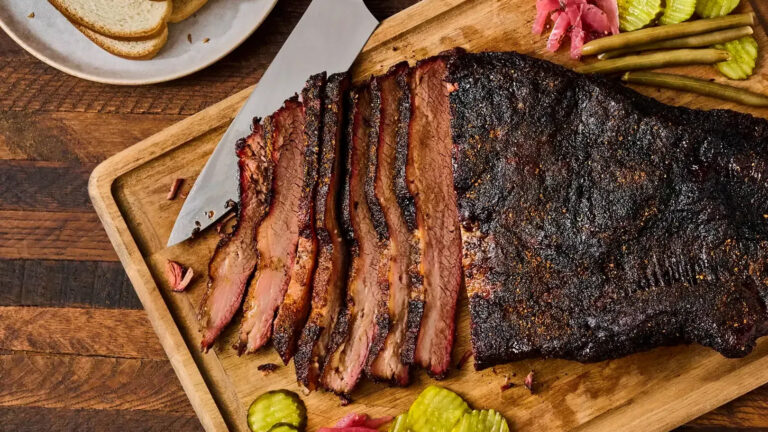
On brisket, bark is the prized dark, flavorful outer layer that forms from the rub, rendered fat and smoke reacting over many low-and-slow hours (the Maillard reaction) — it is firm but gives to a fingernail. A crust is when the surface dries out faster than the fat can render, leaving a hard, jerky-like shell with muted, dehydrated-rub flavor. Good bark, not crust, is the goal.
Brisket bark vs crust: quick facts
What is the difference between bark and crust on brisket?
Bark is a firm-but-yielding, flavorful smoke-and-Maillard layer; crust is a hard, dried-out shell that forms when the surface dehydrates before the fat renders.
How does brisket bark form?
From the dry rub, rendered fat and smoke reacting on the surface over 6+ hours at about 225 to 275 F, via the Maillard reaction and caramelization.
How do I avoid a hard crust?
Keep enough surface moisture and fat rendering (spritzing, fat-side management, steady low temps) so the surface sets into pliable bark instead of drying into crust.
What makes good bark dark?
Smoke compounds depositing on the surface plus the Maillard browning of proteins and rub give bark its mahogany color and flavor.
Bark and crust on a brisket are not the same thing. Bark is a dry, flavorful surface layer formed by smoke + Maillard reaction over many hours; a hard crust is what you get when the surface dried out without enough fat render to keep it pliable. One of them is the target. The other is the cook telling you something went wrong.
The textbook definitions
Bark. The dark, almost mahogany surface on a low-and-slow brisket. Forms from rub + rendered fat + protein reacting with smoke over 6+ hours at 225–275°F. Firm but not hard. You can press a fingernail into it and feel give. Tastes like concentrated brisket essence.
Crust. A thick, hard, sometimes brittle outer shell that forms when the surface dries out faster than the fat can render through it. Texture is closer to jerky than to bark. Flavor is muted — mostly dehydrated rub and char.
Bark is what people are chasing. Crust is what most backyard cooks accidentally make on their first three briskets.
How bark forms (the chemistry)
- Rub dehydrates. Salt and pepper bond with surface moisture, then dry. Rub crystals fuse to the protein.
- Maillard reaction kicks in. Around 285°F surface temp, sugars and amino acids react — brown color, savory umami depth.
- Smoke compounds bind to the wet pellicle. Phenols, syringol, guaiacol attach to the protein during the first 4–6 hours, when the surface is still moist.
All three need TIME at low temperature with intermittent moisture. Crank the smoker too high too early, and you get crust.
Signs you’re building bark, not crust
- Surface goes through an “ugly” pink-purple phase around hour 3 — that’s the smoke ring forming
- Bark sets between hours 4–6 — you can’t scratch the rub off with a fingernail
- Color deepens to mahogany, almost black, by hour 8
- Surface is dry to touch but pliable when pressed
- Smoke smell is sweet, not acrid
5 most common causes of crust
1. Smoker too hot
Above 275°F, the surface dries before smoke can bind. Drop to 225–250°F.
2. Not enough fat cap
Trimmed to bare 1/8 inch leaves nothing to render through the surface. Leave 1/4 inch minimum.
3. Over-rubbing
1/4 inch deep rub creates a barrier smoke can’t penetrate. A medium dusting that just covers the surface is right.
4. Sugar in the rub
Brown sugar burns above 250°F. Sugar-heavy rubs work for ribs but turn brisket bark into burnt-sugar crust. Pure salt-pepper-garlic for brisket.
5. Wrong wood for cook length
Mesquite is too aggressive for a 14-hour cook. Use post oak, pecan, or hickory. Save mesquite for short cooks.
The “open grain” test after slicing
Look at the cut surface where bark meets meat. Good bark has visible texture — you can see open grain below, the bark layer is 1/16 to 1/8 inch deep, and there’s a smoke ring just below. If the bark is more than 1/4 inch deep with no smoke ring — that’s crust.
FAQ
Why does bark stay dark even after slicing?
The dark color is the Maillard reaction baked into the protein structure — it’s not surface pigment.
Can I add bark mid-cook if I started wrong?
Partially. Aggressive spritzing starting at hour 4 (every 20 minutes) can rehydrate and get a softer crust by the end.
Does butcher paper help or hurt bark?
Helps. Foil softens bark by trapping steam. Pink butcher paper breathes — bark stays crusty without over-drying.
Why does my bark look great but the brisket is tough?
Bark is surface. Tenderness is interior collagen breakdown. Pulling at 203°F probe-tender governs tenderness; bark only tells you about surface management.
Should I trim more or less fat for better bark?
Less. 1/4 inch cap is the safe minimum. The fat renders through the surface and keeps bark pliable.
Methodology: bark formation chemistry drawn from AmazingRibs.com (Meathead Goldwyn 2023) and Cook’s Illustrated 2024 brisket testing.
Related reads on PopularBBQ.com
- How Much Brisket Per Person? The 2026 Memorial Day Math — 1/2 lb cooked per adult, +20% safety margin, full table from 6 to 30 guests.
- Tri-Tip vs Brisket for Memorial Day Weekend — 90 minutes vs 12 hours — the side-by-side decision matrix.
- Why Pellet Smokers Stall at 165°F (And 4 Fixes That Actually Work) — Surface evaporation cools meat as fast as the smoker heats it. Pick your fix.
- Reverse Sear for Thin Steaks (Under 1.5 Inches) — Smoke at 200°F to 95°F internal, sear 60–90 sec per side over 600°F.
- Wagyu Burgers on the Grill: The $20-Per-Pound Patty Done Right — Treat Wagyu like a tenderloin, not a McDonald’s patty. 130°F pull.
- 5 Sides That Earn Their Place at a Memorial Day Cookout
Sources & further reading
- AmazingRibs.com — Cooking Science Library (bark formation, Maillard)
- ThermoWorks Blog — Beef cooking science & temperatures
- Modernist Cuisine — Cooking science fundamentals
Reader Favorites
- Easy BBQ Foods: Grill Like a Pro with These 10 Recipes
- Best Beef Breeds: Pick The Best For Smoking Now
- Smoke on a Gas Grill: BBQ Made Simple
- Trimming Beef Brisket: Learn What the Pros Know Now
- Grill Steaks Like a Pro: Master the Perfect Sear Now!
- Beef Cuts: Master BBQ Perfection with These Essential Tips Now
BBQ Temperature Charts & Guides
Four quick-reference tools every cook bookmarks — target temps, pull temps, and how long leftovers keep, plus the full BBQ glossary.
| Cut | Pull | Time |
|---|---|---|
| Brisket | 203°F | 12–16h |
| Spare ribs | 195–203°F | ~6h |
| Pork butt | 203°F | 12–14h |
Target temps & times for 17 cuts, sortable by meat, weight and doneness.
View full chart →| Doneness | Target |
|---|---|
| Rare | 125–130°F |
| Medium-rare | 130–135°F |
| Well-done | 160°F+ |
Rare to well-done, burger safety (160°F) and resting times.
View full chart →| Food | Fridge | Freezer |
|---|---|---|
| Brisket, ribs | 3–4 days | 2–3 mo |
| Smoked sausage | 1 week | 1–2 mo |
| Potato salad | 3–4 days | no freeze |
How long smoked meats & sides keep — fridge and freezer, USDA-based.
View full chart →Every pit term decoded — cooking methods, gear, cuts, wood, and technique, A to Z.
Open the glossary →