Best Meat for Chili: 17 Cuts Compared by Fat and Texture
Best meat for chili is beef chuck cut into cubes, because its fat and connective tissue turn soft and rich over a long, slow simmer.
Originally published: October 23, 2026
Chili con carne is, in Merriam-Webster’s words, “a spiced stew of usually ground beef and minced chiles or chili powder often with beans,” and the best meat for chili depends on what you want in the spoon: a fine crumble, cubes you can chew or shreds that fall apart. The meat changes the flavor, the body of the sauce and how long the pot has to cook. The safe numbers do not change with it. The federal chart at FoodSafety.gov puts ground beef, pork and lamb at 160°F, all chicken and turkey at 165°F, and leftovers at 165°F when you reheat them.
Food safety note. The federal chart at FoodSafety.gov says to cook ground beef, pork and lamb to 160°F, all poultry to 165°F, whole cuts of beef, pork and lamb to 145°F with a 3-minute rest, and to reheat leftovers to 165°F. Venison and other game meat temperatures differ by agency, so the venison section below gives each one. Check the pot with a food thermometer, not a clock.
USDA’s nutrient database puts raw beef short ribs at 36.2 grams of fat per 100 grams and raw elk at 1.5 grams. That is nearly 25 times the fat. That gap is why a lean pot needs added fat and a rich one needs skimming. The meat deserves more thought than the chili powder.
The parts that matter
- Best all-around: beef chuck roast, cubed. USDA lists a chuck arm roast at 18.0 grams of fat per 100 grams raw, and its connective tissue softens in a long simmer.
- Fastest: 80/20 ground beef, at 20 grams of fat per 100 grams raw, for a pot you can eat the same night.
- Leanest: elk at 1.5 grams and venison at 2.4 grams of fat per 100 grams raw, so add fat or expect a drier bowl.
- Richest: beef short ribs at 36.2 grams, so plan to skim the pot.

Best Meat for Chili, Side by Side
Find the meat you have, then read across to see whether it is the best meat for chili for the pot you have in mind. Fat comes from USDA’s FoodData Central for each raw cut, the safe temperature comes from the federal chart at FoodSafety.gov, and the texture and best-fit notes are ours.
| Meat | Fat, raw | Texture and flavor | Safe minimum | Best for |
|---|---|---|---|---|
| Beef chuck roast, cubed | 18.0 g | Cubes that hold shape and soften at the edges | 145°F and a 3-minute rest | Texas-style red, long simmers |
| Beef stew meat, pre-cut chuck | 4.5 g | Leaner cubes that can dry out | 145°F and a 3-minute rest | When the store cut is all you have |
| Ground beef, 80/20 | 20.0 g | Fine crumble that melts into the sauce | 160°F | Weeknight pots, chili dogs |
| Beef brisket, whole | 19.1 g | Chunks that pull into shreds | 145°F and a 3-minute rest | Leftover smoked brisket |
| Beef short ribs | 36.2 g | Silky meat that falls apart | 145°F and a 3-minute rest | A special-occasion pot, skimmed |
| Top sirloin steak | 12.7 g | Firm cubes | 145°F and a 3-minute rest | Quick steak chili |
| Pork shoulder, whole | 18.0 g | Tender shreds | 145°F and a 3-minute rest | Green chili, mixed-meat pots |
| Pork chorizo, raw | 25.1 g | Soft crumble and red fat | 160°F | A pound mixed into a beef pot |
| Chicken thigh, meat only | 4.1 g | Juicy shreds | 165°F | White chicken chili |
| Chicken breast, skinless | 2.6 g | Shreds that dry out if overcooked | 165°F | A fast white chili |
| Ground turkey, 93/7 | 8.3 g | Fine, mild crumble | 165°F | A lighter pot |
| Venison, whole muscle / ground | 2.4 g / 7.1 g | Lean meat that turns dry if overcooked | 160°F; CDC says 165°F for wild game | Deer-camp chili, with added fat |
| Elk, whole muscle / ground | 1.5 g / 8.8 g | The leanest meat on this list | 160°F; CDC says 165°F for wild game | Same as venison |
| Bison, ground | 15.9 g | Beefy crumble | 160°F | A swap for ground beef |
| Wild boar | 3.3 g | Lean, pork-like cubes | 165°F, CDC’s number for wild game | Pork-style chili, cooked through |
| Lamb, ground | 23.4 g | Rich crumble with its own flavor | 160°F | Mixed with beef in a cumin-heavy pot |
| Goat | 2.3 g | Lean meat that cooks like venison | 145°F and a 3-minute rest; 160°F ground | A long, gentle simmer with added fat |
Fat is grams per 100 grams of raw meat from USDA FoodData Central. Chuck, brisket and sirloin are trimmed to 1/8 inch, chicken is meat only, and venison and elk show whole muscle first and ground second. Safe minimums are from FoodSafety.gov, plus CDC’s number for wild game. A pot held at a steady simmer passes all of them, so check it with a thermometer. The number to watch is the reheat, 165°F. Texture and best-for notes are our guidance.
Two rows stand out. USDA’s entry for chuck sold as stew meat is far leaner than its entry for chuck arm roast, and ground venison carries about three times the fat of the whole muscle, so check the label or ask how it was ground.


Best Meat for Chili: Chuck Roast vs Ground Beef
This is the first choice in front of you, and chuck wins it for any pot that simmers a couple of hours or more. America’s Test Kitchen says the collagen in chuck starts turning to gelatin once the meat passes 140°F, and that chunks of chuck roast can take 2 to 2½ hours to turn tender, against about 90 minutes for ground beef. A 2015 Food & Wine piece, republished by Time, said chuck has “a beefier flavor than the ground stuff.”
Buy the roast, NOT the tray marked stew meat. USDA’s entry for chuck sold for stew lists 4.5 grams of fat per 100 grams raw, against 18.0 grams for an arm roast trimmed to 1/8 inch, and in our view that fat helps keep the cubes juicy after hours in the pot. Cut the roast yourself and you decide the size and keep the fat. I would cut 3/4-inch cubes, big enough to stay cubes and small enough to fit on a spoon with the sauce.
Ground beef earns its spot on a weeknight. The 80/20 on the label means 80 percent lean and 20 percent fat, and USDA’s entry for 80/20 ground beef lists exactly 20 grams of fat per 100 grams raw. It browns fast and is safe at 160°F. If you want a coarser crumble, ask the butcher for a coarse grind, sometimes sold as chili grind. A butcher writing for Weber put it plainly: “Coarse ground is best for recipes like chili.”
Brisket and Short Ribs
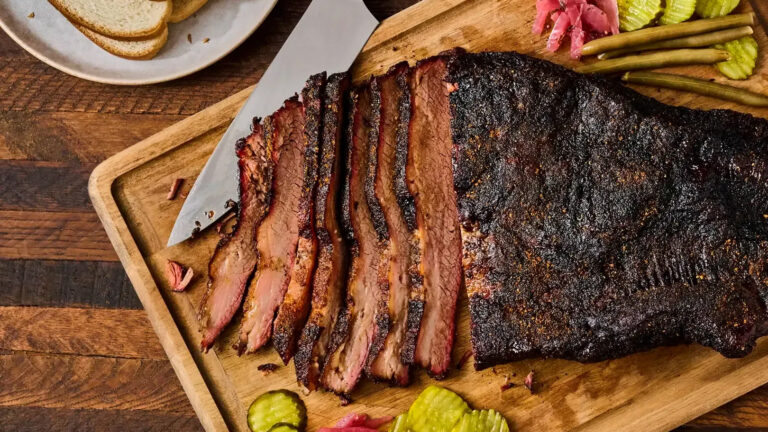
Leftover smoked brisket is the barbecue cook’s chili, and it brings its smoke and bark into the pot. It is already cooked, so it needs to be heated through, not cooked again. I would cube it, stir it in near the end and simmer until the pot reads 165°F, the federal number for reheated leftovers. Our guide to brisket cuts and smoking covers the cook that comes before the chili.
One warning for anyone who competes. The International Chili Society’s rules say meat may be pre-cut or ground but may not be precooked, and CASI defines “scratch” as “starting with raw meat.” Smoked brisket chili is a backyard pot, not a sanctioned entry.
Short ribs are the richest beef on the list at 36.2 grams of fat per 100 grams raw. They braise into silky meat that falls off the bone, and they leave a slick of fat on top of the pot. Skim it, or chill the pot overnight and lift the fat off once it sets.
Can You Use Steak in Chili?
Yes, and top sirloin is the steak I would use. It carries 12.7 grams of fat per 100 grams raw by USDA’s count, it takes a hard sear well and it holds together as cubes. Sear the cubes hard, then give them the last stretch of the simmer rather than the whole afternoon.
I would not spend ribeye money on a chili pot, since the chiles and a long simmer cover up what a ribeye costs extra for. If you have a leftover steak from the grill, cube it and treat it like leftover brisket: in near the end, heated to 165°F. Our steak doneness temperature chart has the numbers for the steak you eat on its own.
Pork in Chili: Shoulder, Chorizo and Sausage
Pork shoulder lists 18.0 grams of fat per 100 grams raw for the whole shoulder, almost exactly what the chuck roast carries, and it shreds the same way after a long simmer. It is the pork I would reach for first in a green chili. Whole pork cuts are safe at 145°F with a 3-minute rest, but like chuck, shoulder needs far more time than that to turn tender. Our pork butt smoking guide works for a shoulder headed to the pot.
Raw pork chorizo is, to my mind, the easiest flavor upgrade here. USDA lists it at 25.1 grams of fat per 100 grams, and that fat comes out paprika-red and seasoned. I would brown a pound with three pounds of beef. Ground pork and sausage of any kind go to 160°F, the same as ground beef, and our smoked sausage guide covers the links if you want them in chunks.
Chicken and Turkey Chili
Chicken thigh meat carries 4.1 grams of fat per 100 grams raw and skinless breast carries 2.6, and thighs carry about 60 percent more fat. That makes thighs the safer bet for a long simmer in a white chicken chili, in our view. Breast meat has little fat to fall back on, so if you use them, poach them in the pot until they hit 165°F, pull them, shred them and stir them back in. Every piece of poultry, ground or whole, has to reach 165°F. Our smoked chicken thighs guide gives you a smoky starting point for the shredded kind.
Ground turkey at 93/7 lists 8.3 grams of fat per 100 grams raw, so brown it in a spoonful of oil or bacon fat and toast the chili powder in that fat.
Venison and Elk Chili
Venison is lean meat. USDA lists raw whole-muscle venison at 2.4 grams of fat per 100 grams and raw elk at 1.5, and the ground versions at 7.1 and 8.8. Wild game is so lean, NDSU Extension says, that it needs added fat or sauce to keep it from turning dry. Utah State Extension suggests grinding in 1 part pork or beef fat to 3 or 4 parts venison, Ohio State gives the same ratio with pork fat, and Utah State says to trim off the deer’s own fat, which carries a strong game flavor. Brown it in oil or bacon fat, keep the pot at a gentle simmer and do not cook it longer than the sauce needs.
FoodSafety.gov lists venison at 160°F. A 2024 CDC report on a trichinellosis outbreak says public health authorities recommend at least 165°F for wild game, and Penn State Extension puts game soups and stews at 165°F. A pot that simmers past 165°F clears all three, so check it with a thermometer.
CDC also advises hunters to check state wildlife and health department rules, to strongly consider having a deer or elk tested for chronic wasting disease before eating the meat, and not to eat meat from an animal that tests positive. Our sister site Popular Outdoorsman covers cuts, safe temperatures and chronic wasting disease in its venison guide, and our own deer jerky recipe is a good home for the rest of the ground meat.
Exotic Meats: Bison, Wild Boar, Lamb and Goat
Ground bison lists 15.9 grams of fat per 100 grams raw, a little leaner than 80/20 beef, and it swaps in pound for pound. FoodSafety.gov puts ground bison at 160°F, the same as ground beef.
Wild boar is a different animal from the pork at the store. USDA lists it at 3.3 grams of fat per 100 grams raw, so it cooks like lean game, not like a fatty pork shoulder. CDC names wild boar among the game animals that can carry the trichinella parasite, warns that freezing may not kill it in wild game, and its 2024 outbreak report says to cook wild game to at least 165°F.
Ground lamb is the opposite: 23.4 grams of fat per 100 grams raw and a flavor strong enough to stand up to a cumin-heavy pot. I would cut it with beef the first time, half and half, and skim the fat it leaves behind. Ground lamb goes to 160°F like ground beef.
Goat runs lean, at 2.3 grams of fat per 100 grams raw, close to venison. FoodSafety.gov groups goat with beef and lamb: 145°F with a 3-minute rest for cuts and 160°F for ground meat. Treat it like venison in the pot, with added fat and a gentle simmer.
Chili Without Meat
Cooked lentils and pinto beans each list about 9 grams of protein per 100 grams in USDA’s database, and black and kidney beans sit just under that, so a meatless pot is not short on protein. What it needs is texture. Two kinds of beans plus lentils give you body, and grains or meat substitutes can stand in for the crumble of ground beef. If you smoke vegetables, our plant-based smoked carrot steak recipe shows how much flavor the smoker adds to a meatless plate.
Mixing Meats in One Pot
Some of the best pots use two meats on purpose. Cubed chuck with 80/20 ground beef gives you cubes to chew and a crumble that thickens the sauce. Venison with pork or chorizo puts back the fat the deer never had.
The over-the-top method mixes meat and smoke in one move. In Meat Church’s version, a ball of seasoned ground meat sits on a rack above the pot in a 225°F smoker, and “it drips flavorful fat into the pot of chili below” until the meat reaches 165°F, about 3 hours by their count. The meat cooks through, then gets broken up and stirred into the pot, so whatever ground meat you hang over the chili decides how rich the bowl ends up.

How to Brown Meat for Chili
America’s Test Kitchen browns meat in batches because a crowded pot lets the meat release moisture and end up “steaming in its own juices.” Pat cubes dry, get the pot hot and leave space between the pieces. Scrape up the browned bits when the liquid goes in.
Toast the chili powder and cumin in the rendered fat before you add the liquid. In our view, that one step does more for a lean pot of venison or turkey than any secret ingredient.
More than two out of three of you are putting the turkey on the smoker this year.
Frequently Asked Questions
What is the best cut of beef for chili?
Chuck roast, cut into cubes. It has enough fat and connective tissue to turn tender in a long simmer, and USDA lists a chuck arm roast at 18.0 grams of fat per 100 grams raw. For a fast weeknight pot, 80/20 ground beef is the easy choice.
Is ground beef or stew meat better for chili?
Ground beef cooks faster and thickens the sauce, and cubes give you something to chew. Skip pre-cut stew meat: USDA lists it at 4.5 grams of fat per 100 grams raw, a quarter of a chuck roast.
Can you put leftover smoked meat in chili?
Yes. Cube or shred leftover brisket, pulled pork or steak, stir it in near the end and heat the pot to 165°F. ICS and CASI cook-off rules do not allow precooked meat.
How do you keep venison chili from drying out?
Add fat and do not overcook it. Utah State Extension suggests grinding in 1 part pork or beef fat to 3 or 4 parts venison, and Ohio State gives the same ratio with pork fat. Brown it in oil or bacon fat and keep the pot at a gentle simmer.
What kind of meat goes with chili?
Beef is the classic, but pork, chicken, turkey, venison, elk, bison, lamb and goat all work. Pick by fat: lean meats need added fat and a gentle simmer, and rich ones need skimming.
Chuck for the weekend pot, 80/20 for a weeknight and a little pork fat for anything that once wore antlers. Short ribs are for showing off, and elk is for the hunter who wants everyone to know he got one.
Sources: Merriam-Webster; USDA FoodData Central; FoodSafety.gov temperature chart; CDC trichinellosis report, 2024; CDC on trichinellosis; CDC on chronic wasting disease; Penn State Extension on venison; Utah State Extension on venison; Ohio State Extension on venison; NDSU Extension on wild game; America’s Test Kitchen on chuck; America’s Test Kitchen on ground beef chili; America’s Test Kitchen on beef stew; Food & Wine via Time, 2015; Weber on ground beef; International Chili Society rules; CASI rules; Meat Church over-the-top chili.
Reader Favorites
- Easy BBQ Foods: Grill Like a Pro with These 10 Recipes
- Best Beef Breeds: Pick The Best For Smoking Now
- Trimming Beef Brisket: Learn What the Pros Know Now
- Grill Steaks Like a Pro: Master the Perfect Sear Now!
- Different Cuts of Pork: Elevate BBQ Mastery Now
- Ben Forte’s Smashburgers: Grill the Ultimate Burger Now
BBQ Temperature Charts & Guides
Four quick-reference tools every cook bookmarks — target temps, pull temps, and how long leftovers keep, plus the full BBQ glossary.
| Cut | Pull | Time |
|---|---|---|
| Brisket | 203°F | 12–16h |
| Spare ribs | 195–203°F | ~6h |
| Pork butt | 203°F | 12–14h |
Target temps & times for 17 cuts, sortable by meat, weight and doneness.
View full chart →| Doneness | Target |
|---|---|
| Rare | 125–130°F |
| Medium-rare | 130–135°F |
| Well-done | 160°F+ |
Rare to well-done, burger safety (160°F) and resting times.
View full chart →| Food | Fridge | Freezer |
|---|---|---|
| Brisket, ribs | 3–4 days | 2–3 mo |
| Smoked sausage | 1 week | 1–2 mo |
| Potato salad | 3–4 days | no freeze |
How long smoked meats & sides keep — fridge and freezer, USDA-based.
View full chart →Every pit term decoded — cooking methods, gear, cuts, wood, and technique, A to Z.
Open the glossary →