Electric Knife: What It’s Good For and How to Carve With One
An electric knife is two serrated blades that saw back and forth on a motor; it carves turkey, ham and roasts cleanly but struggles with bread.
Originally published: November 19, 2026
Safety note. Unplug a corded electric knife, or remove the battery from a cordless one, before you put in, take out or clean the blades. Keep your free hand on the carving fork, well behind the blade, and switch the safety lock on whenever you set the knife down.
The electric knife, or electric carving knife, burst onto the American kitchen scene in the mid-1960s as one of the era’s flashier appliances. Although earlier power-knife patents existed (including one from 1939), the version that became a household fixture is usually credited to inventor Jerome L. Murray, who patented his dual-blade design in 1964. Companies such as General Electric, Black & Decker, and KitchenAid quickly commercialized it. Unlike most kitchen gadgets of the time, which were aimed at housewives, the electric knife was heavily marketed to men which were the traditional carvers of the roast or holiday turkey. Ads promised that it would turn Dad into “a Michelangelo at mealtime,” and the pitch worked: by 1971 roughly one in three American families owned one.
Its appeal was straightforward. Two serrated blades locked together and driven by a small motor reciprocate rapidly, creating a continuous sawing action so the user mostly just guides the tool. It sliced through turkey, ham, roasts, bread, and even cakes with almost no physical effort, produced fairly uniform slices, and added a bit of theatrical flair at the table. Popularity faded for equally practical reasons. The tool is noisy, can shred delicate meat or skin instead of cutting cleanly, offers limited control around bones, and is more of a chore to clean thoroughly than a regular knife. As high-quality manual knives became widely available and the novelty wore off, the electric knife retreated to the back of many cabinets and pulled out mainly once or twice a year for big holiday birds. Still sold today in both corded and cordless versions, it remains a specialized tool rather than an everyday essential: excellent for volume slicing when you want speed and ease, less ideal when precision or quiet is the priority.
It is not the right tool for everything. Test kitchens that put electric knives through turkeys and loaves of bread found the same thing. They are good on poultry and roasts and poor on bread. Here is what an electric knife is good for, when a carving knife is the better pick, and how to carve a turkey with one.
The parts that matter
- How it works: two serrated blades clipped together move in opposite directions, a sawing action you do not have to make.
- Good at: turkey, chicken, ham and roasts.
- Poor at: bread; the thin blades wobble and cut unevenly.
- Blade length: about 7 inches or longer for big roasts and briskets.
- Look for: a sharp blade, a button under the handle, a safety lock and a quiet motor.
What Is an Electric Knife?
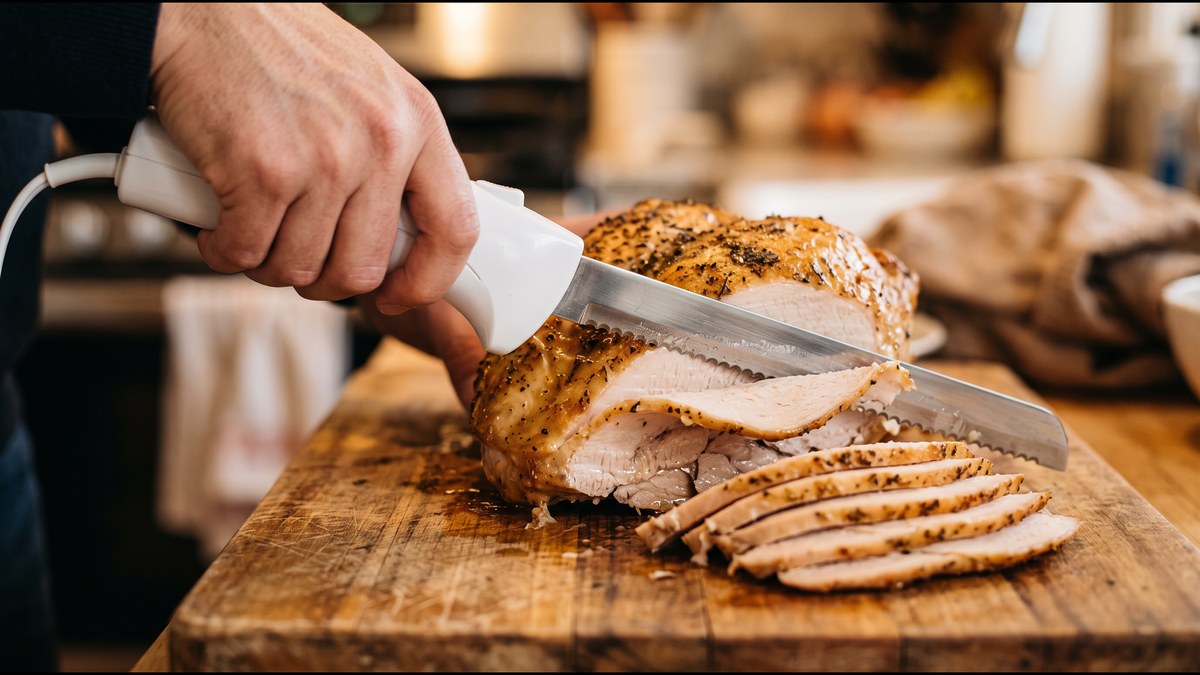
An electric knife is a kitchen appliance for slicing food. Two serrated blades clip together side by side and snap into a motorized handle. Switch it on and the blades slide back and forth lengthwise against each other, so the knife saws through the food while you guide it. Some plug into the wall and some run on a rechargeable battery.
The invention is usually credited to Jerome L. Murray. Another inventor, Clem E. Kosterman, filed a patent for an electric knife in 1939.
What Is an Electric Knife Good For?
Meat. America’s Test Kitchen found that the best electric knives carved turkey and chicken neatly without tearing the skin, and that the thin, slightly flexible blades follow the bone the way a boning knife does. Bread was a different story.
| Food | Good fit? | Why |
|---|---|---|
| Turkey and chicken | Yes | Clean slices, skin stays on, blades follow the bone |
| Ham and roasts | Yes | Thin, even slices with no pressure on the meat |
| Brisket | With a long blade | Blades under about 7 inches can’t span a whole brisket |
| Bread | No | Flexible blades wobble and cut uneven slices; use a bread knife |
Fit ratings follow America’s Test Kitchen’s electric knife testing. Its testers recommend a standard serrated bread knife for loaves.
Electric Knife vs Carving Knife: Which Is Better for Turkey?
Both work. The difference is who is holding the knife.
| Electric knife | Carving knife | |
|---|---|---|
| Skill needed | Low; the motor does the sawing | More; long, smooth strokes take practice |
| Joints | Awkward; hard to find a joint by feel | Easy; the tip finds the joint |
| Breast slices | Thin and even | Thin and even if the blade is sharp |
| Upkeep | Serrated blades; follow the manufacturer’s instructions | Sharpen and hone it like any kitchen knife |
| Noise | Some models are loud | Silent |
Pros still lean toward a regular blade. America’s Test Kitchen surveyed professional cooks and most preferred a boning or chef’s knife for carving roasts, and the National Turkey Federation’s carving guide says to skip electric knives. But the same testing found a well-made electric knife is an effective alternative. If your carving knife is dull, or the person carving has never done it, the electric knife will give you better slices.
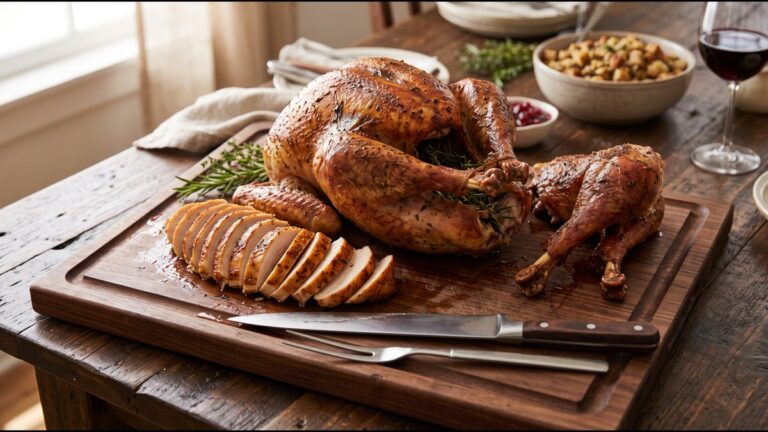
A good split: use a regular knife to take the legs, wings and breast off at the joints, then switch to the electric knife to slice the breast.
How Do You Carve a Turkey With an Electric Knife?
- Rest the bird. Let the turkey stand at least 20 minutes, per USDA, so the juices settle.
- Take it apart. Remove the legs and wings at the joints with a regular knife or the electric knife’s tip, wiggling each joint to find it first.
- Lift off the breast. Cut down along the breastbone and follow the rib cage to take each breast half off in one piece.
- Slice. Lay the breast skin side up, hold it with the fork, and let the blades do the cutting. Guide the knife down through the meat without pressing. Slice crosswise, about 1/4 to 1/3 inch thick.
- Finish the dark meat. Cut the thigh meat off the bone and slice it the same way.
The full method, with the breast-on-the-bird option for carving at the table, is in our how to carve a turkey guide. Ham works the same way: our smoked ham guide covers the cook, and the ham glaze recipe covers the finish.
What Should You Look for in an Electric Knife?
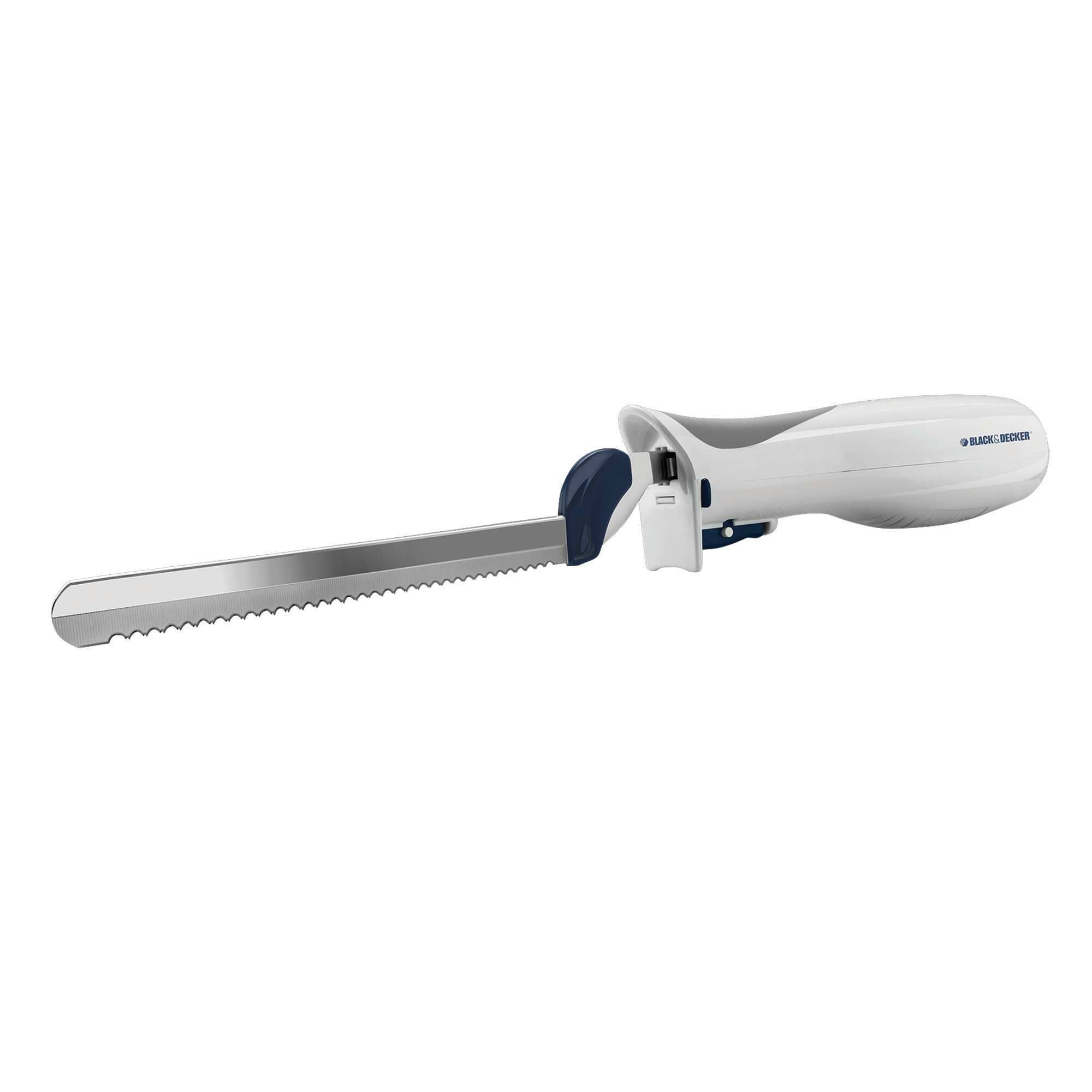
When shopping for an electric knife, prioritize a model that balances power, control, and convenience for the jobs you actually do—usually holiday roasts, bread, or occasional volume slicing. Look for stainless-steel serrated blades that are long enough for a turkey or large roast (typically 7–9 inches), easy to remove, and preferably dishwasher-safe so cleanup isn’t a chore. An ergonomic, non-slip handle reduces fatigue, while a safety lock helps prevent accidental starts. Corded versions generally offer consistent power without battery worries, but a good cordless model can be more flexible at the table if it has solid runtime. Also check noise level (quieter is better), overall weight, whether it includes a storage case or fork, and the warranty, Black+Decker, Hamilton Beach, and Cuisinart remain among the more reliable everyday options.
- A sharp blade. Sharpness made the biggest difference in clean slices.
- Blade length of about 7 inches or more. Shorter blades can’t handle large roasts or briskets.
- A comfortable handle. Rounded handles that stay cool and don’t vibrate much were the most comfortable.
- A button under the handle. It is the easiest to press and hold; buttons on top or pushing forward strained testers’ thumbs.
- A quieter motor. The loudest models came close to lawn-mower noise.
- A safety lock. It stops the blades from starting by accident, which matters with guests reaching across the table.
Corded or cordless comes down to where you carve. A corded knife has to sit near an outlet; a cordless one goes anywhere but runs on a battery that needs charging before the holiday. A model-by-model comparison is coming in the Popular BBQ kitchen knives series.
How Do You Clean and Store an Electric Knife?
Unplug it or pull the battery, then release the blades and separate the two halves. Wash the blades in hot, soapy water, or in the dishwasher only if the manufacturer says they are dishwasher safe. Never put the motor handle in water; wipe it with a damp cloth. Store the blades clipped together in their case or a blade guard so the teeth don’t chip and nobody reaches into a drawer full of serrations.
A whole turkey won easily, with turkey breasts and not smoking tied for second.
Frequently Asked Questions
Are electric knives any good?
Yes, for meat. In America’s Test Kitchen’s testing the best models carved turkey and chicken neatly without tearing the skin. They are poor at slicing bread.
Is an electric knife better than a carving knife for turkey?
Not better, easier. A sharp carving knife in practiced hands does just as well, and most professional cooks prefer one, but an electric knife gives a beginner thin, even slices with little skill.
Can you cut bread with an electric knife?
You can, but it does a poor job. The flexible blades wobble and cut uneven slices, so a standard serrated bread knife is the better tool.
What blade length should an electric knife have?
About 7 inches or longer. America’s Test Kitchen found shorter blades can’t handle large roasts or briskets.
How does an electric knife work?
Two serrated blades are clipped together, and the motor moves them back and forth lengthwise against each other, creating a sawing action while you guide the knife.
Can you still buy an electric knife?
Yes. Corded and cordless electric knives are still sold, often as sets with a carving fork, a storage case or a second blade.
Keep the carving knife for the joints and let the electric knife slice. Your turkey platter will look like it came off a carving station.
Sources: America’s Test Kitchen, electric knife testing; Wikipedia, Electric knife; National Turkey Federation, How to Carve a Turkey; USDA, Let’s Talk Turkey.
Reader Favorites
- Essential BBQ Tools: Get The Tools Pros Recommend Now
- Cleaning Your Gas Grill Cooking Grate: Make it Great Again
- Stainless Steel BBQ Grill Cleaning: Master Maintenance Now
- Grill Baskets: Smoky Veggies & Fish Made Easy
- How to Grill Pizza: Stone or Grates? Tips & Tricks
- Black Friday: Find BBQ Deals for You Outdoor Chef Now
BBQ Temperature Charts & Guides
Four quick-reference tools every cook bookmarks — target temps, pull temps, and how long leftovers keep, plus the full BBQ glossary.
| Cut | Pull | Time |
|---|---|---|
| Brisket | 203°F | 12–16h |
| Spare ribs | 195–203°F | ~6h |
| Pork butt | 203°F | 12–14h |
Target temps & times for 17 cuts, sortable by meat, weight and doneness.
View full chart →| Doneness | Target |
|---|---|
| Rare | 125–130°F |
| Medium-rare | 130–135°F |
| Well-done | 160°F+ |
Rare to well-done, burger safety (160°F) and resting times.
View full chart →| Food | Fridge | Freezer |
|---|---|---|
| Brisket, ribs | 3–4 days | 2–3 mo |
| Smoked sausage | 1 week | 1–2 mo |
| Potato salad | 3–4 days | no freeze |
How long smoked meats & sides keep — fridge and freezer, USDA-based.
View full chart →Every pit term decoded — cooking methods, gear, cuts, wood, and technique, A to Z.
Open the glossary →