

BBQ Rub Recipe Calculator: How Much Rub for Your Meat
BBQ rub recipe calculator: our house rule is 1/2 cup of rub per 10 pounds of meat. Pick a rub and a weight to get your batch.
Last updated: November 12, 2026 · Originally published November 11, 2026
Food safety note. Rub does not cook anything, the heat does. Cook to a safe internal temperature checked with a food thermometer, and do not dip a hand or spoon that touched raw meat back into the rub jar. Mix only what you need for the cook.
The parts that matter
- Our house rule is about 1/2 cup of rub for every 10 pounds of meat, which works out to 0.8 tablespoon per pound.
- For a lighter coat, use about half that, 0.4 tablespoon per pound.
- Leave the salt out of the rub if the meat was brined or sold with a salt solution.
- Rubs with sugar in them are for low-and-slow cooks; table sugar starts to caramelize at 320°F.
- Texas A&M’s brisket rub says to put it on at least overnight before cooking.
BBQ rub calculator: how much rub to mix
Mix 1/2 cup + 1 Tbsp + 1 3/4 tsp of the Texas A&M brisket rub for 12 pounds of meat.
| Ingredient | Amount |
|---|---|
| Canning or pickling salt | 3 Tbsp + 1/4 tsp |
| Paprika | 1 Tbsp + 1 5/8 tsp |
| Coarse ground black pepper | 2 1/4 tsp |
| Fine ground black pepper | 1 1/8 tsp |
| Onion powder | 2 1/4 tsp |
| Garlic powder | 2 1/4 tsp |
| Cayenne pepper | 2 1/4 tsp |
| Brown sugar, packed | 2 1/4 tsp |
| Granulated sugar | 2 1/4 tsp |
The math for your batch
- Rub needed: 12 lb x 2.4 tsp per lb = 28.8 tsp, or 1/2 cup + 1 Tbsp + 1 3/4 tsp. There are 3 teaspoons in a tablespoon and 48 in a cup.
- The original recipe makes 300 tsp.
- Scale: 28.8 ÷ 300 = 0.096. Every ingredient is multiplied by that number and rounded to the nearest 1/8 teaspoon.
This rub has sugar in it. Table sugar starts to caramelize at 320°F, so keep it on low-and-slow cooks or put it on late for a hot one.
Recipe: Texas A&M AgriLife Extension, Dr. Jeff Savell; makes enough for four large briskets.
This calculator runs in your browser. It sends nothing and stores nothing.
How much rub per pound of meat?
Find your weight in the left column. The middle column is our house coat and the right column is the light coat.
| Meat weight | House rule, 1/2 cup per 10 lb | Light coat, 0.4 Tbsp per lb |
|---|---|---|
| 2 pounds | 1 Tbsp + 1 3/4 tsp | 2 3/8 tsp |
| 5 pounds | 1/4 cup | 2 Tbsp |
| 8 pounds | 1/4 cup + 2 Tbsp + 1 1/4 tsp | 3 Tbsp + 5/8 tsp |
| 10 pounds | 1/2 cup | 1/4 cup |
| 12 pounds | 1/2 cup + 1 Tbsp + 1 3/4 tsp | 1/4 cup + 2 3/8 tsp |
| 15 pounds | 3/4 cup | 1/4 cup + 2 Tbsp |
| 20 pounds | 1 cup | 1/2 cup |
Amounts are rounded to the nearest 1/8 teaspoon. The house rule is ours. The light coat matches McCormick’s turkey rub, 5 1/4 tablespoons for a 12- to 14-pound bird, covered in our turkey rub guide.
How the calculator works
It does three things. First it multiplies your meat weight by the coat you picked to find how much rub you need. Then it adds up the whole recipe in teaspoons. Then it divides the first number by the second and multiplies every ingredient by the answer.
Worked example. You have a 12-pound brisket and want Texas A&M’s rub. At the house rule, 12 pounds times 2.4 teaspoons per pound is 28.8 teaspoons, a little over half a cup. Texas A&M’s full recipe makes 6 1/4 cups, or 300 teaspoons, enough for four large briskets. 28.8 divided by 300 is 0.096, so every ingredient gets multiplied by about a tenth. The 2 cups of salt becomes 3 tablespoons and 1/4 teaspoon, and the 1 cup of paprika becomes 1 tablespoon and 1 5/8 teaspoons.
That is the whole trick to a homemade BBQ rub. Mix the amount you need, and you never end up with a coffee can of stale rub in the cabinet.
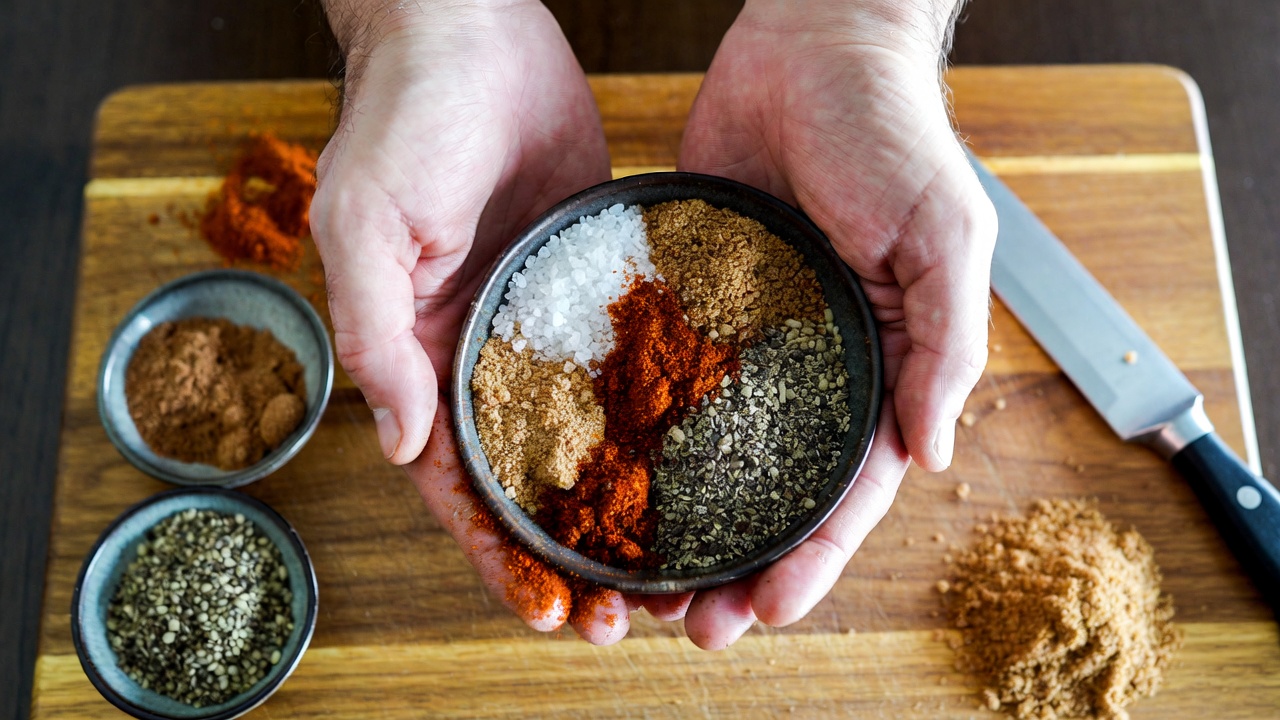
When to leave the salt out
Salt-free is the right call any time the meat already has salt in it. A brined turkey, a dry-brined pork butt or a store-bought roast labeled with an added solution has all the salt it needs, so the rub should not add more. Set the salt box to “No” and the calculator scales the rest of the recipe to the same total amount. Our turkey rub guide covers the brined-bird problem in detail.
If you do salt in the rub, the calculator shows how much salt ends up on each pound of meat, so you are not guessing.
The rub recipes in the calculator
Texas A&M AgriLife Extension’s brisket rub is a big-batch competition-style blend of salt, paprika, two grinds of black pepper, onion, garlic, cayenne and two sugars. The burger rub comes from our best BBQ rubs page. The five poultry rubs come from our turkey rub guide, where each one is written out with its salt shown separately. They work just as well on chicken and pork.
Half of you are feeding fewer than 8 this Thanksgiving.
Frequently asked questions
How much rub do you use per pound of meat?
Our house rule is about 1/2 cup per 10 pounds, which is 0.8 tablespoon per pound. For a lighter coat, use about 0.4 tablespoon per pound.
How much rub for a brisket?
A 12-pound brisket takes about 1/2 cup plus 1 tablespoon and 1 3/4 teaspoons at our house rule. Texas A&M’s own recipe makes about 1 1/2 cups per large brisket, a heavier coat.
How long before cooking should you put rub on?
Texas A&M says to apply its brisket rub at least overnight before cooking. For a quick cook, put it on while the smoker comes up to temperature.
Should rub have salt in it?
Yes, unless the meat was brined or already has a salt solution in it. Then leave the salt out and let the brine do that job.
How long does homemade BBQ rub last?
Our best BBQ rubs page says a dry rub keeps about three months before it goes dull. Store it in a sealed jar away from heat.
A good rub is just the right amount of the right spices. Weigh the meat, mix the batch and get the fire going.
Sources: Texas A&M AgriLife Extension, Dr. Jeff Savell, “Brisket Rub Recipe”; Popular BBQ, “Turkey Rub: Five Flavors and How Much for Your Bird”; Popular BBQ, best BBQ rubs.
Weekend Pitmaster Want more detail? Read Best BBQ Rubs: Ratios, Storage and How to Apply Them
Reader Favorites
- Essential BBQ Tools: Get The Tools Pros Recommend Now
- Cleaning Your Gas Grill Cooking Grate: Make it Great Again
- Stainless Steel BBQ Grill Cleaning: Master Maintenance Now
- Grill Baskets: Smoky Veggies & Fish Made Easy
- How to Grill Pizza: Stone or Grates? Tips & Tricks
- How To Master a Homemade Barbecue Sauce Recipe Best
BBQ Temperature Charts & Guides
Four quick-reference tools every cook bookmarks — target temps, pull temps, and how long leftovers keep, plus the full BBQ glossary.
| Cut | Pull | Time |
|---|---|---|
| Brisket | 203°F | 12–16h |
| Spare ribs | 195–203°F | ~6h |
| Pork butt | 203°F | 12–14h |
Target temps & times for 17 cuts, sortable by meat, weight and doneness.
View full chart →| Doneness | Target |
|---|---|
| Rare | 125–130°F |
| Medium-rare | 130–135°F |
| Well-done | 160°F+ |
Rare to well-done, burger safety (160°F) and resting times.
View full chart →| Food | Fridge | Freezer |
|---|---|---|
| Brisket, ribs | 3–4 days | 2–3 mo |
| Smoked sausage | 1 week | 1–2 mo |
| Potato salad | 3–4 days | no freeze |
How long smoked meats & sides keep — fridge and freezer, USDA-based.
View full chart →Every pit term decoded — cooking methods, gear, cuts, wood, and technique, A to Z.
Open the glossary →