Himalayan Salt Block Recipe: Science Meets Southern BBQ Now
Last updated: September 2, 2026 · Originally published June 27, 2025

A Himalayan salt block seasons food from below as it sears, which is why it suits a filet or a pork tenderloin better than anything long-cooked.
Below: how to heat one without cracking it, how to store it so it lasts, and two recipes that play to what the block actually does well. It is a real tool rather than a novelty, but it is also fragile and slow to heat, and both of those catch people out. Fire up your grill. Let’s get to it!
Why Use a Himalayan Salt Block?
First off, what’s so special about a Himalayan salt grilling stone? These blocks, carved from ancient pink salt mines in Pakistan, hold heat like nobody’s business. They keep your food hot and cook it even, giving you that perfect sear. The science kicks in with the Maillard reaction—that’s the magic that browns your steak and amps up flavor. When your meat hits the Himalayan pink salt BBQ plank, moisture pulls salt into the surface, adding a balanced salty kick. Plus, minerals like calcium and magnesium give a subtle flavor boost that’s hard to beat. It’s like adding a pinch of Southern soul to every bite. Check out Serious Eats for more on the Maillard reaction.
Some people call it a fad and a pretty plate, and the criticisms are fair enough: it is fragile, it is slow to come up to temperature, and it is awkward to clean. The counter-argument is that nothing else seasons evenly from underneath while it sears. Both of those things are true, and the debate is covered further down.
How to Heat and Care for Your Himalayan Salt Block
Next, let’s talk heating a Himalayan salt block. Patience is the whole thing here. Rush it and the block cracks. On a kettle grill:
- Low Heat (15 minutes): Set your grill to low, around 200°F, and place the block on the grates. Let it warm slow to avoid thermal shock.
- Medium Heat (15 minutes): Crank it to medium, about 350°F, and give it another 15 minutes.
- High Heat (15-20 minutes): Push to high, aiming for 500°F or more. Total time’s about 45-50 minutes. Sprinkle water on it—if it sizzles and vanishes, you’re ready.
Use a ThermoWorks Signals to watch the grill temperature so you do not overshoot. Hickory or cherry gives a light smoke that will not bury the salt.
For care, let the block cool completely—takes a few hours. Then, wipe it with a damp cloth. No soap; it soaks into the salt and stays there. If food’s stuck, scrub gently with a soft brush, then dry it thoroughly. A quick read on The Meadow’s guide says the same.
Himalayan Salt Block Storage Tips
Then, let’s cover Himalayan salt block storage. Keep it in a cool, dry spot—think a windowsill or a cupboard. In a humid climate, wrap it in a towel to keep moisture off it. Make sure it’s bone-dry before storing to avoid any salt buildup. Simple, but it’ll keep your Himalayan salt slab for grilling in top shape.
Ingredients for Your Himalayan Salt Block Recipe
Two recipes below. One is a straight high-heat sear, the other smokes first and finishes on the block.
Recipe 1: Himalayan Salt Block Filet Mignon
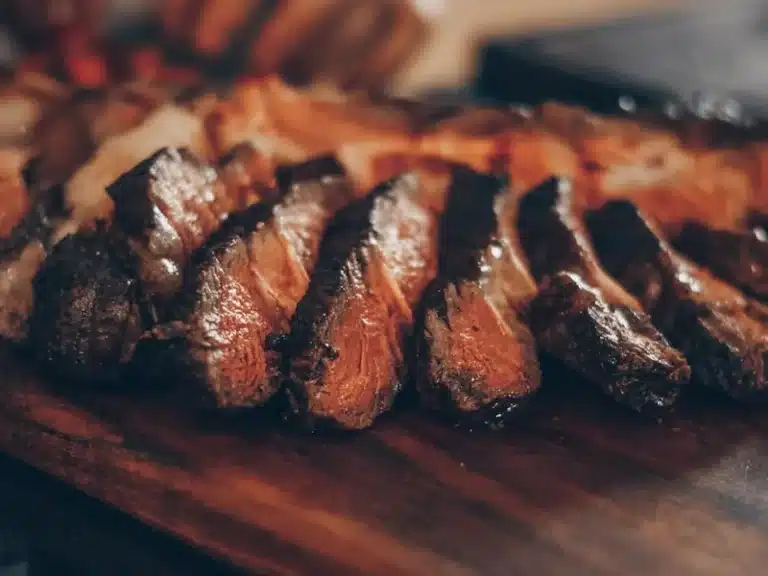
This is your go-to for a quick, show-stopping dish. The Himalayan salt block grill gives filet mignon a perfect crust with no extra seasoning.
Ingredients:
- 2 filet mignon steaks (1-inch thick, about 6 oz each)
- Black pepper (freshly ground)
- Himalayan salt block
Instructions:
- Heat your Himalayan salt block as described (low 15 min, medium 15 min, high 15-20 min to 500°F).
- Pat steaks dry and sprinkle lightly with black pepper—no salt needed, the block’s got you covered.
- Place steaks on the hot block. Cook 4-5 minutes per side for medium-rare (135°F internal).
- Rest 5 minutes, then slice and serve. That Maillard crust will have your guests begging for seconds.
Cook Time: 8-10 minutes | Serves: 2
The salt block’s heat sears the steak, locking in juices and boosting that Maillard reaction. It is also the most watchable thing you can put on a grill, which is half the reason people buy the block in the first place.

Recipe 2: Smoked Salt Block Pork Tenderloin
This one is for the low-and-slow crowd. Smoke the pork first, then finish it on the block for the crust.
Ingredients:
- 1 pork tenderloin (1-1.5 lbs)
- 2 tbsp coffee-chili rub (or your favorite BBQ rub)
- Hickory wood chunks
- Himalayan salt block
Instructions:
- Set your smoker to 225°F with hickory wood. Rub the pork with coffee-chili rub.
- Smoke until internal temp hits 140°F (about 2-3 hours). Use ThermoWorks Signals to track it.
- Heat your Himalayan salt block to 500°F (same method as above).
- Sear the pork on the block, 3-4 minutes per side, until it hits 145°F internal.
- Rest 10 minutes, slice, and serve. That salty, smoky crust is next-level.
Cook Time: 2-3 hours smoke + 12-16 minutes grill | Serves: 4
The combination of hickory smoke and a salt-block crust is the reason to bother with the two-stage cook rather than just smoking it through.
The Pitmaster’s Take: Flavor vs. Fad
So, why do pitmasters love grilling with a Himalayan salt block? It’s the flavor—subtle, mineral-rich, and unique. The pink hue also makes for a stunning presentation, perfect for impressing at cookouts. But there’s a debate. Some folks on forums like BBQ Brethren call it a gimmick, saying it’s pricey and cracks easy. Others, like the pros at Food Fire Friends rate it highly when it is handled properly. The honest answer is that both camps are describing the same object; the difference is whether they learned the technique.
Community and Southern Tradition
There is a practical reason the block turns up at gatherings rather than at weeknight dinners. It takes 45 minutes to heat and cooks in two, so it only makes sense when people are already standing around. That is not a criticism; it is what it is good at.
Conclusion: Fire Up Your Salt Block
That is the method. Try the filet or the pork tenderloin next time you have people over, and give yourself the full 45 minutes to heat the block. Tell me how it goes in the comments, or tag us at @PopularBBQ.
Two thirds of you put beans in your chili every time.
Reader Favorites
- Smoking Ahi Tuna on a Salt Block: A Unique Option
- Himalayan Salt Block Grilling: Your Guide to the Salt Life
- Himalayan Salt Block Care: Essential Tips for Grilling
- Himalayan Salt Block Foods: Best Grilling Choices
- Himalayan Salt Block History: From Ancient Origins to BBQ
- Using Himalayan Salt Block: Key Considerations for Grilling
BBQ Temperature Charts & Guides
Four quick-reference tools every cook bookmarks — target temps, pull temps, and how long leftovers keep, plus the full BBQ glossary.
| Cut | Pull | Time |
|---|---|---|
| Brisket | 203°F | 12–16h |
| Spare ribs | 195–203°F | ~6h |
| Pork butt | 203°F | 12–14h |
Target temps & times for 17 cuts, sortable by meat, weight and doneness.
View full chart →| Doneness | Target |
|---|---|
| Rare | 125–130°F |
| Medium-rare | 130–135°F |
| Well-done | 160°F+ |
Rare to well-done, burger safety (160°F) and resting times.
View full chart →| Food | Fridge | Freezer |
|---|---|---|
| Brisket, ribs | 3–4 days | 2–3 mo |
| Smoked sausage | 1 week | 1–2 mo |
| Potato salad | 3–4 days | no freeze |
How long smoked meats & sides keep — fridge and freezer, USDA-based.
View full chart →Every pit term decoded — cooking methods, gear, cuts, wood, and technique, A to Z.
Open the glossary →