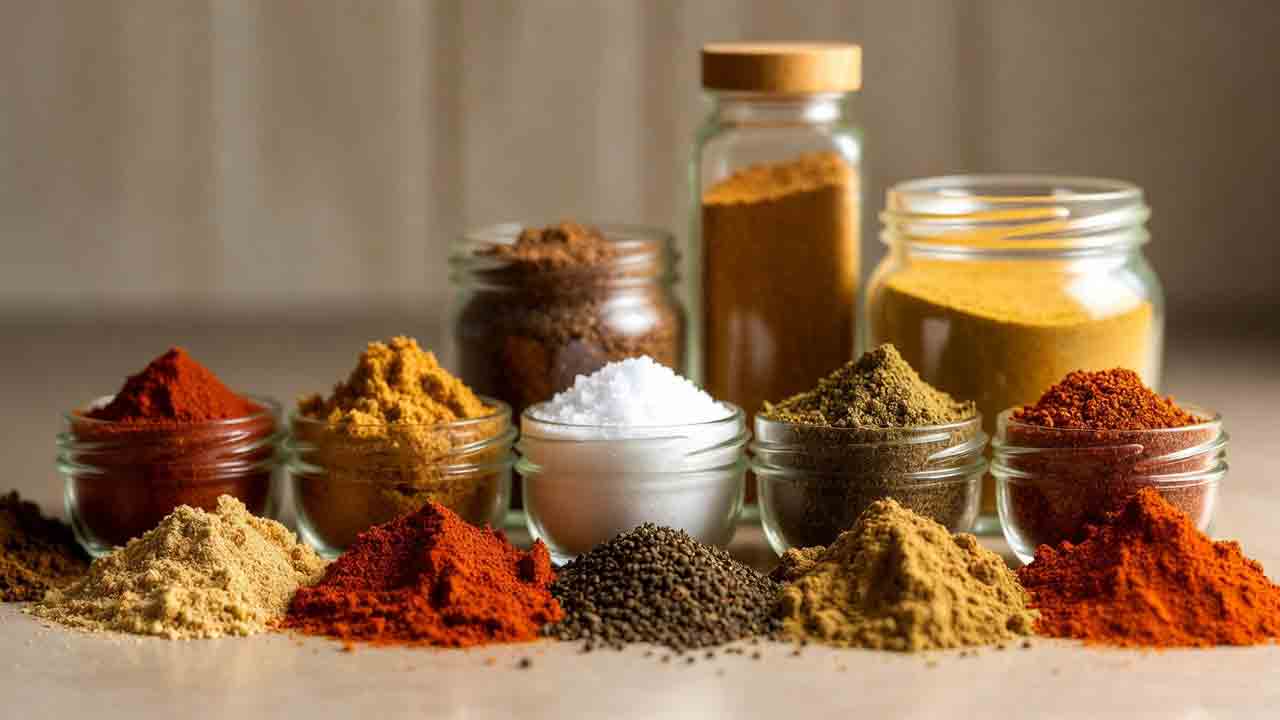
Rib Rub: The Recipe by Weight, Not by the Teaspoon
A good rib rub is roughly equal parts brown sugar and paprika, half that much salt by weight, and smaller amounts of pepper, garlic and onion.
A good rib rub is roughly equal parts brown sugar and paprika, about half that much salt by weight, and smaller amounts of black pepper, garlic and onion powder. Measure it by weight, not by the teaspoon — a teaspoon of Diamond Crystal kosher salt and a teaspoon of table salt differ by more than 2× in the salt they deliver, which is why the same written recipe produces different ribs in different kitchens.
The parts that matter
- A rub recipe written in teaspoons is at least three different recipes. We derive each salt’s density from its own nutrition panel so you can convert any of them.
- The five top-ranking rib rubs span a 13.6-fold range in salt-to-sugar ratio. None of them gives weights. None states a salt percentage. None cites a source.
- Chili powder is about 7.3% salt — 42 times the sodium of paprika. If your rub contains it, you are adding salt you never counted.
- Sugar does not burn at rib smoking temperatures. FSIS caps smoking at 300 °F; every published sucrose decomposition figure sits above that. The claim is imported from grilling.
- The 3-2-1 method has no institutional basis whatsoever — it appears nowhere in FSIS, Extension or peer-reviewed literature.
Every rib rub recipe on the internet is written in tablespoons and teaspoons. That convention quietly breaks the recipe, because the single most important ingredient in a rub — salt — is sold in forms whose density differs by more than a factor of two.
This guide fixes that. Below you will find the salt conversion math derived from manufacturers’ own nutrition panels, an audit of what the top-ranking rib rubs actually deliver once you convert them to weight, the ingredient lists of four commercial rubs in label order, and a rub recipe given in grams first.
Why does the same rub recipe taste different every time?
Because “1 tablespoon of kosher salt” is not a quantity. It is a volume of a substance whose bulk density depends on crystal shape, and the two dominant kosher salt brands have very different crystals.
You can derive any salt’s weight per teaspoon from the back of its own box. Sodium is 39.334% of sodium chloride by mass, so a declared sodium figure per serving converts straight to grams of salt. Here is that arithmetic run on the published panels:
| Salt | Declared serving | Declared sodium | Derived g per tsp | Cross-check |
|---|---|---|---|---|
| Morton Coarse Kosher | ¼ tsp (1.2 g) | 480 mg | 4.88 g | 1.2 g × 4 = 4.80 g — agrees within 1.6% |
| Morton Iodized Table Salt | ¼ tsp (1.5 g) | 590 mg | 6.00 g | 1.5 g × 4 = 6.00 g — exact agreement |
| Diamond Crystal Kosher | ¼ tsp | 280 mg | 2.85 g | No gram weight published — see note |
| USDA “Salt, table” (FDC 173468) | 1 tsp | 38,800 mg/100 g | 6.00 g | Implies 582 mg per ¼ tsp vs Morton’s 590 — 1.4% apart |
The headline ratios: Morton kosher delivers 1.7× the salt of Diamond Crystal per teaspoon. Table salt delivers 2.1× — more than double. Swap brands without adjusting and you have either an inedibly salty rub or a bland one.
A note on the Diamond Crystal figure
Diamond Crystal publishes no nutrition panel on its own website. We loaded the manufacturer’s product page live on 2026-08-21 and found none — and both of the URLs the internet links for this product now return the site’s own 404 page, because the item has been renamed to “Kosher Salt Flakes.” The 2.85 g/tsp figure is derived from the panel’s 280 mg declaration per ¼ tsp. As a sanity check, Diamond Crystal’s own marketing claims bracket it — though those claims disagree with each other, with the foodservice site saying “~50% less sodium by volume than table salt” and the consumer site saying “53% less.” Those work out to 3.00 and 2.82 g/tsp respectively. Our 2.85 sits inside that range. Verify against a physical box if precision matters to you.
How much salt is actually in the top-ranking rib rubs?
We converted five top-ranking rib rub recipes to weight using USDA gram-weights for each spice and the salt densities above. The results are not close to each other.
| Recipe | Sugar (g) | Salt called for | Salt g — Morton | Salt g — Diamond | Ratio salt:sugar (Morton) |
|---|---|---|---|---|---|
| Barbecue Bible | 27.5 | 6 tsp | 28.8 | 16.9 | 1 : 0.95 — salt exceeds sugar |
| The Kitchn | 55.0 | 6 tsp | 28.8 | 16.9 | 1 : 1.91 |
| Hey Grill Hey | 55.0 | 2 tsp | 9.6 | 5.6 | 1 : 5.73 |
| Grilled Cheese Social | 110.0 | 3 tsp | 14.4 | 8.5 | 1 : 7.64 |
| LeelaLicious | 41.3 | 1½ tsp “sea salt” | ~9.0 | — | 1 : 4.58 (uncertain) |
The spread runs from 1:0.95 to 1:13.0 once you account for salt brand — a 13.6-fold range across five pages all answering the same question. Salt as a percentage of the finished rub runs from about 7% to about 26%.
One recipe that cannot be what it says it is
The Kitchn’s rib rub states it was “tested with both Diamond Crystal and Morton kosher salt.” Its 2 tablespoons of salt is either 28.8 g or 16.9 g depending on which — a difference of 11.9 g in a rub totalling about 100 g, or 70% more salt one way than the other. Those cannot both be the tested recipe. Either one version is materially over- or under-salted, or “tested” is doing less work than it appears to.
Worked out fully: the Morton build comes to 110.6 g total with salt at 26.0% of the rub; the Diamond Crystal build comes to 98.7 g with salt at 17.1%.
Two conversion caveats we are not hiding
Packed versus unpacked brown sugar is a 52% swing. USDA’s own data: 1 cup packed = 220 g, unpacked = 145 g. Brown sugar is the largest ingredient by weight in most of these rubs, and only one of the five specifies which. Every ratio above shifts if you scoop loosely.
“Sea salt” is unresolvable. Grain size spans roughly 4–6 g per teaspoon with no manufacturer named, so that row cannot be converted with confidence and is flagged rather than guessed. Barbecue Bible’s “kosher or coarse salt” offers two different densities as interchangeable in a single phrase.
Is there hidden salt in rub ingredients?
Yes, in one ingredient, and it is a big one.
USDA FoodData Central lists chili powder (FDC 171319) at 2,870 mg sodium per 100 g. Run that through the conversion and chili powder is 7.30% salt by weight — because US “chili powder” is a blend, not a single spice. A teaspoon of it (2.7 g per USDA) carries 0.197 g of salt, about 4% of a teaspoon of Morton kosher.
Set against the single spices, the gap is stark:
| Ingredient | FDC ID | Sodium mg/100 g | Salt % by weight | Data points (n) |
|---|---|---|---|---|
| Chili powder | 171319 | 2,870 | 7.30% | 0 — imputed |
| Onion powder | 171327 | 73 | 0.186% | 1 |
| Paprika | 171329 | 68 | 0.173% | 3 |
| Garlic powder | 171325 | 60 | 0.153% | 3 |
| Rosemary, dried | 171333 | 50 | 0.127% | 6 |
| Oregano, dried | 171328 | 25 | 0.064% | 3 |
| Black pepper | 170931 | 20 | 0.051% | 5 |
| Cinnamon, ground | 171320 | 10 | 0.025% | 6 |
| Salt, table | 173468 | 38,800 | 98.6% | 1 |
There is no legal definition of chili powder
We checked, because it seemed unlikely. 21 CFR 101.22 (current as of 8/19/2026) enumerates the spices — paprika, black pepper, rosemary, cumin, oregano, turmeric and about thirty more. Chili powder is not among them. FDA’s Compliance Policy Guide 525.750 defines 37 spices and also omits it.
The only definition that exists is a trade-association one. The American Spice Trade Association’s guide describes chili powder as “a blend that also contains other spices. Typically, a chili powder blend consists of about 80% ground chili pepper, along with garlic powder, oregano, ground cumin seed and a little salt.” That document carries no date and no regulatory force. So the single largest hidden sodium source in home rub recipes is a legally undefined product.
While we were in the regulation, two other things surfaced that rub writing gets wrong. Garlic powder and onion powder are legally not spices — FDA states plainly that “dried or dehydrated onions and garlic are not considered to be spices,” which is exactly why commercial labels break them out separately from “spices.” And paprika is legally a color as well as a spice: 21 CFR 101.22 requires it be declared as “spice and coloring” unless named, which is why you see “extractives of paprika (color)” on labels.
Do commercial rubs lead with salt or sugar?
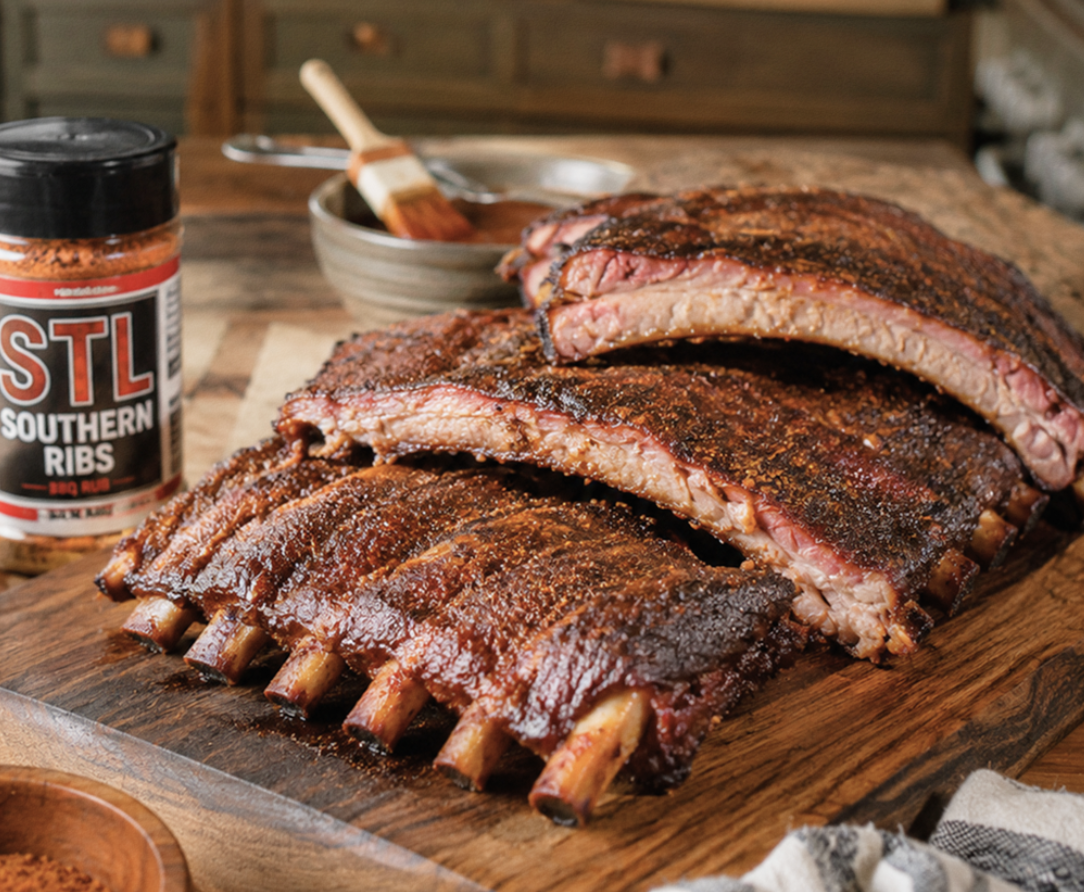
There is no industry consensus, which is itself the finding. US labeling requires ingredients in descending order by weight, so position one is the largest component by mass:
| Brand | First ingredient | Ingredient list as printed |
|---|---|---|
| Meat Church Honey Hog | Sugar | Sugar, salt, honey powder, spices including paprika, dextrose, dehydrated garlic, celery, silicon dioxide, spice extractives. No MSG. |
| Killer Hogs The BBQ Rub | Brown sugar | Brown sugar, sugar, salt, paprika, spices including chili pepper, evaporated cane juice, dehydrated garlic and orange peel, onion powder, MSG, mustard flour, extractives of paprika (color), dill weed, turmeric (color), natural flavor. |
| McCormick Grill Mates Sweet & Smoky | Salt | Salt, sugar, brown sugar, spices (including cinnamon, chipotle chili pepper, celery seed), paprika, garlic, onion & vinegar. |
| Bad Byron’s Butt Rub | Salt | Salt, black pepper, granulated onion, granulated garlic, paprika, chipotle powder, microcrystalline cellulose. Contains no sugar at all. |
Two of four lead with sugar, two with salt, and one contains no sugar whatsoever. Killer Hogs stacks three separate sweeteners. The premise that “a BBQ rub is mostly brown sugar” is true for about half the market and false for the other half.
One more thing worth reporting: only McCormick publishes a machine-readable sodium figure on its own product page (600 mg per 2 tsp — that is 1.53 g of salt per serving). Meat Church and Killer Hogs render their panels only as label images. Craft BBQ brands publish systematically less nutrition data than the large spice companies.
And no rub can legally call itself low sodium
Under 21 CFR 101.61, “low sodium” means 140 mg or less per reference amount — and because a rub’s reference amount is small (≤2 tbsp), the dual test applies and it must also meet the threshold per 50 g. That works out to a maximum of about 0.36% salt by weight. Essentially no barbecue rub on the market can make that claim. Note too that “salt free” (requires under 5 mg sodium) and “no salt added” (only requires that none was added, and triggers a mandatory disclaimer) are different claims that rub marketing routinely conflates.
Does sugar burn in a rib rub?
This is the category’s signature warning, and the numbers do not support it at smoking temperatures.
FSIS’s “Smoking Meat and Poultry” (last updated August 13, 2024) sets the chamber ceiling at 300 °F. Every published figure for sucrose decomposition onset — even the lowest commonly cited, around 320 °F — sits above that ceiling. Ribs at 225–275 °F are not reaching it.
There is a deeper problem with the claim, too. Lee, Thomas and Schmidt (2011) in the Journal of Agricultural and Food Chemistry (DOI 10.1021/jf104852u) found that the loss of crystalline structure in sucrose “has been shown to be due to the kinetic process of thermal decomposition (termed apparent melting), rather than thermodynamic melting.” In plain terms: sucrose has no fixed melting point. Its apparent melting temperature depends on how fast you heat it. Any article quoting a single number for when sugar melts is quoting a constant the primary literature says does not exist. (That finding was formally contested in the same journal, so treat it as a live scientific dispute rather than settled.)
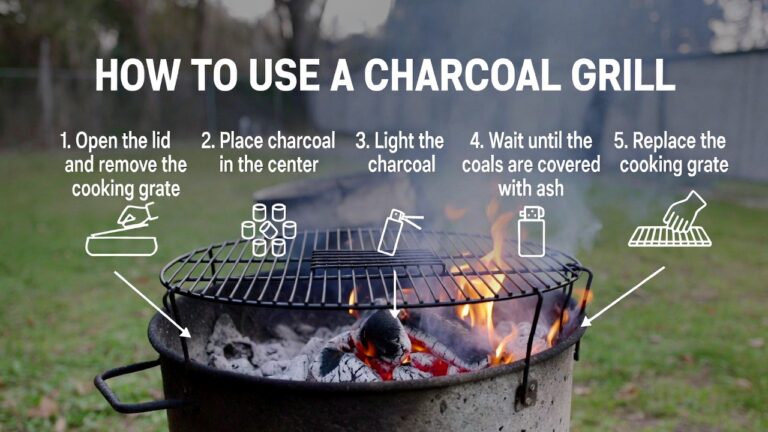
The distinction the category collapses is chamber air temperature versus radiant surface temperature. Sugar actually does burn when you finish ribs over direct flame, or when you glaze and crank the heat — surface temperatures there run far above the chamber reading. It is a grilling and glazing problem, not a low-and-slow problem. Our charcoal grill guide covers the direct-heat side, where the concern is real.
What about carcinogens from rubs?
The National Cancer Institute fact sheet on chemicals in meat cooked at high temperatures (reviewed July 11, 2017) says HCAs and PAHs form when meat is cooked “using high-temperature methods, such as pan frying or grilling directly over an open flame,” and that formation increases “above 300 ºF.”
Two structural points follow. First, NCI’s 300 °F threshold sits at the very top of the FSIS smoking range — ribs cooked low and slow are below the line NCI draws, so the anxiety the category imports from grilling largely does not apply. Second, the fact sheet does not mention rubs, spices, marinades or seasonings anywhere. Its risk-reduction advice is entirely about heat management.
You will see claims that rosemary or turmeric in a rub cuts HCA formation. There is real peer-reviewed work behind that — Puangsombat and Smith 2010 (DOI 10.1111/j.1750-3841.2009.01491.x), and a 2025 air-frying study finding turmeric reduced HCAs by 69.4%. But every one of those studies cooks at 375–400 °F on ground meat with the spice blended into the matrix at a controlled weight percentage. None cooks at rib temperatures, uses whole-muscle bone-in cuts, or applies spice as a surface rub. And Uzun and Oz (2021) found the direction of effect is not even consistent — spices can increase HCAs depending on rate and temperature. We are not going to tell you a rub is protective; the study that would show it has not been run.
Best Rib Rub
Given in grams first. The volumes are provided for convenience and are calculated for Morton coarse kosher salt; if you use Diamond Crystal, use the gram figure or increase the volume by about 70%.
Ingredients — makes about 200 g (roughly 1 cup)
- 70 g brown sugar, packed (about ⅓ cup packed)
- 50 g paprika (about 7 tbsp)
- 34 g Morton coarse kosher salt (about 7 tsp) — or 34 g Diamond Crystal, about 12 tsp
- 21 g black pepper, coarse ground (about 3 tbsp)
- 15 g garlic powder (about 1½ tbsp)
- 10 g onion powder (about 1½ tbsp)
- 4 g dry mustard (about 2 tsp)
- 2 g cayenne (about 1 tsp), or to taste
That works out to salt at 17% of the finished rub and a salt-to-sugar ratio of 1 : 2.06 — deliberately near the middle of the published range rather than at either extreme, and stated as a number so you can move it on purpose. Want it more savory? Take the sugar to 50 g and you are at 1:1.5. Sweeter? 100 g of sugar puts you at 1:2.9.
Note there is no chili powder in this rub. That is deliberate — it would add roughly 7.3% of its own weight back as uncounted salt. If you want that flavor, use ancho or chipotle powder (single-ingredient ground chile, near-zero sodium) and keep control of your salt.
Method
- Weigh everything into a bowl. Whisk until the color is uniform with no streaks of paprika or pockets of sugar.
- Break up any brown sugar lumps with your fingers or push the mix through a coarse sieve.
- Store airtight, away from light. Ground spices lose aroma over months rather than spoiling; make what you will use in a season.
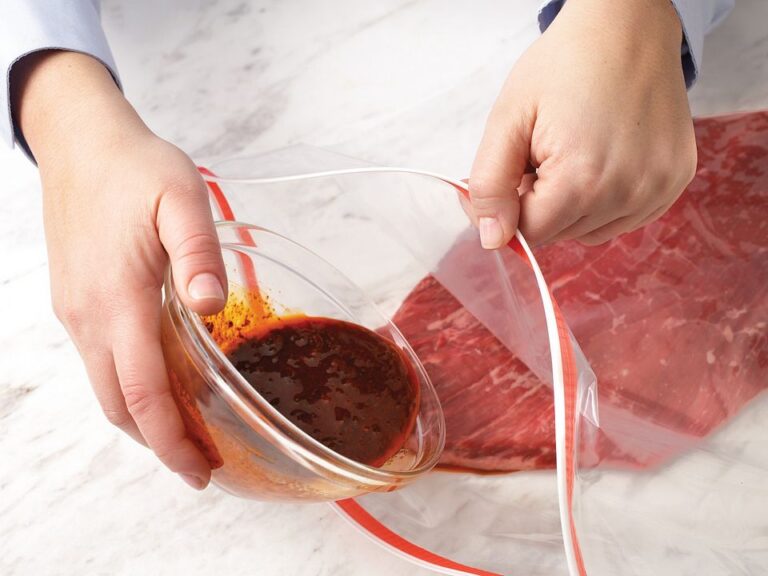
- To apply: pat the ribs dry, remove the membrane from the bone side, apply a thin binder if you like, then dust evenly. About 12–15 g of rub per pound of ribs is a reasonable starting point. Let it sit 30–60 minutes until it looks wet.
Salt conversion cheat sheet
| If a recipe calls for | Diamond Crystal | Morton Kosher | Table salt |
|---|---|---|---|
| 1 tsp | 2.85 g | 4.88 g | 6.00 g |
| 1 tbsp | 8.6 g | 14.6 g | 18.0 g |
| To deliver 10 g of salt | 3½ tsp | 2 tsp | 1⅔ tsp |
What temperature are ribs done at?
Two different answers, for two different questions, and it is worth keeping them apart.
For safety: pork ribs are whole-muscle pork, so FoodSafety.gov (reviewed November 21, 2024) puts them at 145 °F with a three-minute rest. FSIS’s own cooking chart names ribs explicitly — back, country-style or spareribs, roasted 1½ to 2 hours, to “145 degrees F and allow to rest for at least 3 minutes.”
For tenderness: considerably higher, and here the federal record runs out. FSIS’s chart adds the qualifier “(or until fork tender)” and never says what temperature that is. Texas A&M AgriLife’s BBQ Science page (updated September 13, 2024) gives 185–195 °F for collagen-to-gelatin conversion — but states it for briskets and pork butts, not ribs.
The widely-quoted 195–203 °F rib window has no government, Extension or peer-reviewed source that we could find. We use it, most cooks use it, and it works — but it is craft consensus and should be labeled as such rather than attributed to an authority. The same is true, more starkly, of the 3-2-1 method: the single most-repeated technique in this category appears nowhere in FSIS, Extension or the peer-reviewed literature. It is trade folklore, not a protocol.
For pull temperatures across every cut, see our smoking times and temperatures chart. If you want to understand what salt is doing to the meat rather than just how much to use, the dry-brining guide covers diffusion, timing and the sodium math in more depth. And if you are curing or preserving anything alongside your barbecue, the altitude-adjusted tables in the canning time chart at Current Homesteading use the same primary-source approach.
What we would not tell you
- A burn temperature for brown sugar. No peer-reviewed, government or Extension source states one. Every result we found was a forum or a commercial blog.
- That 195–203 °F for ribs comes from anywhere official. It does not. The nearest sourced figure is Texas A&M’s 185–195 °F for other cuts.
- That the 3-2-1 method is validated. Confirmed absent from FSIS entirely.
- That a rub reduces carcinogens. The literature is real but was run at 375–400 °F on ground meat with spices mixed in, and one study found spices can increase HCAs.
- That “chile powder” versus “chili powder” carries regulatory meaning. Neither spelling has a legal definition.
How this guide was made: research-based, not a kitchen test. Salt densities are derived from manufacturers’ published nutrition declarations using the 39.334% sodium-to-salt conversion and cross-checked against USDA FoodData Central. Competitor recipes were converted to weight using USDA gram weights, with every uncertain conversion flagged rather than smoothed. Regulatory text is quoted from eCFR and FDA guidance as of the dates shown. Reviewed and edited by James Nicholas.
Frequently Asked Questions
What’s a good basic ratio for a rib rub?
Roughly equal parts brown sugar and paprika, about half that much salt by weight, and smaller amounts of black pepper, garlic and onion powder. Measure it by weight rather than by the teaspoon, since salt density varies enormously between brands.
Why does it matter whether I measure salt by weight or by the teaspoon?
Because a teaspoon of Diamond Crystal kosher salt and a teaspoon of table salt differ by more than 2× in the salt they actually deliver. A rub recipe written only in teaspoons is effectively at least three different recipes depending on which salt you use.
Does chili powder add hidden salt to a rib rub?
Yes. Chili powder is about 7.3% salt by weight — roughly 42 times the sodium of paprika. If a rub recipe includes chili powder, it is contributing salt that most recipes never count in their stated seasoning.
Does the sugar in a rib rub burn at smoking temperatures?
No, not at the temperatures ribs are actually smoked at. FSIS caps smoking at 300 °F, and every published sucrose decomposition figure sits above that temperature. The “sugar burns” warning is a claim imported from high-heat grilling, not something that applies to low-and-slow rib smoking.
Reader Favorites
- Easy BBQ Foods: Grill Like a Pro with These 10 Recipes
- Best Beef Breeds: Pick The Best For Smoking Now
- Smoking Pork Butts: Master Competition-Level BBQ Now
- Different Cuts of Pork: Elevate BBQ Mastery Now
- How To Master a Homemade Barbecue Sauce Recipe Best
- Easy Pulled Pork Recipe: Simple, Tasty, and Perfect for Gatherings
BBQ Temperature Charts & Guides
Four quick-reference tools every cook bookmarks — target temps, pull temps, and how long leftovers keep, plus the full BBQ glossary.
| Cut | Pull | Time |
|---|---|---|
| Brisket | 203°F | 12–16h |
| Spare ribs | 195–203°F | ~6h |
| Pork butt | 203°F | 12–14h |
Target temps & times for 17 cuts, sortable by meat, weight and doneness.
View full chart →| Doneness | Target |
|---|---|
| Rare | 125–130°F |
| Medium-rare | 130–135°F |
| Well-done | 160°F+ |
Rare to well-done, burger safety (160°F) and resting times.
View full chart →| Food | Fridge | Freezer |
|---|---|---|
| Brisket, ribs | 3–4 days | 2–3 mo |
| Smoked sausage | 1 week | 1–2 mo |
| Potato salad | 3–4 days | no freeze |
How long smoked meats & sides keep — fridge and freezer, USDA-based.
View full chart →Every pit term decoded — cooking methods, gear, cuts, wood, and technique, A to Z.
Open the glossary →