Pork Loin Temp: 145°F, the Rest, and Tenderloin Explained
Pork loin internal temp: 145°F, followed by a three-minute rest. Pork tenderloin uses the same number.
The safe pork loin temp is 145 °F internal, followed by a three-minute rest. Pork tenderloin uses the same number. What differs is the oven: USDA roasts a loin at 350 °F for about 20 minutes per pound, and a tenderloin at 425–450 °F for 20–27 minutes total. Ground pork is the exception at 160 °F with no rest.
The parts that matter
- 145 °F is not a threshold — it is a dwell. USDA’s own commercial lethality table gives 145 °F a four-minute hold. The first temperature that kills instantly is 158 °F.
- USDA tells you three minutes and tells industry four. We could not find a federal document that reconciles the two. Clemson Extension has quietly sided with four.
- A boneless pork loin is a pork loin with the tenderloin cut out of it. That is USDA’s fabrication spec, and it is the cleanest explanation of why shoppers confuse the cuts.
- The parasite behind two generations of dry pork is dead at 144 °F — one degree below the modern target — and the regulation everyone still cites for it was repealed in 2018.
- Loin is not “the fatty one.” Trimmed of its fat cap it lands within 23 calories of tenderloin at identical protein.
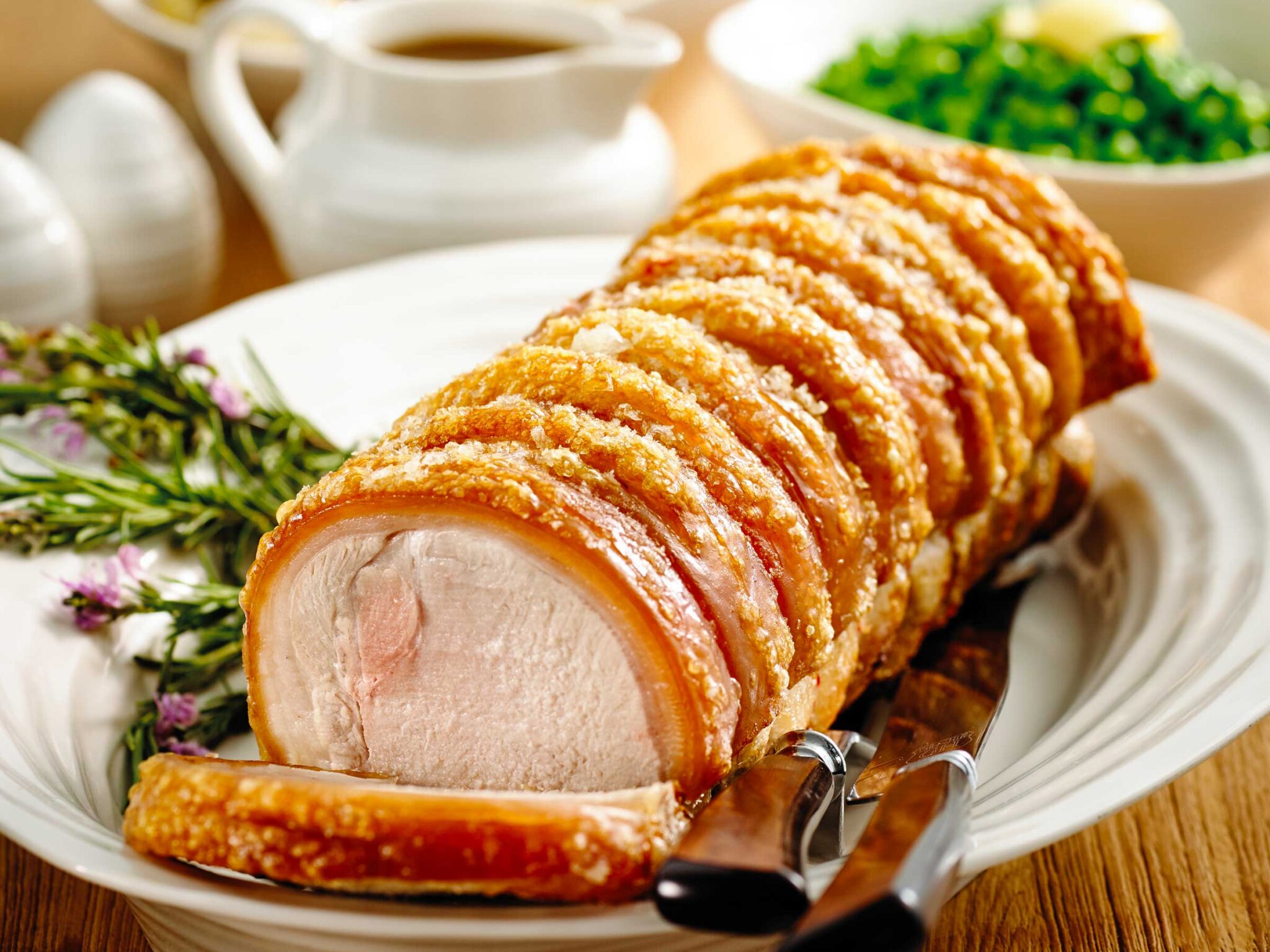
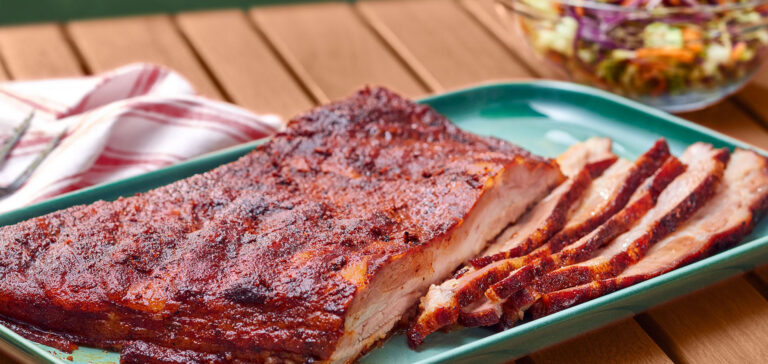
image courtesy of Australian pork
Ask the internet what temperature to cook a pork loin to and you get an argument. Google’s own People Also Ask box still surfaces “Should pork tenderloin be 145 or 160?” — fifteen years after the federal government answered it. The top organic results for the question are Reddit threads and Facebook posts, not publishers.
So this guide does something the ranking pages do not: it cites the primary documents. Every temperature, time and weight below comes from USDA, FSIS, the Code of Federal Regulations, CDC, or a land-grant Extension service, with the source and its date attached. Where those sources disagree with each other — and they do, in four separate places — we show the disagreement instead of averaging it away.
What temperature should pork loin be cooked to?
145 °F, with a three-minute rest. This is stated identically across every current federal consumer source we retrieved:
The FoodSafety.gov safe minimum internal temperature chart (page last reviewed November 21, 2024) lists pork steaks, roasts and chops at “145°F (63°C) Rest time: 3 minutes.”
FSIS “Fresh Pork From Farm to Table” (last updated December 10, 2024) says: “Cook all raw pork steaks, chops and roasts to a minimum internal temperature of 145 degrees F as measured with a food thermometer before removing meat from the heat source. For safety and quality, allow meat to rest for at least three minutes before carving or consuming.”
Two exceptions matter and almost nobody mentions the second one. Ground pork is 160 °F with no rest, because grinding distributes surface bacteria through the whole mass. And FSIS also specifies 160 °F for organ and variety meats — heart, kidney, liver, tongue, chitterlings. That is a live 160 °F pork instruction hiding in plain sight.


Why did USDA lower pork from 160°F to 145°F?
The change was announced on May 25, 2011 by Diane Van, then manager of the USDA Meat and Poultry Hotline, in “Cooking Meat? Check the New Recommended Temperatures”:
“USDA has lowered the recommended safe cooking temperature for whole cuts of pork from 160 ºF to 145 ºF with the addition of a three-minute rest time… It’s just as safe to cook cuts of pork to 145 ºF with a three-minute rest time as it is to cook them to 160 ºF, the previously recommended temperature, with no rest time.”
USDA gave three reasons: equivalence of lethality, harmonization with the standards FSIS already applies to federally inspected plants, and consumer simplicity — one number for all whole-muscle red meat.
One detail that appears on no page we audited: according to an NDSU Extension news release of the same date, the underlying research — a 2007 Ohio State consumer study and a Texas A&M risk assessment — was funded by the Pork Checkoff. That is not a scandal and it does not make the science wrong. It is simply never mentioned.
Is the three-minute rest actually required?
Here is the most interesting thing we found, and it is a genuine contradiction inside USDA’s own documents.
USDA tells consumers three minutes. FSIS tells meat plants four.
The FSIS Cooking Guideline for Meat and Poultry Products (Revised Appendix A), document ID FSIS-GD-2021-14, December 2021, contains Table 2 — “Time-Temperature Combinations for Meat Products to Achieve Lethality.” At 145 °F it requires a four-minute dwell for a 6.5-log reduction of Salmonella.
| Internal temp | °C | 6.5-log reduction | 7-log reduction |
|---|---|---|---|
| 130 °F | 54.4 | 112 min | 121 min |
| 135 °F | 57.2 | 36 min | 37 min |
| 140 °F | 60.0 | 12 min | 12 min |
| 144 °F | 62.2 | 5 min | 5 min |
| 145 °F | 62.8 | 4 min | 4 min |
| 150 °F | 65.6 | 67 sec | 72 sec |
| 155 °F | 68.3 | 22 sec | 23 sec |
| 157 °F | 69.4 | 14 sec | 15 sec |
| 158 °F | 70.0 | 0 sec | 0 sec |
| 160 °F | 71.1 | 0 sec | 0 sec |
Why this is a real contradiction rather than a category error: USDA itself claimed the equivalence, writing that the new consumer recommendation “reflect[s] the same standards that the agency uses for cooked meat products produced in federally inspected meat establishments.” And USDA’s own definition of rest closes the obvious escape hatch — it defines rest time as “the amount of time the product remains at the final temperature.” That describes an isothermal hold at 145 °F, which is exactly what Appendix A measures. So “carryover cooking covers the gap” is not available as a reconciliation under USDA’s own wording, even though in practice a roast’s center usually does drift upward during the rest.
And an independent land-grant institution has already picked a side. Clemson Home & Garden Information Center’s pork factsheet (last revised January 13, 2021) says four minutes — five separate times, with zero mentions of three. We verified this in a live browser on August 21, 2026. Examples, verbatim: “Cook whole muscle cuts of pork, such as chops and roasts to a minimum internal temperature of 145 °F with a 4-minute rest before carving.” Five consistent occurrences is an editorial decision, not a typo.
MONITOR
We found no FSIS document that explains why the consumer figure is three minutes and the establishment figure is four. Two honest caveats belong with this finding: Appendix A targets ready-to-eat commercial product, and for an intact whole-muscle cut, contamination is essentially a surface phenomenon — the exterior passes far above 145 °F long before the center arrives. That is a legitimate reason a consumer number could be less conservative. But no agency document says so. The discrepancy is verified; the reconciliation is not. If in doubt, rest four minutes — it costs you nothing.

What is the difference between pork loin and pork tenderloin?
They are different muscles from the same primal, and USDA’s fabrication spec explains the confusion better than any recipe site has.
From USDA AMS Institutional Meat Purchase Specifications, Fresh Pork — Series 400 (effective November 2014):
- Item No. 410, Pork Loin (bone-in): “The tenderloin shall remain intact.”
- Item No. 413, Loin, Whole, Boneless: “All skin, bones, cartilages, the tenderloin, and lean and fat overlying the blade bone shall be removed.”
- Item No. 415, Tenderloin: “This item is prepared from Item No. 410. The tenderloin shall be removed intact.”
Read those together and the picture is clear: a bone-in pork loin contains the tenderloin. The boneless pork loin in your supermarket is that same primal with the tenderloin cut out — and the tenderloin on the shelf beside it is the piece that was removed. They are not merely confusable neighbors. They are two halves of one fabrication step.
| Pork loin | Pork tenderloin | |
|---|---|---|
| Muscle | M. longissimus + M. multifidus dorsi | M. psoas major (+ psoas minor, removed) |
| Location on the hog | Dorsal — along the top of the back | Ventral — beneath the lumbar vertebrae |
| Job in the live animal | Postural / locomotor back muscle | Hip flexor, barely weight-bearing |
| USDA spec weight | 8–13+ lb (Item 413, whole boneless) | 1–2 lb (Item 415) |
| Target internal temp | 145 °F + rest | 145 °F + rest |
| USDA oven temp | 350 °F | 425–450 °F |
| USDA time | ~20 min per lb | 20–27 min total |
| Calories per 100 g raw, lean+fat | 198 kcal (FDC 167818) | 120 kcal (FDC 168312) |
| Fat per 100 g raw, lean+fat | 12.6 g | 3.53 g |
| Protein per 100 g raw | 19.7 g | 20.6 g |
The practical distinction is oven temperature, not internal temperature. Traeger publishes an entire page on pork loin versus pork tenderloin and concludes they “cook to the same internal temperature” — true, and it misses the useful half. FSIS specifies 350 °F for a loin and 425–450 °F for a tenderloin. A tenderloin is a small, lean, fast-cooking muscle that wants high heat and a short stay; a loin is a large roast that wants moderate heat and time.
Is pork loin fattier than tenderloin?
As purchased, yes — 198 kcal against 120 per 100 g, and 3.6 times the fat. But that comparison hides where the fat lives. Take USDA’s lean-only figures and the gap mostly closes: 143 kcal for loin (FDC 168230) against 120 for tenderloin (FDC 168249), at essentially identical protein.
In other words, most of a pork loin’s “fattiness” is the separable fat cap, not marbling inside the muscle. Trim the cap and you have a cut nutritionally close to tenderloin at a fraction of the price per pound. No nutrition comparison we audited makes this distinction.
One shelf note: FoodData Central carries a separate entry (FDC 168361) for enhanced pork tenderloin — brine-injected product, which dominates retail. Enhanced pork is already carrying salt solution, so it behaves differently if you brine it again. Check the label for a “contains up to X% solution” declaration before you add salt. Our dry-brining guide covers how to adjust.
What about trichinosis? Isn’t that why pork was cooked to 160°F?
It was. It is no longer a reason, on two independent grounds.
First, the parasite dies at 144 °F — instantly. The old federal trichina treatment table at 9 CFR 318.10 required 21 hours at 120 °F, 30 minutes at 130 °F, one minute at 140 °F, and listed 144 °F as instant. One degree below the temperature USDA now recommends.
Second, that regulation no longer exists. We loaded it live on August 21, 2026: eCFR renders 9 CFR 318.10 as “[Reserved]” — an empty section, with Title 9 last amended July 20, 2026. It was struck by the Federal Register rule of May 31, 2018, effective July 30, 2018, on the grounds that the prescriptive rules were “inconsistent with the Hazard Analysis and Critical Control Point (HACCP) regulations” and “no longer necessary.” Any 2026 article citing 9 CFR 318.10 as live authority is citing a repealed rule.
The epidemiology agrees. CDC (last reviewed September 10, 2024) reports “only about 15 confirmed cases per year” nationally, and notes that contaminated meat “comes from meat-eating animals such as bear, wild boar, or walrus.” CDC’s surveillance summary for 2008–2012 found 84 analyzed cases: pork products accounted for 22, of which 10 were linked to commercial pork. That is roughly two commercial-pork cases per year, nationally. Meats other than pork accounted for 45 cases — and 41 of those 45 were bear. For comparison, during 1947–1951 the United States averaged about 400 cases and 10–15 deaths a year.
The irony nobody has pointed out
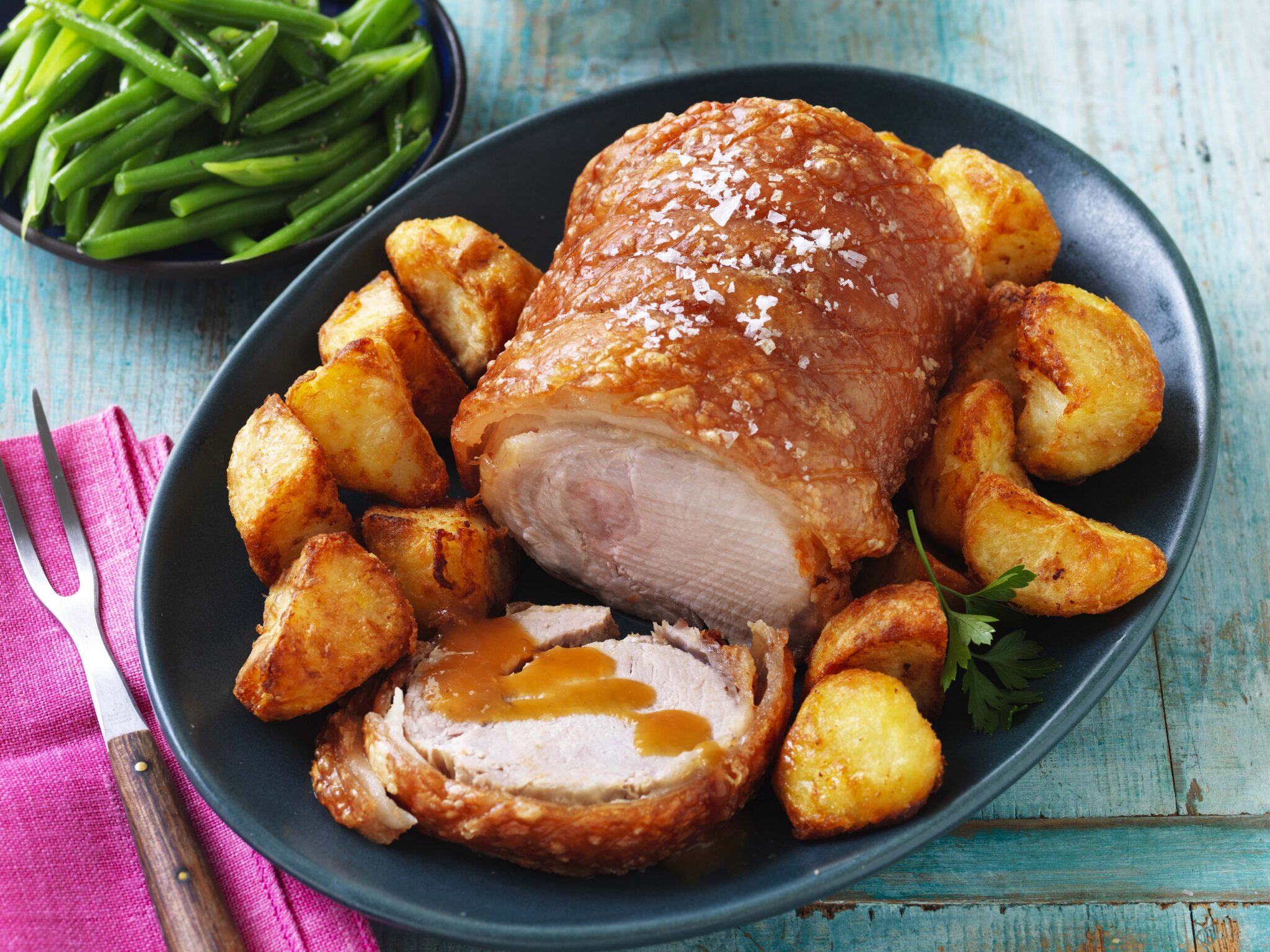
The same FoodSafety.gov chart that puts whole-muscle pork at 145 °F puts venison at 160 °F — no rest time, no whole-cut/ground distinction. A whole-muscle venison roast and a whole-muscle pork roast are the same kind of object, and the government separates them by 15 degrees.
Yet by CDC’s own numbers, wild game — not pork — is where trichinella actually lives today. The 160 °F rule has migrated onto the meats where it is now epidemiologically justified, while pork, whose supply chain earned the reduction, keeps 145 °F. The temperature tracks the animal’s husbandry, not the pathogen. Hunters can see how that plays out on the venison side in our sister guide at Popular Outdoorsman.
How long do you cook a pork loin?
This is where the institutions stop agreeing. For an identical 2 lb boneless loin at 350 °F:
| Source | Stated rate | 2 lb boneless loin | Tenderloin |
|---|---|---|---|
| FSIS, “Fresh Pork From Farm to Table” (Dec 10, 2024) | 20 min/lb | 40 min | 20–27 min total at 425–450 °F |
| Clemson HGIC (rev. Jan 13, 2021) | 20–30 min/lb | 40–60 min | 20–30 min total at 425–450 °F |
| National Pork Board (industry) | 26–28 min/lb (2 lb) | 52–56 min | 20–35 min at 425 °F |
There is a detail worth noticing in that table. Clemson’s chart is otherwise a near-copy of the FSIS chart — the crown roast, Boston butt, ribs and fresh ham rows are identical. The two rows that were changed are the loin row (20 → 20–30) and the tenderloin row (20–27 → 20–30), both edited in the direction of longer cooking. Somebody at Clemson deliberately revised exactly the two cuts this article is about.
Our advice: ignore minutes per pound and cook to temperature. Time-per-pound charts assume a shape, a starting temperature and an oven calibration that yours will not match. They are useful for planning dinner, not for deciding doneness. As FSIS puts it in “Doneness Versus Safety”: “Appearance and color are not reliable indicators of safety or doneness.”
Can you smoke a pork loin? What temperature?
You can, and FSIS’s “Smoking Meat and Poultry” page (last updated August 13, 2024) sets the envelope: keep the chamber “between 225 and 300 °F throughout the cooking process,” cook to 145 °F, rest three minutes, and refrigerate within two hours of removing it from the smoker.
Beyond that, the federal record is empty. We searched FSIS and six Extension domains: there is no institutional guidance addressing smoked pork loin as a distinct case — no smoker time estimate, no note about the cut’s leanness, no separate advice for tenderloin on a smoker. Any smoker time you read for pork loin, including ours, is craft practice rather than institutional guidance, and it should be labeled that way.
What the sources do support is a framework. Combine the 225–300 °F chamber window with FSIS’s Danger Zone definition (40–140 °F) and Appendix A’s recommendation to “limit the total time product temperature is between 50 and 130 °F to 6 hours or less,” and you have a defensible rule for a lean cut: run the chamber at the upper half of the window so the roast clears the danger zone briskly, and pull at 145 °F. A lean loin has no fat reserve to forgive an overshoot. For a step-by-step cook, see our smoked pork loin recipe, and check pull temperatures against the smoking times and temperatures chart.
One live error worth knowing about
While checking Extension sources we found a genuine mistake on a land-grant food-safety page. Illinois Extension’s meat temperatures chart, loaded live on August 21, 2026, reads:
Pork — All cuts including ground products: Medium 145 °F *, Well-done 145 °F * … Ground pork 160 °F
* after holding for 3 minutes
The heading assigns 145 °F to ground pork, and four rows later the same table says 160 °F. The page contradicts itself, and one of the two answers is contrary to USDA guidance. Ground pork must reach 160 °F — USDA’s 2011 announcement explicitly excluded ground meat: “This change does not apply to ground meats… which should be cooked to 160 ºF and do not require a rest time.” We flag it here because the chart is otherwise a source people reasonably trust.
What we would not tell you
Three things are repeated everywhere and we could not source any of them:
- “Carryover cooking adds 5–10 °F.” We searched FSIS, USDA, CDC and six Extension domains. No institutional source states a carryover figure, or even asserts that temperature rises after removal from heat. USDA’s only statement on the physics implies the opposite — that the meat “remains at the final temperature.” The effect is real in any kitchen; the number is not sourced.
- “Pull at 140 °F and let carryover finish it.” A YouTube short advocating this currently ranks on page one for pork loin temp. It contradicts the USDA minimum on its face and has no institutional support.
- “A typical pork loin roast is 2–5 lb.” That is a roasting-chart bracket, not a specification. USDA’s actual spec for a whole boneless loin is 8–13+ lb; retail loins are cut down from it. We cite the spec as a spec and the chart as a chart.
How this guide was made: research-based, not a kitchen test. Every temperature, time, weight and case count above was retrieved from the linked primary source and is dated. Where we verified a claim by loading a page in a live browser rather than an automated fetch, we say so. Reviewed and edited by James Nicholas.
Frequently Asked Questions
What temperature should pork loin be cooked to?
145 °F, followed by a three-minute rest, per FoodSafety.gov and USDA/FSIS. That is the current consumer-facing standard and has been since USDA lowered pork from 160 °F, as covered above.
Do you really need to rest pork loin for the full three minutes?
FSIS’s own consumer guidance says yes, but as this article notes, FSIS’s internal Appendix A compliance table for processors lists a shorter dwell time at 145 °F than the three minutes given to home cooks — a real discrepancy between the two documents, not a typo we’re inventing. The three-minute figure is the one to follow at home.
What is the difference between pork loin and pork tenderloin?
They are different cuts under USDA’s own IMPS specifications (loin vs. tenderloin have separate spec numbers), not the same muscle sold under two names. The loin is the larger, fattier cut; the tenderloin is the narrower, leaner one — see the cut-by-cut breakdown above for the spec-level detail.
Do you still need to worry about trichinosis in pork?
Not the way older cooking advice suggests. The 160 °F rule that many people still repeat dates to when trichinosis was a real risk in commercial pork; that risk is now rare in USDA-inspected pork, which is why the safe minimum came down to 145 °F. The history of that change, and why some older sources haven’t caught up, is covered above.

Reader Favorites
- Budget-Friendly BBQ Tips: Master Savings Now!
- Easy BBQ Foods: Grill Like a Pro with These 10 Recipes
- Cleaning Your Gas Grill Cooking Grate: Make it Great Again
- Stainless Steel BBQ Grill Cleaning: Master Maintenance Now
- Best Beef Breeds: Pick The Best For Smoking Now
- Lid Open or Closed: Master Your Grill Heat Now
BBQ Temperature Charts & Guides
Four quick-reference tools every cook bookmarks — target temps, pull temps, and how long leftovers keep, plus the full BBQ glossary.
| Cut | Pull | Time |
|---|---|---|
| Brisket | 203°F | 12–16h |
| Spare ribs | 195–203°F | ~6h |
| Pork butt | 203°F | 12–14h |
Target temps & times for 17 cuts, sortable by meat, weight and doneness.
View full chart →| Doneness | Target |
|---|---|
| Rare | 125–130°F |
| Medium-rare | 130–135°F |
| Well-done | 160°F+ |
Rare to well-done, burger safety (160°F) and resting times.
View full chart →| Food | Fridge | Freezer |
|---|---|---|
| Brisket, ribs | 3–4 days | 2–3 mo |
| Smoked sausage | 1 week | 1–2 mo |
| Potato salad | 3–4 days | no freeze |
How long smoked meats & sides keep — fridge and freezer, USDA-based.
View full chart →Every pit term decoded — cooking methods, gear, cuts, wood, and technique, A to Z.
Open the glossary →