Kamado Grills: Specs, Prices and Warranties Compared
A kamado is a thick-walled ceramic or insulated-steel charcoal cooker with a hinged dome and adjustable vents, starting around $330.
A kamado is a thick-walled ceramic or insulated-steel charcoal cooker with a hinged dome and adjustable top and bottom vents. Current models run from about $330 for a painted-steel AKORN to $4,640 for a Komodo Kamado, with the mainstream ceramic 18-inch class at $999 to $2,199. Every manufacturer in this comparison caps its warranty at the original purchaser, and four of seven make product registration a condition of coverage.
The parts that matter
- No manufacturer publishes ceramic wall thickness. Not Big Green Egg, Kamado Joe, Primo, Vision, or Louisiana Grills. Every insulation and fuel-efficiency claim in this category is unmeasured marketing copy as far as we could source it.
- The gasket is where warranties diverge most. Kamado Joe covers it for 2 years, Big Green Egg and Vision for 1 year, and Primo for 30 days.
- No kamado warranty here transfers to a second owner, and Big Green Egg states that failing to register the grill invalidates the warranty outright.
- The firebox is the part most likely to crack, and it is the part you currently cannot reliably buy. On August 19, 2026, Big Green Egg listed the Large firebox as unavailable and Kamado Joe’s Classic multi-piece firebox as no longer available.
- Kamado Joe’s own product page says its 18-inch deflector plates fit the Large Big Green Egg. The ecosystem is less closed than either company’s marketing implies.
- Big Green Egg’s MiniMax costs $356 more than the Small for the identical 13-inch grid and identical 133 square inches of cooking area.
Prices, stock status and warranty terms verified August 19, 2026. Prices move; the warranty terms rarely do.
What is a kamado grill?
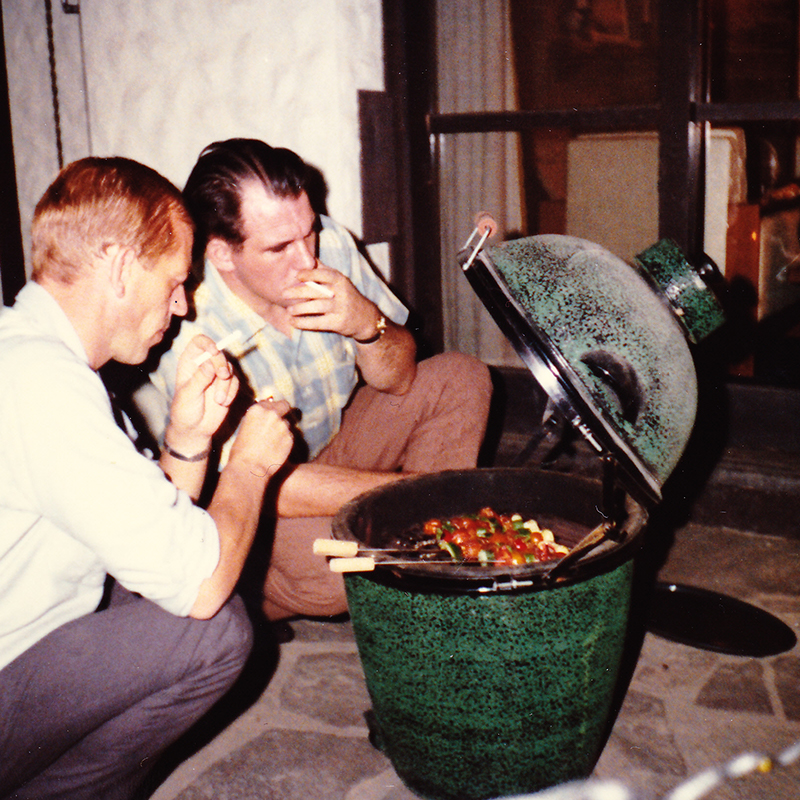
“Kamado” is the Japanese word for a stove or cooking range — literally a place for the cauldron. The modern outdoor version descends from the mushikamado, a round clay pot with a removable domed lid found in southern Japan, which came to American attention after the Second World War.
Big Green Egg’s own company history credits founder Ed Fisher, a Navy veteran, with opening The Pachinko House in Atlanta in 1974 to import and sell them, and with renaming the product after its shape. By the early 1980s Fisher had partnered with a Mexican ceramic manufacturer for mass production, and Big Green Egg has stated that its grills have been made in Mexico “for more than 25 years.”
Two claims you will read constantly are not supported by anything we could find. The first is that kamados are a 3,000-year-old Chinese design; the sourced account routes the precursor from the Korean peninsula to Japan during the Kofun period, and the retailer page asserting the Chinese origin cites nothing at all. The second is that a man named Richard Johnson brought the kamado to America; no encyclopedia, museum, academic source, or manufacturer history page we checked names him, and the one page dedicated to the claim would not load on an expired certificate.
One more thing: Big Green Egg contradicts itself on its founding story. One page on biggreenegg.com says Fisher discovered the cooker “during WWII”; another says American servicemen discovered it after the war and that Fisher, a Navy veteran, opened his first store in 1974.
Kamado grill specs, prices and warranties compared
Twenty-seven current models. Specifications come from each manufacturer’s own product pages, brochures and warranty documents. Prices are the figure shown on the named site on August 19, 2026. Click any column heading to sort. “Not published” means exactly that — the manufacturer does not publish the number, and we did not fill the hole with an estimate.
| Brand | Model | Body | Grid (in) | Primary area (sq in) | Weight (lb) | Published temp range (F) | Body warranty | Gasket warranty | Price (USD) | Price source | Stock 8/19/26 |
|---|---|---|---|---|---|---|---|---|---|---|---|
| Big Green Egg | MiniMax | Ceramic | 13 | 133 | 76 | 200–750 | Limited lifetime | 1 year | $849.99 | biggreenegg.com | In stock |
| Big Green Egg | Small | Ceramic | 13 | 133 | 80 | 200–750 | Limited lifetime | 1 year | $493.99 | biggreenegg.com | Sold out |
| Big Green Egg | Medium | Ceramic | 15 | 177 | 114 | 200–750 | Limited lifetime | 1 year | $899.99 | biggreenegg.com | In stock |
| Big Green Egg | Large | Ceramic | 18.25 | 262 | 162 | 200–750 | Limited lifetime | 1 year | $1,199.99 | biggreenegg.com | In stock |
| Big Green Egg | XL | Ceramic | 24 | 452 | 219 | 200–750 | Limited lifetime | 1 year | $1,649.99 | biggreenegg.com | In stock |
| Big Green Egg | 2XL | Ceramic | 29 | 672 | 375 | 200–750 | Limited lifetime | 1 year | $2,799.99 | biggreenegg.com | In stock |
| Kamado Joe | Joe Jr | Ceramic | 13.5 | 150 | 82.5 | up to 750 | Lifetime (dome and base) | 2 years | $499.99 | kamadojoe.com | In stock |
| Kamado Joe | Classic Joe I | Ceramic | 18 | 250 | 227.7 | 225–750 | Lifetime (dome and base) | 2 years | $999.99 | kamadojoe.com | In stock |
| Kamado Joe | Classic Joe II | Ceramic | 18 | 250 | 227.7 | 225–750 | Lifetime (dome and base) | 2 years | $1,499.99 | kamadojoe.com | Sold out |
| Kamado Joe | Classic Joe III | Ceramic | 18 | 250 | 280.6 | 225–750 | Lifetime (dome and base) | 2 years | $2,199.99 | kamadojoe.com | Listed |
| Kamado Joe | Big Joe II | Ceramic | 24 | 450 | 407.4 | 225–750 | Lifetime (dome and base) | 2 years | $2,299.99 | kamadojoe.com | In stock |
| Kamado Joe | Big Joe III | Ceramic | 24 | 450 | 406.3 | 225–750 | Lifetime (dome and base) | 2 years | $3,299.99 | kamadojoe.com | In stock |
| Kamado Joe | Konnected Joe | Ceramic | 18 | Not published | Not published | Not published | Lifetime (dome and base) | 2 years | $1,999.99 | kamadojoe.com | In stock |
| Kamado Joe | Big Joe Konnected Joe | Ceramic | 24 | Not published | Not published | Not published | Lifetime (dome and base) | 2 years | $2,999.99 | kamadojoe.com | In stock |
| Primo | Oval XXL 500 | Ceramic (oval) | Not published | 500 | 282 | 151–850+ | Limited lifetime | 30 days | $2,199.00 | Grillio | Listed |
| Primo | Oval XL 400 | Ceramic (oval) | Not published | 400 | 250 | 151–850+ | Limited lifetime | 30 days | $1,699.00 | BBQGuys | In stock |
| Primo | Oval LG 300 | Ceramic (oval) | Not published | 300 | 152 | 151–850+ | Limited lifetime | 30 days | $1,299.00 | Grillio | Listed |
| Primo | Oval Jr 200 | Ceramic (oval) | Not published | 210 | 100 | 151–850+ | Limited lifetime | 30 days | $999.00 | Grillio | Listed |
| Primo | Large Round | Ceramic | Not published | 280 | 200 | 151–850+ | Limited lifetime | 30 days | $999.00 | Grillio | Listed |
| Weber | Summit Kamado E6 | Insulated steel | 24 | 452 | Not published | Not published | 10 yr bowl/lid/ring | 2 years | $1,399.00 | weber.com | Not stated |
| Weber | Summit Kamado S6 | Insulated steel | 24 | 452 | Not published | Not published | 10 yr bowl/lid/ring | 2 years | $2,399.00 | weber.com | Not stated |
| Char-Griller | AKORN 20 in | Painted steel | 20 | 325 (445 total) | 84.4 | 200–700 | 5 yr site / 1 yr retailer | 1 year | $329.99 | homedepot.com | Listed |
| Vision Grills | Kamado S-Series 22 in | Ceramic | 22 | 604 (two tiers) | 191 | Not published | Limited lifetime | 1 year | $799.00 | homedepot.com | In stock |
| Vision Grills | Professional C-Series | Ceramic | 18.875 | 604 (356 + 239) | 227 | Not published | Limited lifetime | 1 year | $899.00 | bbqguys.com | Sold out |
| Blaze | 20 in Cast Aluminum Kamado | Cast aluminum | 20 | 400 | 161 | Not published | Lifetime (all parts) | Not itemized | $2,069.10 | bbqguys.com | In stock |
| Louisiana Grills | K24 Ceramic 24 in | Ceramic | Not published | 689.56 (tiers unstated) | Not published | up to 700 | Not published | Not published | $1,539.99 | louisiana-grills.com | Sold out |
| Komodo Kamado | 23 in Ultimate | Refractory + 304 stainless | 23 | 978 (three levels) | 548 | Interior rated 2,200 | Not published | Not published | $4,640.00 | komodokamado.com | Preorder on many variants |
Download the full dataset (CSV) — 27 models, 18 fields, including shell thickness, transferability, registration requirement and country of manufacture.
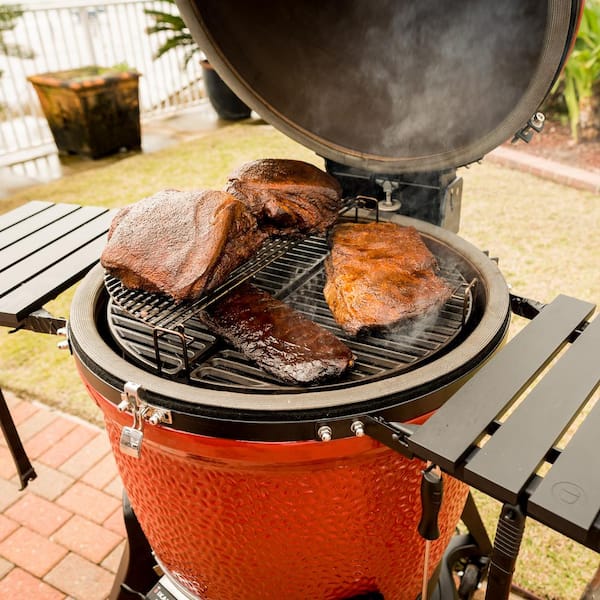
Why cooking-area numbers are not comparable across brands
This is the single most abused specification in the category, and it is worth understanding before you compare anything.
Big Green Egg publishes 262 square inches for its 18.25-inch Large. Kamado Joe publishes 250 square inches for its 18-inch Classic. Those are both primary-grate figures and they are comparable. But Vision publishes 604 square inches for a 22-inch grill by counting two tiers, Komodo Kamado publishes 978 square inches by counting three, and Louisiana Grills publishes 689.56 square inches for a 24-inch body without saying how many tiers that includes.
The distortion is easy to see at the extreme. Komodo Kamado’s own site lists 978 square inches for the 23-inch Ultimate; a long-standing third-party review of the same grill lists 415, because it counts one level. Same grill, a 2.4x difference, and neither number is wrong — they are answering different questions.
Kamado Joe’s position is stranger still. Its comparison marketing argues it beats Big Green Egg on cooking surface through its two-level Divide & Conquer system, while publishing a smaller primary number than Big Green Egg and never publishing a total-with-accessories figure at all.
Practical rule: compare grid diameter first, primary square inches second, and treat any “total cooking area” number as a marketing figure unless the manufacturer says how many racks it counts.
Which kamado warranty actually covers the parts that fail?
Every ceramic kamado sold in the US carries a lifetime or limited-lifetime warranty on the ceramic. That headline is nearly identical across brands and it is nearly useless as a comparison, because the ceramic dome is not usually what fails. The bands, the hinge, the gasket and the firebox are.
Here is what the actual warranty documents say about those parts.
| Brand | Body | Bands and hinge | Gasket | Transfers to second owner? | Registration required for coverage? |
|---|---|---|---|---|---|
| Big Green Egg | Limited lifetime | 5 years, structural integrity only; “adjustment or alignment of parts” excluded | 1 year | No — “This limited warranty is non-transferable” | Yes — failure to register “will invalidate your Warranty” |
| Kamado Joe | Lifetime, dome and base | 5 years | 2 years | No | Yes |
| Primo | Limited lifetime | 5 years, rust-through | 30 days | Original purchaser only | No — registration is voluntary |
| Weber Summit Kamado | 10 years, bowl/lid/center ring, rust or burn through | 2 years (“all remaining parts”) | |||
| 2 years | No | No — coverage “not dependent on when you register” | |||
| Vision Grills | Limited lifetime — but “cracks” and “crazing” are expressly excluded | 5 years | 1 year | No | Yes, within 30 days, with dated receipt |
| Char-Griller AKORN | 5 years hood and bottom per chargriller.com; 1 year per the Home Depot listing | 1 year | 1 year | No | Yes — “Grills must be registered to file a warranty claim” |
| Blaze | Lifetime | Lifetime | Not itemized | Not addressed | Yes, within 30 days |
Four things fall out of that table that no buying guide we found has published:
- A used kamado carries no manufacturer warranty from any of these brands. All of them limit coverage to the original purchaser. Big Green Egg goes further, stating on its dealer policy page that it “does not extend warranty coverage to products once they are resold by unauthorized resellers or resold by private parties.”
- Big Green Egg excludes the most common service event on its own product. Its exclusion list covers “replacement due to adjustment or alignment of parts,” which is precisely what a loosening band is. A replacement band and hinge assembly for a Large lists at $189.99 at Ace Hardware — 16% of the $1,199.99 grill.
- Primo’s 30-day gasket term is the shortest consumable coverage in the category by a factor of twelve, and Primo also conditions its coverage on documented maintenance, including “check and tighten bolts several times per season and after each high heat cook.”
- Vision’s lifetime ceramic warranty excludes “scratches, cracks, chips, dents, crazing” — on a product whose headline feature is the lifetime ceramic warranty. Vision’s own manual and the Home Depot listing also disagree on side shelves: 90 days in the manual, three years on the retail page.
Weber is the outlier in a way worth naming. Its Summit Kamado is the only unit here whose body coverage is a defined ten years against a defined failure mode, rather than an open-ended “lifetime” with a structural-integrity carve-out, and it is the only brand besides Primo that does not condition coverage on registration.
What does a kamado cost to keep running?
Consumable and replacement-part prices, checked August 19, 2026.
| Part | Brand | Price | Availability on 8/19/26 |
|---|---|---|---|
| Ultra Performance gasket kit (2XL/XL/Large) | Big Green Egg | $39.99 | In stock |
| Series I gasket kit | Kamado Joe | $31.99 | Listed |
| Wire mesh gasket kit, Series II and III | Kamado Joe | $112.99 | Listed |
| convEGGtor, Large | Big Green Egg | $99.99 | In stock |
| Half-moon deflector plates, set of two | Kamado Joe | $79.99 | In stock |
| Fire ring, Large | Big Green Egg | $89.99 | In stock |
| Fire box, Large | Big Green Egg | $179.99 | Unavailable for purchase |
| Multi-piece firebox, Classic 18 in | Kamado Joe | $200.93 | Out of stock, “no longer available” |
| One-piece ceramic firebox, Big Joe | Kamado Joe | $85.00 | Out of stock, flagged obsolete |
| Firebox base, Classic Joe | Kamado Joe | $37.99 | Listed |
| Stainless firebox ring | Kamado Joe | $37.99 | Sold out |
| Band and hinge assembly kit, Large | Big Green Egg | $189.99 (Ace Hardware) | Not stated |
| Kontrol Tower top vent | Kamado Joe | $74.99 | Listed |
| Cast iron fire grate | Kamado Joe | $62.99 | Listed |
Two findings there deserve to be pulled out.
The firebox is the part most commonly reported to crack, and on the day we checked it was the part you could not reliably buy from either market leader. Big Green Egg’s Large firebox was listed as unavailable for purchase, Kamado Joe’s Classic multi-piece firebox as no longer available, and the Big Joe one-piece ceramic firebox as obsolete. Big Green Egg’s site carried a standing notice that some ceramic accessory orders were taking longer than usual. A lifetime ceramic warranty is worth less when the covered part is not in the catalog.
Kamado Joe’s newer grills cost more to maintain than its older ones. The Series II and III wire-mesh gasket kit is $112.99 against $31.99 for the Series I kit — 3.5x — and 2.8x the $39.99 Big Green Egg kit. That is a recurring cost, not a one-time one, and nobody discloses it at the point of sale.
One gap we will not paper over: no manufacturer publishes a gasket replacement interval. Big Green Egg’s own copy says only to replace it “in time” after long and intensive use. Owner comments on that page range from three years to eighteen. That is anecdote, not a spec, and we are not going to convert it into one.
Are you locked into one brand’s accessories?
Less than the marketing implies, and the evidence comes from one of the manufacturers.
Kamado Joe’s own product page for its half-moon deflector plates states that the Classic 18-inch set fits “Kamado Joe Classic Joe series, Kamado Joe Konnected Joe, Large Big Green Egg, and other 18-inch round charcoal grills,” and that the Big Joe 24-inch set fits the XL Big Green Egg. One manufacturer explicitly markets its ceramic deflectors as fitting its main competitor’s grills.
Big Green Egg does not reciprocate — the convEGGtor is sold per size and is not cross-listed for other brands — but the practical point stands: on the two most common diameters, 18 and 24 inches, the deflector market is more open than either company’s comparison page suggests.
Do kamados really burn one-third the charcoal?
We could not source that claim to anyone.
Not Big Green Egg, not Kamado Joe, not Primo, not Weber, not Vision, not Char-Griller. What the manufacturers actually say is unquantified: Kamado Joe writes that a kamado “uses less charcoal due to superior insulation” with no measurement or comparison basis; Weber says its insulated steel minimizes “the amount of charcoal burned” with no quantity or baseline; Char-Griller claims “fuel efficiency for longer burn times” with no number. Big Green Egg’s nearest statement is the unquantified superlative “no smoker performs more efficiently,” and its FAQ does not address fuel consumption at all.
The only quantified “one-third” claim we found anywhere in the category is a retailer’s line that lump charcoal produces one-third the ash of briquettes — a statement about ash volume, not fuel consumption, and itself uncited. That looks like the origin of the folklore.
The deeper problem is that we could not locate a single published measurement of kamado ceramic thermal mass, thermal conductivity, R-value, or heat-retention rate from any manufacturer, standards body, university, or accredited independent lab. No manufacturer publishes ceramic wall thickness either. The only heat-loss experiment we surfaced was published by a kamado manufacturer, which disqualifies it as evidence. Consumer Reports does test kamados, but its published methodology is outcome-based — a thin-crust pizza test and a low-and-slow pork shoulder test — and its numeric results are behind a paywall.
So the honest statement is this: kamados demonstrably hold temperature well in practice, and every hard claim about how much better they are appears to be unmeasured. If a manufacturer publishes a real figure, we will add it here.
Will a ceramic kamado crack in cold weather?
This is where the folklore diverges hardest from the documents, and the answer surprised us.
We read the owner’s manuals. The Big Green Egg 2XL manual contains no cold-weather warning, no thermal-shock warning, no rapid-temperature-change warning, no warning about adding cold food or liquid to hot ceramic, and no cracking warning. Neither does the Kamado Joe Classic III manual. Neither does the Vision manual. Big Green Egg’s FAQ page does not address cold weather, cracking, or thermal shock either.
What the manuals do warn about is flashback. Kamado Joe’s manual: “When cooking above 350°F (175°C), carefully open the grill (or burp the grill) each time you lift the grill dome to prevent flashback – a surge of white-hot heat caused by a rush of oxygen.” Vision’s manual gives the same warning at 500°F and tells you to open both vents first. Big Green Egg’s manual warns about over-firing: “When flame spills out of the EGG, you are over-firing.”
Cracking appears in these documents in only one place: the warranty exclusions. Big Green Egg excludes “breakage or cracks or other damage from dropping, improper storage, misuse or abuse.” Vision excludes “scratches, cracks, chips, dents, crazing” outright.
In other words the safety documents and the warranty documents are answering two different questions. The documented operator hazard is a burn from flashback. The documented financial hazard is a crack that nobody warns you how to avoid and nobody covers.
Carbon monoxide: what CPSC actually says
Charcoal in an enclosed space kills people, and this is the one part of the guide where the primary source is unambiguous.
CPSC Publication 465, “Charcoal Grill Safety Tips”: “Burning charcoal inside can kill you. It gives off carbon monoxide, which has no odor. NEVER burn charcoal inside homes, vehicles or tents.” CPSC’s 1999 news release goes further: “Charcoal should never be used indoors, even if ventilation is provided.” That release cited roughly 20 deaths and 400 emergency-room-treated injuries per year from charcoal-grill carbon monoxide — figures from 1999, which we are not presenting as current.
CPSC’s guidance specifically covers grilling in garages, cooking in tents, and bringing a warm grill into a camper or vehicle, and notes that coals take a long time to fully extinguish.
Kamado Joe and Char-Griller both print a titled CARBON MONOXIDE HAZARD block on the first page of their manuals; Vision Grills carries a real but much weaker one-sentence warning inside a placement paragraph. Big Green Egg prints none. We checked fifteen Big Green Egg documents covering every size the company makes — Mini, MiniMax, Small, Medium, Large, XLarge and 2XL, in both model and pre-assembly versions — and none contains the phrase “carbon monoxide.” The manuals carry no safety prose at all; each points the owner to a single line, “CAUTION: SEE SAFETY NOTICE — www.biggreenegg.com/safetytips.” That page does not mention carbon monoxide either. On indoor use it says only: “Be cautious about using the Egg indoors, adhering to building codes and safety requirements.” Owners do still meet a carbon monoxide warning — on the charcoal bag, because 16 CFR 1500.14(b)(6) requires it of the fuel. That is a legal mandate on charcoal, not a Big Green Egg safety decision.
On recalls: we found no CPSC recall of any kamado grill. We are stating that as “no recall found in searches conducted August 19, 2026,” not as a verified negative, because CPSC’s recall search endpoint is closed to automated queries and SaferProducts.gov’s public search could not be run programmatically.
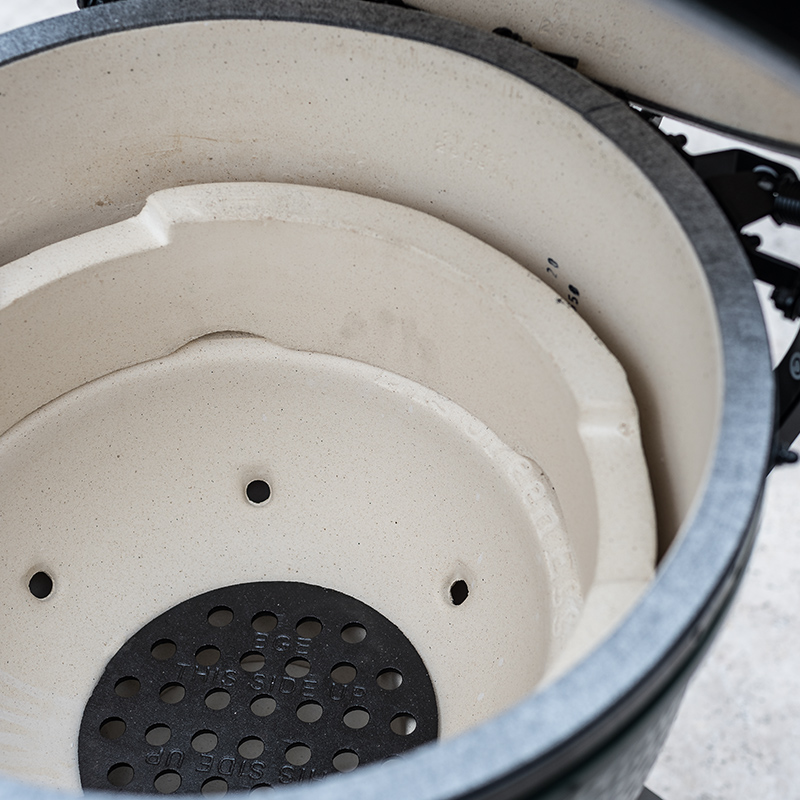
Kamado Joe vs Big Green Egg: what each company publishes
Both companies publish a comparison page. Neither publishes a price, a warranty term, or a weight on it.
Kamado Joe’s comparison table claims 20-minute assembly against 60 to 90 minutes for Big Green Egg, one box against multiple boxes, a patented slide-out ash drawer against “not available,” and a lid that lifts “with one finger” against “19 lbs of force required.” The 19-pound figure carries no source, no methodology and no instrumentation, and it is published by the manufacturer of one of the two products. It is the most attackable claim on the first page of that search result.
A more useful, sourced number on assembly burden: Big Green Egg charges $149 for White Glove Assembly, listed on its 2XL and MiniMax pages.
The differences you can actually verify from the two companies’ own documents:
- Cooking area, primary grate: BGE Large 262 sq in at 18.25 in; KJ Classic 250 sq in at 18 in. BGE XL 452 sq in at 24 in; KJ Big Joe 450 sq in at 24 in. Effectively a tie.
- Weight: the Big Joe II is 407.4 lb against 375 lb for the BGE 2XL — the Kamado Joe is heavier despite having 222 fewer square inches.
- Gasket coverage: Kamado Joe 2 years, Big Green Egg 1 year.
- Consumable cost: BGE’s gasket kit $39.99, Kamado Joe’s Series II/III kit $112.99.
- Country of manufacture: Big Green Egg publishes it (Mexico, and says so directly). Kamado Joe does not publish it anywhere we could find.
- Cart and shelves: included on Kamado Joe’s Classic and Big Joe carts; sold separately on Big Green Egg.
One more oddity from Kamado Joe’s own site: the Classic Joe I and Classic Joe II are both listed at 227.7 lb with identical 46.2 x 47.6 in dimensions, despite being different generations with different hardware.
How to choose a size
Diameter, not square inches, is the number that decides what fits.
- 13 to 13.5 in (133 to 150 sq in) — BGE MiniMax and Small, Kamado Joe Joe Jr. One pork butt, four to six burgers, a spatchcocked chicken at a squeeze. Note the pricing: the BGE MiniMax at $849.99 and the Small at $493.99 have the identical 13-inch grid and identical 133 sq in of cooking area. The $356 premium buys a different stand and portability, not cooking surface.
- 15 in (177 sq in) — BGE Medium. Actually a two-to-four-person grill.
- 18 to 18.25 in (250 to 262 sq in) — BGE Large, Kamado Joe Classic. This is the volume class of the category for a reason: a full brisket fits diagonally, two racks of ribs fit with a rib rack, and the accessory market is deepest here.
- 20 to 22 in — Char-Griller AKORN, Blaze, Vision S-Series. The AKORN at $329.99 is the only way into a kamado-style cooker for under $400, and it is steel rather than ceramic, so it heats faster, weighs 84 lb instead of 200-plus, and its manual warns “some rust may appear over time.”
- 24 in and up (450 to 672 sq in) — BGE XL and 2XL, Kamado Joe Big Joe, Weber Summit Kamado, Louisiana Grills K24. Two briskets. Also 375 to 407 lb of grill; plan the delivery before you plan the cook.
If you are cross-shopping a kamado against a pellet cooker, the honest framing is that they solve different problems: a kamado gets to 700–750°F for searing and pizza, which no pellet grill in the consumer class does, and a pellet grill holds a set temperature without you touching a vent. Our guide to fixing the stall on a pellet smoker covers the other half of that trade.
What nobody publishes
These are gaps, not answers. We are listing them because a buying guide that pretends the data exists is worse than one that admits it does not.
- Shell or wall thickness for any ceramic kamado — Big Green Egg, Kamado Joe, Primo, Vision and Louisiana Grills all omit it.
- Any measurement of ceramic thermal performance from a manufacturer, standards body, university or accredited lab.
- Weber Summit Kamado weight and maximum temperature — neither appears on either product page.
- Vision Grills and Blaze maximum temperature — not published.
- Primo dimensions for every model — absent from the product pages and from the January 2024 brochure. Primo’s “optional rack system” figures are also smaller than the primary areas they supposedly add to, and Primo never states whether they are additional or replacement.
- Kamado Joe country of manufacture, and Komodo Kamado, Vision and Louisiana Grills likewise.
- Kamado Joe total cooking area with Divide & Conquer — never published as a number.
- Gasket replacement interval — no manufacturer publishes one.
- Kettle Joe status — kamadojoe.com/products/kettle-joe returns a 404 and the model appears in no current collection, but we found no discontinuation announcement. Treat it as discontinued by inference, not by statement.
Prices move; check before you buy
Three prices for the same grill on the same day is normal here. The Kamado Joe Big Joe II was $2,299.99 on kamadojoe.com, $1,935.12 at Home Depot and $2,199 at Grillio on August 19, 2026. The Classic Joe III was $2,199.99 direct, $2,199.00 at Home Depot and $1,999 at Grillio.
Be careful with the channel, though. Big Green Egg’s dealer policy states it “does not extend warranty coverage to products once they are resold by unauthorized resellers,” and that it does not authorize distribution “through discount club stores, shopping clubs, wholesale clubs, or other discount chain stores, or through any e-commerce sites other than biggreenegg.com.” On a brand whose warranty is already non-transferable and registration-conditional, where you buy is a warranty decision, not just a price decision.
How this guide was made. Specifications, warranty terms and manual language were read directly from each manufacturer’s own product pages, warranty pages and owner’s manuals. Prices and stock status were recorded from the named site on August 19, 2026. Safety guidance comes from CPSC’s published documents. I do not test grills, and nothing here is presented as a test result or a first-hand impression. Where a manufacturer does not publish a number, this guide says so rather than estimating it. Researched and written by James Nicholas, edited by the Popular BBQ team.
Frequently Asked Questions
What is a kamado grill and what does it cost?
A kamado is a thick-walled ceramic or insulated-steel charcoal cooker with a hinged dome and adjustable top and bottom vents. Current models run from about $330 for a painted-steel AKORN to $4,640 for a Komodo Kamado, with the mainstream ceramic 18-inch class priced $999 to $2,199.
Do kamado warranties transfer to a new owner?
No, not on any brand covered in this comparison. Every manufacturer caps its warranty at the original purchaser, and Big Green Egg states outright that failing to register the grill invalidates the warranty.
What part of a kamado grill fails most often?
The firebox, and as of August 19, 2026 it was also the hardest part to buy as a replacement — Big Green Egg listed its Large firebox as unavailable, and Kamado Joe’s Classic multi-piece firebox was no longer available either.
Do Kamado Joe and Big Green Egg parts interchange?
Partially. Kamado Joe’s own product page states that its 18-inch deflector plates fit the Large Big Green Egg, which means the ecosystem is less closed than either company’s marketing suggests.
Sources
- Manufacturer product pages and warranty terms: Big Green Egg, Kamado Joe, Primo, Weber, Char-Griller, Blaze, Komodo Kamado, Louisiana Grills
- Owner’s manuals: Big Green Egg 2XL, Kamado Joe Classic III (KJ15040921), Vision Grills M8J3H1, Char-Griller AKORN 6719/E16620/96719
- CPSC Publication 465, Charcoal Grill Safety Tips
- CPSC News Release 99-051, January 15, 1999
- Retail pricing checked August 19, 2026 at biggreenegg.com, kamadojoe.com, weber.com, homedepot.com, bbqguys.com, acehardware.com, louisiana-grills.com, komodokamado.com and Grillio
- Big Green Egg company history and Big Green Egg Europe manufacturing statement (July 19, 2018)
Related on Popular BBQ: Smoking times and temperatures master chart · How to use a charcoal grill · What is barbecue, really? · Big Green Egg pork butt · Reverse sear steak
Across the Brand Avalanche network: Current Homesteading’s canning and preserving guide · Popular Outdoorsman on food plots for deer
Last verified: August 19, 2026. Prices and stock status are checked monthly; warranty terms are checked when a manufacturer revises them.
Reader Favorites
- Essential BBQ Tools: Get The Tools Pros Recommend Now
- Cleaning Your Gas Grill Cooking Grate: Make it Great Again
- Stainless Steel BBQ Grill Cleaning: Master Maintenance Now
- Grill Baskets: Smoky Veggies & Fish Made Easy
- How to Grill Pizza: Stone or Grates? Tips & Tricks
- Black Friday: Find BBQ Deals for You Outdoor Chef Now
BBQ Temperature Charts & Guides
Four quick-reference tools every cook bookmarks — target temps, pull temps, and how long leftovers keep, plus the full BBQ glossary.
| Cut | Pull | Time |
|---|---|---|
| Brisket | 203°F | 12–16h |
| Spare ribs | 195–203°F | ~6h |
| Pork butt | 203°F | 12–14h |
Target temps & times for 17 cuts, sortable by meat, weight and doneness.
View full chart →| Doneness | Target |
|---|---|
| Rare | 125–130°F |
| Medium-rare | 130–135°F |
| Well-done | 160°F+ |
Rare to well-done, burger safety (160°F) and resting times.
View full chart →| Food | Fridge | Freezer |
|---|---|---|
| Brisket, ribs | 3–4 days | 2–3 mo |
| Smoked sausage | 1 week | 1–2 mo |
| Potato salad | 3–4 days | no freeze |
How long smoked meats & sides keep — fridge and freezer, USDA-based.
View full chart →Every pit term decoded — cooking methods, gear, cuts, wood, and technique, A to Z.
Open the glossary →