
Dry Brining: How Much Salt, How Long, and Why Your Salt Brand Changes Everything
How much salt a dry brine needs, how long to leave it, and why switching salt brands changes the amount more than most cooks expect.
By James Nicholas · Researched from manufacturer nutrition panels, USDA FSIS, land-grant Extension publications and peer-reviewed meat science
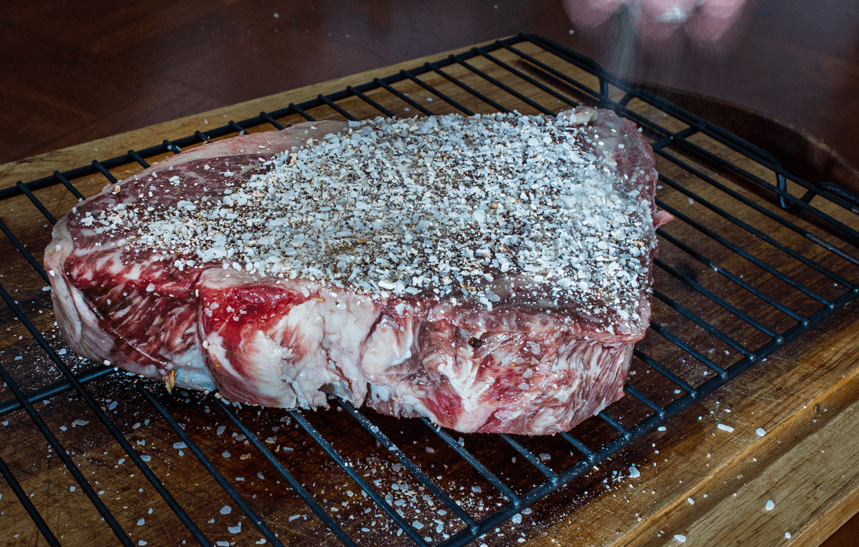
Dry brining is salting meat in advance and letting it rest — no water added. Salt draws moisture to the surface, dissolves into a concentrated brine, and is reabsorbed carrying seasoning inward. Aim for roughly 0.5–0.75% of the meat’s weight in salt, and weigh it, because brands differ enormously: one teaspoon is 2.8 g of Diamond Crystal kosher, 4.8 g of Morton kosher, and 6.0 g of table salt. USDA caps refrigerated dry brining at 2 days.
The parts that matter
- Volume measurements are the whole problem. Reaching for Morton where a recipe meant Diamond Crystal over-salts by 71%. Reaching for table salt over-salts by 114% — you have more than doubled the dose.
- You can derive any salt’s density from its own nutrition panel. Divide the sodium milligrams by 0.39334. We validated the method against three Morton panels and it matched all three exactly.
- Two of the most trusted names in American cooking publish Morton substitutions that deliver 26 to 29% more salt by weight than the Diamond Crystal amounts they replace. America’s Test Kitchen’s Morton instruction delivers 25.7% more salt by weight than the recipe it tested. Serious Eats’ is 28.6% over. Arithmetic below.
- USDA and the internet flatly disagree on method. FSIS says sealed food-grade bag, up to 2 days. Every consumer page we checked says uncovered on a rack for up to 3 days.
- Check the label before you salt. The 3% cap on added solution no longer exists — the regulation behind it is marked [Reserved]. Butterball’s fresh whole turkey declares 4%, its frozen bird 8%.
What does dry brining actually do to meat?
Salt on a wet surface dissolves. The resulting concentrated brine draws water out of the muscle by osmosis, then — as the salt concentration inside and outside equalizes — that seasoned liquid is drawn back in. What changes along the way is the muscle’s ability to hold onto water when heat hits it.
The mechanism is well described in the peer-reviewed literature. Graiver and colleagues, studying salt diffusion in pork longissimus dorsi at 4 °C, attribute the effect to “the lateral expansion of myofibrils, which is coupled to protein solubilization” and to “enhanced electrostatic repulsion between myofibril filaments causing the filament lattices to expand for water entrapment.” In plain terms: salt makes the protein scaffolding swell and hold water.
USDA’s own poultry page quotes Dr. Alan Sams of Texas A&M to the same effect: “It dissolves protein in muscle, and the salt and protein reduce moisture loss during cooking.”
An honest correction we have not seen published anywhere. The peak water-holding effect in that literature occurs at roughly 1 molar NaCl in the meat’s aqueous phase. Meat is about 73% water, so that works out to roughly 4.3% salt on whole-meat weight. Every culinary dry brine we surveyed — including USDA’s — lands between 0.31% and 1.47%. Home dry brining operates 3 to 14 times below the concentration where the swelling curve peaks. It still seasons, and it still helps; but the “salt maximizes water-holding capacity” line repeated on food blogs is borrowed from a concentration regime no home cook ever reaches. That is arithmetic, not opinion.


How much salt should you use, by weight?
Here is the number the entire category has been dancing around. Salt should be dosed as a percentage of the meat’s weight, because that is the only unit that survives a change of salt brand, a change of bird size, or a change of continent. It is the unit meat science already uses. It is used by almost no cookbook.
| Protein / cut | Salt as % of raw weight | Why |
|---|---|---|
| Whole turkey, whole chicken | 0.6–0.75% | Large mass, long rest, skin to dry out; the upper half of the published range |
| Chicken pieces, turkey breast | 0.5–0.75% | Shorter rest, higher surface-to-mass ratio |
| Steaks, chops (1 in. and up) | 0.5–0.75% | Seasoning depth is the goal, not cure |
| Pork shoulder, brisket, large roasts | 0.75–1.0% | Thick, long cook, much of the surface is trimmed or bark |
| Fish fillets | 0.5–0.75%, 45–90 min only | Delicate protein; longer reads as cured, not seasoned |
| Ground meat | Do not dry brine | Salt dissolves myofibrillar protein into a gel; burgers turn springy and dense |
These targets are our synthesis of the published range shown further down, presented as an editorial convention rather than a discovered fact. No federal agency or Extension service publishes a percentage-of-weight dry-brine standard.
Download the dry-brine calculator (CSV)
Salt density reference plus 120 rows of salt-by-weight targets for eight proteins at fifteen weights, converted to teaspoons in four salt brands. Free to reuse with attribution (CC BY 4.0).
Why does the salt brand change everything?
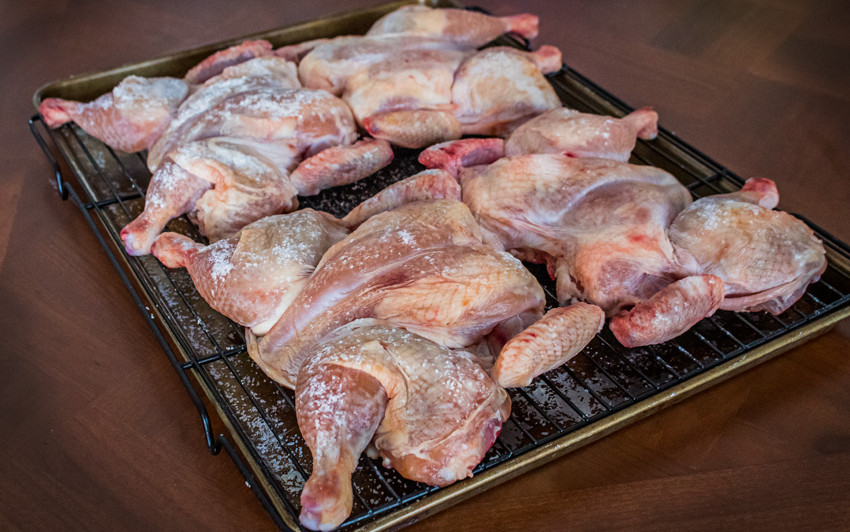
“One teaspoon of kosher salt per pound” is not an instruction. It is a range. Kosher salt crystals differ so much in shape and density between brands that a teaspoon of one weighs a little over half a teaspoon of another.
What a teaspoon of each salt actually weighs
| Salt | Grams per teaspoon | Grams per tablespoon | Source |
|---|---|---|---|
| Diamond Crystal kosher | 2.8 | 8.4 | UC ANR Extension; ATK; back-calculated from the product’s own 280 mg sodium declaration |
| Morton coarse kosher | 4.8 | 14.4 | Morton nutrition panel (1.2 g per ¼ tsp), rev. 2015-11-21; UC ANR; ATK |
| Morton fine sea salt | 5.6 | 16.8 | Morton nutrition panel (1.4 g per ¼ tsp), rev. 2016-09-01 |
| Table / canning salt | 6.0 | 18.0 | Morton iodized panel (1.5 g per ¼ tsp), rev. 2019-02-11; UC ANR |
The method: read any salt’s density off its own label
Diamond Crystal publishes no gram weight on its box or its product page. It does publish sodium: 280 mg per ¼ teaspoon. Sodium is 39.334% of sodium chloride by mass, so:
280 ÷ 0.39334 = 711.7 mg of salt per ¼ tsp = 2.85 g per teaspoon.
We validated that method against the three Morton products that print both numbers, and it reproduced each printed weight exactly: 480 mg → 1.220 g against a printed 1.2 g; 590 mg → 1.500 g against a printed 1.5 g; 560 mg → 1.424 g against a printed 1.4 g. Three for three. You can now derive the density of any salt in any store — house brands included — from the panel on the back.
What happens when you grab the wrong box
Read each row as: “I used this salt where the recipe meant that one, at the same spoon volume.”
| Used ↓ / Recipe meant → | Diamond Crystal | Morton kosher | Morton fine sea | Table / canning |
|---|---|---|---|---|
| Diamond Crystal | — | −41.7% | −50.0% | −53.3% |
| Morton kosher | +71.4% | — | −14.3% | −20.0% |
| Morton fine sea | +100.0% | +16.7% | — | −6.7% |
| Table / canning | +114.3% | +25.0% | +7.1% | — |
A 71% overdose is the difference between a seasoned bird and one nobody finishes. This is the single most common way a dry brine fails, and it has nothing to do with technique.
Even the best sources in the business get this conversion wrong.
America’s Test Kitchen, “Roast Salted Turkey” (October 26, 2012). The recipe calls for 5 tablespoons of Diamond Crystal, distributed across cavity, breast and legs. Its Morton note reduces those to 4½ tsp, 2¼ tsp per breast half, and 1 tsp per leg. Do the arithmetic: the Diamond Crystal path is 15 tsp × 2.8 g = 42.0 g. The Morton path is 11 tsp × 4.8 g = 52.8 g. The Morton instruction delivers 25.7% more salt than the recipe they actually developed and tested.
Serious Eats, “How to Brine a Turkey for Thanksgiving” (published November 2014, last updated November 13, 2024), in its dry-brine section. ½ cup Diamond Crystal “or six tablespoons Morton’s.” That is 24 tsp × 2.8 = 67.2 g versus 18 tsp × 4.8 = 86.4 g. 28.6% over.
Serious Eats applied a volume factor of exactly 0.75. ATK is not internally uniform: it used 0.75 on the cavity and each breast half but 0.667 on the legs, for a blended 0.733. The correct factor is 0.583 — 2.8 divided by 4.8, which is also exactly what the two brands’ own sodium panels give you (280 mg divided by 480 mg). This is not a one-off slip in one recipe: ATK’s house substitution guide hard-codes 2 tbsp Diamond Crystal to 1½ tbsp Morton, the same 0.75.
What do the published turkey ratios work out to?
Every widely-cited dry-brine ratio, restated as a percentage of a 13 lb (5,897 g) bird, in both salt brands:
| Source | Published ratio | If Diamond Crystal | If Morton kosher |
|---|---|---|---|
| USDA FSIS | 1 Tbsp per 5 lb | 0.37% | 0.63% |
| The Kitchn | 1 Tbsp per 5 lb | 0.37% | 0.63% |
| Napoleon | 1 Tbsp per 5 lb | 0.37% | 0.63% |
| Meat Church | 1 Tbsp per 4 lb | 0.46% | 0.79% |
| AmazingRibs / Myles Cooks | ½ tsp per lb | 0.31% | 0.53% |
| ATK salting chart | 1 tsp per lb | 0.62% | 1.06% |
| ATK recipe, as tested | 5 Tbsp DC per 12–14 lb | 0.71% | — |
| Serious Eats | ½ cup DC, any bird | 1.14% | 1.47% (their Morton line) |
The full published span is 0.31% to 1.47% — a 4.7× spread. And note the top row: a single federal recommendation ranges from 0.37% to 0.63% depending on which box is in your cupboard. USDA specifies “kosher salt” without naming a brand, and ships a 71% ambiguity along with it.
How long should you dry brine?
Long enough for the salt to travel. Salt moves through muscle by diffusion, and diffusion is slow, predictable, and indifferent to your dinner plans.
How far the salt actually gets
Using the effective diffusion coefficients Graiver and colleagues measured in pork at 4 °C, and the standard first-order penetration estimate, here is roughly how deep the salt front reaches:
| Time | Slower estimate | Faster estimate |
|---|---|---|
| 1 hour | 0.7 mm | 1.9 mm |
| 12 hours | 2.3 mm | 6.6 mm |
| 24 hours | 3.2 mm | 9.3 mm |
| 48 hours | 4.6 mm | 13.1 mm |
| 72 hours | 5.6 mm | 16.1 mm |
Our calculation, from published coefficients, using a one-dimensional model. Real meat is not a semi-infinite slab and a dry brine’s surface film is far more concentrated than a soaking solution, so treat these as an order-of-magnitude bracket — roughly 3–9 mm at 24 hours, 5–16 mm at 72 hours.
That single table explains most of the confusion in this category. A 1-inch steak is meaningfully seasoned in a few hours. A turkey breast is never seasoned to the bone, not in 72 hours, not ever. Dry brining is a surface-and-near-surface technique, and the reason it works on a bird is that the outer centimeter is where the skin, the crust and most of the eating experience live.
Two independent cross-checks: the traditional country-ham rule of about an inch per week, attributed to Ziegler and Miller’s 1938 Pennsylvania Agricultural Experiment Station bulletin, runs roughly three times faster than pure diffusion predicts — real curing is not pure diffusion. And University of Kentucky work found penetration is muscle-specific: over 60 days at 4 °C the semimembranosus hit USDA’s 4% salt minimum throughout by day 30, the semitendinosus by day 60, and the biceps femoris only at its outer surface.
Published timings, and where they disagree
| Cut | Recommendation | Source | Covered? |
|---|---|---|---|
| Whole turkey | Up to 2 days, massage every 8–12 h | USDA FSIS (upd. May 20, 2024) | Sealed bag, air pressed out |
| Whole turkey | 24–48 h | America’s Test Kitchen | Wrapped in plastic |
| Whole turkey | 24–48 h | Clemson HGIC (Nov 18, 2021) | Covered with plastic wrap |
| Whole turkey | 12–24 h uncovered, cover loosely beyond | Serious Eats | Split |
| Whole turkey | 1–3 days | The Kitchn, Gimme Some Oven, Napoleon | Uncovered |
| Turkey breast | 6–24 h | ATK | Wrap beyond 12 h |
| Whole chicken | 6–24 h | ATK | On a rack, refrigerated |
| Chicken pieces | 4–24 h | ATK; practitioner consensus | Uncovered |
| Steak | 1 hour, room temperature, ¾ tsp per 8 oz | ATK | Uncovered |
| Steak | 12–48 h refrigerated ideal; 45 min minimum | Serious Eats | Uncovered on a rack |
| Pork chops | 1 h (ATK) to 12–36 h (practitioner) | Disputed | Mixed |
| Pork shoulder | 12 h to 3 days | Serious Eats | Uncovered on a rack |
| Beef / lamb roasts | 6–24 h (ATK) to 3 days (Serious Eats) | Disputed | ATK: wrapped. SE: uncovered |
| Fish | 45–90 min for thick white fillets | Serious Eats | Refrigerated |
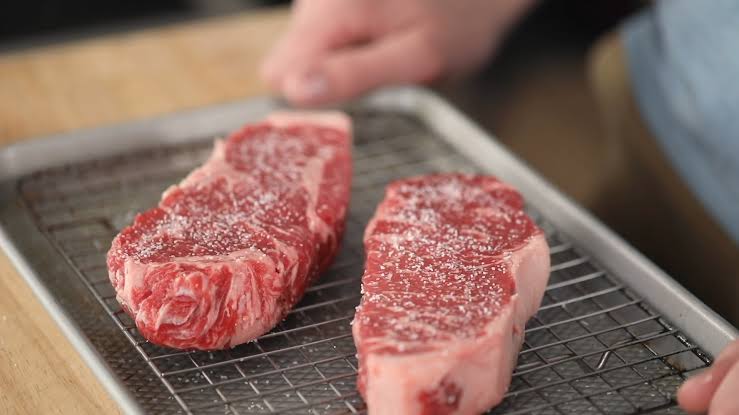
Note the steak row. Two of the most authoritative kitchens in America publish recommendations that differ by a factor of roughly forty — one hour on the counter versus two days in the fridge — and neither acknowledges the other exists.
Is the 40-minute steak rule real?
You will read everywhere that you should salt a steak either immediately before cooking or at least 40 minutes ahead, but never in between, because the window in the middle leaves the surface wet and kills the crust.
The rule traces to exactly one source: J. Kenji López-Alt, writing at Serious Eats in March 2011. His method, in his own description, was six thick-cut bone-in ribeyes salted at ten-minute intervals and seared, with the steaks that were salted immediately or rested at least 40 minutes turning out best.
That is n = 6, one trial, unblinded, judged by eye and palate by a single cook, and in fifteen years nobody has replicated it. The mechanism he proposes — surface water beading out and then being reabsorbed — is physically plausible and broadly consistent with the diffusion data above. But Serious Eats’ own more recent restatement has already widened the danger zone to “roughly 5 to 45 minutes,” and a number that drifts within a single publication is a number nothing is anchoring.
Our position: it is a reasonable working heuristic with a known author, a known date and a known sample size. Treat it as that, not as physics.
Is it safe to leave salted poultry uncovered in the fridge?
This is where the internet and USDA part company, and no page we surveyed flags it.
USDA FSIS publishes an explicit dry-brine protocol (last updated May 20, 2024): rub the salt over the surface, “place the poultry in a food-grade plastic bag, press out the air and seal tightly,” and “refrigerate for up to 2 days,” massaging every 8 to 12 hours.
Separately, FSIS’s storage guidance allows a fresh whole turkey only 1 to 2 days in the refrigerator, full stop.
Every consumer page we checked recommends the opposite method — uncovered on a rack — for up to 3 days. Those pages put readers outside USDA’s stated window on both counts.
We are not going to pretend the conflict resolves cleanly, because it does not. Cooks go uncovered for a real reason: a dry refrigerator dehydrates the skin, and dehydrated skin is the entire point of dry-brining a bird. Covering it in a sealed bag gives up most of that benefit.
What we can tell you plainly:
- USDA’s published protocol is sealed bag, 2 days maximum. That is the conservative, agency-backed option and it is what we would recommend to anyone cooking for immunocompromised, elderly, pregnant or very young guests.
- The FDA Food Code 2022, section 3-302.11(A)(4), requires food in regulated kitchens to be stored “in packages, covered containers, or wrappings,” and its exemption list — which does cover primal cuts of raw meat on sanitized racks — does not exempt whole raw poultry. Home kitchens are not regulated by the Food Code, so this is an analogy rather than a rule, but it is the closest regulatory signal that exists.
- If you go uncovered anyway, keep the refrigerator at 40 °F or below, put the bird on the bottom shelf on a rimmed tray so nothing can drip onto ready-to-eat food, and stay inside 48 hours rather than stretching to 72.
- Cook poultry to 165 °F, checked in the innermost thigh, the innermost wing and the thickest part of the breast — the three points FSIS actually specifies, which we cover in detail in our guide to how to use a meat thermometer.
One more finding worth stating: Clemson is the only Cooperative Extension service we located that covers dry brining at all, and it gives no per-pound ratio. Illinois and Wisconsin Extension cover wet brining only. The .edu literature on this technique is essentially absent, which is a large part of why the advice online has never been checked against anything.
Is your turkey already brined? How to read the label
Dry-brining a bird that arrived pre-salted is the fastest way to ruin one. This is also the section where the guidance online — including USDA’s own consumer pages — is out of date.
The 3% cap no longer exists. FSIS consumer pages still say bone-in poultry may carry up to 3% added solution and boneless up to 8%. The regulation behind that, 9 CFR 381.169, now reads “[Reserved]” in the live Code of Federal Regulations. It was rescinded by the 2014 final rule on Descriptive Designation for Raw Meat and Poultry Products Containing Added Solutions (Docket FSIS-2010-0012), effective January 1, 2016. Caps were replaced by mandatory disclosure. There is no ceiling now — there is a number printed on the front of the package.
And the market has moved past the old cap: Butterball’s fresh whole turkey declares “up to 4% of a solution,” and its frozen whole turkey declares “up to 8%.”
| Check | What to look for | Why |
|---|---|---|
| 1. Product name, front panel | A numeral plus a percent sign: “Contains up to 4% of a solution of water, salt…” | The 2014 rule requires the percentage to be part of the product name, not buried in the ingredients |
| 2. Permitted trigger words | basted, self-basting, marinated, contains, containing, flavored with, for flavoring | These are the terms the rule allows in the name |
| 3. The word that will not be there | “Enhanced” | The 2014 rule prohibits “enhanced” in the product name. Every article telling you to look for it is wrong |
| 4. Retained water, principal display panel | “up to X% retained water” | A separate rule, 9 CFR 441.10. FSIS notes it is “not unusual for poultry to declare 8 to 12% retained water” from chill-tank cooling |
| 5. Kosher birds | Salted during koshering | ATK: “do not salt it; it already contains a good amount of sodium” |
Put items 1 and 4 together and a shopper can face a bird carrying up to about 12% added water from processing plus another 4–8% salt solution — two independent percentages, in two different places on the package, under two different regulations, before a single grain of your salt goes on.
If the label declares any added solution, skip the dry brine or cut it to a third and season for flavor only.
Dry brine or wet brine?
Here is a claim you will see everywhere that the evidence does not support: dry brining produces juicier meat than wet brining.
The most-cited experiment behind the entire dry-brine movement — López-Alt’s November 2012 Serious Eats test, 24 chicken breasts across four batches — found the opposite on moisture. He reports that brining cuts total moisture loss by 30–40%, and that the salted breast, while much moister than an unsalted one, was “a couple of percentage points drier than the brined breast.” His preference for dry brining is explicitly about flavor, not yield: the water a wet brine adds is, in his words, plain tap water.
No peer-reviewed head-to-head study of dry versus wet brining exists. We looked. The honest summary:
| Wet brine | Dry brine | |
|---|---|---|
| Mass retained after cooking | Slightly higher | Slightly lower |
| Flavor concentration | Diluted — some of the retained weight is water | Concentrated — nothing added but salt |
| Skin crispness | ATK: brining “inhibits browning” and makes crisp skin harder | Better — surface dries out during the rest |
| Equipment and hassle | Bucket, gallons of liquid, refrigerator space | Salt and a tray |
| Evidence quality | One measured practitioner test | Same test; no peer-reviewed comparison |
For the fuller comparison of the two techniques and when each earns its keep, see brine vs marinade. If you want maximum weight on the scale, wet brine. If you want the bird to taste more like turkey and the skin to shatter, dry brine. We would not tell you dry brining wins on juiciness, because the only real measurement says it does not.
How to dry brine, step by step
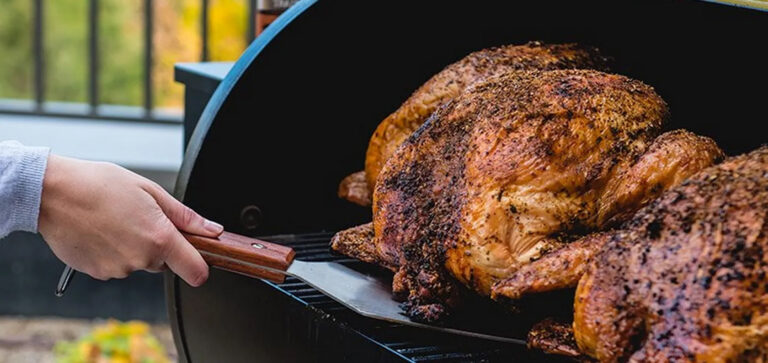
Dry brining is the first step in our smoked turkey guide and our crispy-skin whole chicken guide, and it is what puts the crust on a reverse-seared steak.
- Read the label first. Any declared solution percentage means skip or drastically reduce the salt.
- Weigh the meat in grams, or convert: pounds × 453.6.
- Multiply by your target percentage from the table above. A 5,897 g (13 lb) turkey at 0.65% needs 38 g of salt.
- Weigh the salt. If you have no scale, divide the grams by 2.8 for Diamond Crystal, 4.8 for Morton kosher, or 6.0 for table salt to get teaspoons. Our 38 g example is 13½ tsp of Diamond Crystal, 8 tsp of Morton kosher, or 6¼ tsp of table salt — three very different-looking piles doing exactly the same job.
- Apply it everywhere — surface, cavity, and under the skin over the breast and thighs where you can loosen it without tearing.
- Rest it cold. USDA: sealed bag, up to 2 days, massaged every 8–12 hours. Uncovered on a rack gives better skin; keep it under 48 hours and on the bottom shelf.
- Pat dry and cook. Do not rinse a correctly-dosed dry brine — you would be washing off seasoning you measured. Poultry to 165 °F.
- Salt the food at the table lightly, if at all. It has been seasoned from the inside.
An open question we are not going to fake an answer to. Does all the applied salt end up in the meat? Meathead Goldwyn says yes, all of it gets absorbed and no rinsing is needed. ATK’s own turkey recipe instructs you to rinse off the excess. Both cannot be right, and we could find no study in the literature measuring salt retained versus salt applied. That is a genuine gap, and we would rather publish the gap than a number.
Common dry-brining mistakes
- Measuring by volume without naming the brand. The 71% error. Everything else is a rounding difference by comparison.
- Dry-brining an enhanced bird. Check the front panel.
- Adding sugar-heavy rubs before a long rest. Fine for flavor, but sugar on a hot direct fire caramelizes at 338 °F and carbonizes shortly after. Add sweet rubs late — see our smoking times and temperatures chart for where each cut actually sits.
- Dry-brining ground meat. Salt dissolves myofibrillar proteins into a gel; the texture goes springy and sausage-like.
- Going to 72 hours because a blog said so. USDA says 2 days. The additional depth between 48 and 72 hours is roughly a millimeter or two.
- Salting fish like meat. Past about 90 minutes you are curing, not seasoning.
Where dry brining fits with everything else
Salt is the only seasoning ingredient that reliably travels into muscle. Everything else — herbs, spices, sugar, oil, acid — works on the surface, which is why marinating times follow completely different rules. Once the bird or the steak is seasoned, the next two variables are fire management and internal temperature: our guide to setting up a charcoal grill covers the first, and the smoking times and temperatures chart covers the second. For the wider story of how salt, smoke and fire became American barbecue, see what barbecue actually is.
Across the Brand Avalanche network, our colleagues at Current Homesteading cover the other end of the salt-and-preservation spectrum in their home canning times and pressures chart.
What we refused to publish
- “Don’t exceed 72 hours or the intramuscular fat dries out.” Stated by one manufacturer with no source and no mechanism. We found nothing supporting it.
- A percentage figure for “less moisture loss from dry brining.” The only measured moisture numbers we located are for wet brining. Laundering them into dry-brine claims is how bad numbers get born.
- Any figure for what share of American turkeys are sold pre-brined. No USDA, AMS or National Turkey Federation source publishes it.
- “Look for ‘enhanced’ on the label.” Legally impossible since 2016.
- The 3% added-solution cap. The regulation is [Reserved]; Butterball’s own fresh bird exceeds it.
Frequently Asked Questions
How much salt should you use for dry brining?
Roughly 0.5–0.75% of the meat’s weight in salt, and weigh it rather than measuring by volume — brands differ enormously. One teaspoon is 2.8 g of Diamond Crystal kosher salt, 4.8 g of Morton kosher salt, and 6.0 g of table salt.
Does the brand of salt actually matter for dry brining?
Yes, substantially. Reaching for Morton where a recipe meant Diamond Crystal over-salts by 71%; reaching for table salt over-salts by 114%, more than doubling the intended dose. Two widely trusted recipe sources publish Morton substitutions that deliver 26–29% more salt by weight than the Diamond Crystal amounts they were meant to replace.
How long can you dry brine meat in the refrigerator?
USDA FSIS caps refrigerated dry brining at 2 days in a sealed food-grade bag. Most consumer recipe sources instead recommend leaving the meat uncovered on a rack for up to 3 days — a genuine disagreement between the federal method and common recipe advice, not a typo.
Do I need to worry about pre-brined or “enhanced” turkey before dry brining it?
Yes — check the label first. Added-solution percentages vary by product: Butterball’s fresh whole turkey declares 4% added solution, its frozen bird 8%. A pre-brined bird needs less or no additional salt.
How long should you dry brine a steak?
Serious Eats puts the ideal at 12 to 48 hours uncovered on a rack in the refrigerator, with 45 minutes as the minimum. America’s Test Kitchen salts a steak 1 hour ahead at room temperature, at ¾ teaspoon per 8 ounces.
How long should you dry brine a turkey?
USDA FSIS allows up to 2 days in a sealed bag in the refrigerator, massaging the bird every 8 to 12 hours. America’s Test Kitchen and Clemson HGIC both use 24 to 48 hours, so a turkey salted one to two days ahead fits every source in the timing table above.
Sources:
- USDA FSIS, Poultry: Basting, Brining, and Marinating — last updated May 20, 2024
- USDA FSIS, Turkey from Farm to Table — last updated July 2, 2024
- USDA FSIS, Water in Meat & Poultry — last updated January 8, 2025
- 9 CFR 381.169 [Reserved]; 9 CFR 441.10, retained water declarations — verified against the live eCFR, August 19, 2026
- USDA FSIS, Descriptive Designation for Raw Meat and Poultry Products Containing Added Solutions, final rule, Docket FSIS-2010-0012, published December 31, 2014, effective January 1, 2016
- FDA Food Code 2022, §3-302.11
- Morton Salt nutrition panels: coarse kosher (rev. 2015-11-21), iodized table (rev. 2019-02-11), fine sea salt (rev. 2016-09-01)
- University of California Agriculture & Natural Resources, Salt for Preserving and Cooking; UC Master Food Preserver, Salt, the Only Rock We Eat!, May 2, 2025
- Graiver N., Pinotti A., Califano A., Zaritzky N. (2006), “Diffusion of sodium chloride in pork tissue,” Journal of Food Engineering 77(4):910–918
- Kim H.W. et al. (2015), “Effect of Pre-rigor Salting Levels on Physicochemical and Textural Properties of Chicken Breast Muscles,” Korean Journal for Food Science of Animal Resources 35(5):577–584
- Ziegler & Miller (1938), Pennsylvania Agricultural Experiment Station Bulletin 355, via The National Provisioner, January 14, 2013
- Clemson Cooperative Extension HGIC, How to Brine a Turkey: Wet and Dry Brining, November 18, 2021
- America’s Test Kitchen: Roast Salted Turkey (2012); Kosher Salt taste test (October 4, 2019); salting chart (October 5, 2015)
- Serious Eats / J. Kenji López-Alt: Perfect Pan-Seared Steaks (March 2011); The Food Lab: The Truth About Brining Turkey (November 2012); How to Dry Brine (December 2019)
- Butterball product pages, fresh and frozen whole turkey, retrieved August 19, 2026
How this guide was made. Every salt weight here comes from a manufacturer nutrition panel, a land-grant Extension publication, or both — and where a manufacturer publishes no weight, we derived it from its own sodium declaration and validated the method against three panels that print both figures. Regulatory citations were checked against the live eCFR on August 19, 2026, not against secondary reporting. Diffusion depths are our own calculation from published coefficients and are labeled as estimates. Claims we could not source, we left out and said so. Researched, sourced, and human-edited.


Reader Favorites
- Budget-Friendly BBQ Tips: Master Savings Now!
- Easy BBQ Foods: Grill Like a Pro with These 10 Recipes
- Cleaning Your Gas Grill Cooking Grate: Make it Great Again
- Stainless Steel BBQ Grill Cleaning: Master Maintenance Now
- Best Beef Breeds: Pick The Best For Smoking Now
- Lid Open or Closed: Master Your Grill Heat Now
BBQ Temperature Charts & Guides
Four quick-reference tools every cook bookmarks — target temps, pull temps, and how long leftovers keep, plus the full BBQ glossary.
| Cut | Pull | Time |
|---|---|---|
| Brisket | 203°F | 12–16h |
| Spare ribs | 195–203°F | ~6h |
| Pork butt | 203°F | 12–14h |
Target temps & times for 17 cuts, sortable by meat, weight and doneness.
View full chart →| Doneness | Target |
|---|---|
| Rare | 125–130°F |
| Medium-rare | 130–135°F |
| Well-done | 160°F+ |
Rare to well-done, burger safety (160°F) and resting times.
View full chart →| Food | Fridge | Freezer |
|---|---|---|
| Brisket, ribs | 3–4 days | 2–3 mo |
| Smoked sausage | 1 week | 1–2 mo |
| Potato salad | 3–4 days | no freeze |
How long smoked meats & sides keep — fridge and freezer, USDA-based.
View full chart →Every pit term decoded — cooking methods, gear, cuts, wood, and technique, A to Z.
Open the glossary →