Smoked Spatchcock Turkey: Times by Weight
Smoked spatchcock turkey cooks flat at 275°F in roughly 16 to 18 minutes per pound. It is done at 165°F in the breast, thigh and wing.
Last updated: November 19, 2026 · Originally published November 17, 2026
Food safety note. The USDA says to thaw a turkey completely in the refrigerator before smoking, keep the smoker between 225°F and 300°F, and cook all poultry to 165°F, checked in the thickest part of the breast and the innermost thigh and wing. Refrigerate leftovers within 2 hours. The times in this article are planning estimates; the thermometer decides when it is done.
Smoking a spatchcocked turkey has become a favorite way to prepare the holiday bird for good reason. By removing the backbone and flattening the turkey, you create a more even thickness that cooks faster and more uniformly than a traditional whole turkey, while exposing more skin to the heat for better browning and crispiness. When you add the low-and-slow heat of a smoker, the result is deeply flavored meat that stays juicy, with a subtle smoky taste that pairs well with classic sides.
Because cook times for a smoked spatchcock turkey depend heavily on the bird’s weight, knowing the right duration for your size of turkey is essential for hitting the perfect internal temperature without drying it out. Smaller birds finish noticeably faster than larger ones at the same smoker temperature, so having weight-based guidelines helps you plan your timeline, maintain steady heat, and serve a safely cooked, flavorful turkey every time.
The parts that matter
- Done: 165°F in the breast, thigh and wing, per the USDA.
- Pit: the USDA range is 225°F to 300°F. Hey Grill Hey runs 275°F.
- Time: a 15 lb bird takes 4 to 4½ hours at 275°F, per Hey Grill Hey. That works out to 16 to 18 minutes per pound.
- Big birds: Smoking-Meat.com says plan on 6 to 7 hours for a 22 lb spatchcocked turkey at its 240°F.
- Rest: 10 to 15 minutes before carving.
Why Does a Flat Turkey Cook More Evenly?
A traditional whole turkey cooks unevenly because of its shape. The thick breast meat sits high and exposed, while the darker thigh and leg meat is packed into the cavity and protected by the backbone and surrounding structure. Heat has a much longer path to reach the deepest parts of the thighs, so the breast often finishes (and begins to dry out) before the legs reach a safe temperature.
Spatchcocking removes the backbone and flattens the bird, which largely solves that problem. The thighs and legs are now spread out and sit at a similar thickness to the breast, so heat reaches every section more or less at the same time. With no deep cavity slowing heat transfer and more surface area exposed to the smoker’s heat and airflow, both white and dark meat come up to temperature together. The result is a more evenly cooked turkey with less risk of overdone breast or underdone thighs.
There is a bonus: more skin faces the smoke. Our smoked turkey guide makes the same point about spatchcocking and covers the round-bird method if you would rather leave it whole.
Thaw It All the Way First
The safest way to thaw a frozen turkey is in the refrigerator. Place the bird on a rimmed tray or in a large container to catch any juices, then keep it in a refrigerator set at 40°F or below. Plan on roughly 24 hours of thawing time for every 4 to 5 pounds of turkey—so a 12- to 16-pound bird typically needs 3 to 4 days, while a 16- to 20-pound turkey needs 4 to 5 days. Once fully thawed, the turkey can safely stay in the refrigerator for another 1 to 2 days before cooking.
Never thaw a turkey on the counter or at room temperature. As the outer layers warm above 40°F, they enter the danger zone (40–140°F) where bacteria such as Salmonella and Campylobacter can multiply rapidly, even while the center of the bird is still frozen. Some bacterial toxins are heat-stable and may not be destroyed by cooking, raising the risk of foodborne illness. If a turkey has been left out for more than two hours, it is safest to discard it.
Behind schedule already? Our turkey thaw and cook time planner works backward from dinner, including the cold-water method.
How to Cut Out the Backbone

The National Turkey Federation recommends heavy-duty kitchen shears; a sharp knife or a cleaver also works. Here is the order:
- Breast side down, tail toward you. Pat the bird dry so it does not slide around the board.
- Cut along one side of the backbone. The National Turkey Federation says to start at the tail and keep cutting until you have snipped through the rib bones up to the neck.
- Cut the other side and lift the backbone out.
- Snip the inside of the breastbone, flip it, and press. That is Hey Grill Hey’s method: turn the bird over and push down on the center of the breast until you hear a crack and it lies flat.
Listen for the crack. The turkey is fine. The turkey is past caring.
Do not throw out the backbone. The National Turkey Federation points out you can use it for a flavorful turkey broth or gravy. Think of it as the tip you pay the gravy for showing up.
Brine or Dry Brine?
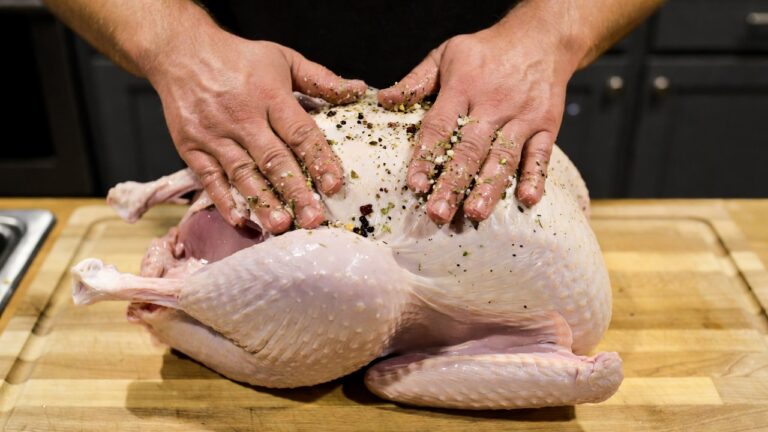
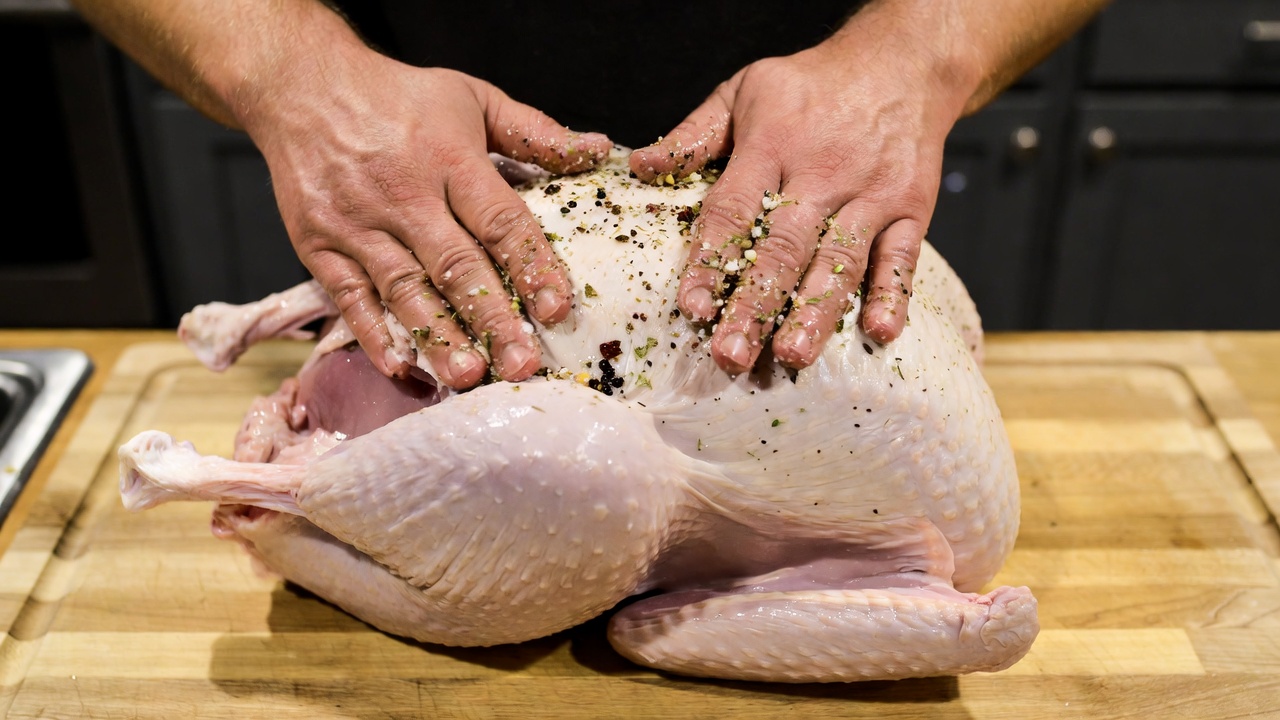
A wet brine means fully submerging the turkey in a saltwater solution (often with sugar and aromatics) for 12–24 hours. A dry brine is simpler: you rub salt, and sometimes a bit of sugar or spices, directly onto the skin and under it, then let the bird rest uncovered in the refrigerator for 24–72 hours. Both methods work because salt changes the structure of the muscle proteins, allowing the meat to hold onto more of its natural moisture during cooking instead of squeezing it out as it heats. The result is a juicier, better-seasoned turkey that is more forgiving if the temperature runs a little high.
Either approach is better than skipping brining altogether, especially for a lean bird like turkey that can dry out during a long smoke. Wet brining adds a bit of extra liquid and can be slightly more forgiving, while dry brining seasons more deeply, concentrates the turkey’s natural flavor, and dries the skin so it crisps better in the smoker. In the end, salt is doing the real work: it seasons the meat throughout and helps it retain moisture, giving you a more tender, flavorful finished turkey.
I lean dry brine for the smoker, since you are not adding water to skin you want crisp. Our dry brining guide has the salt by weight for every brand.
What Pit Temperature for Smoked Spatchcock Turkey?
Anywhere inside the USDA’s 225°F to 300°F range, and I would aim at the upper half. Here is why. The top spatchcock recipes run 240°F at Smoking-Meat.com and 275°F at Hey Grill Hey, and our own house guide runs 275°F to 300°F for poultry. Hotter in that range means less time in the danger zone and better skin.
So, 225 or 250? Neither, for this bird. Both are legal under the USDA range, but a flat turkey is built to take more heat. Take my advice and run 275°F.
Use two thermometers, the way the USDA says to smoke anything: one at the grate for the air, and one in the meat. The lid gauge is a rumor.
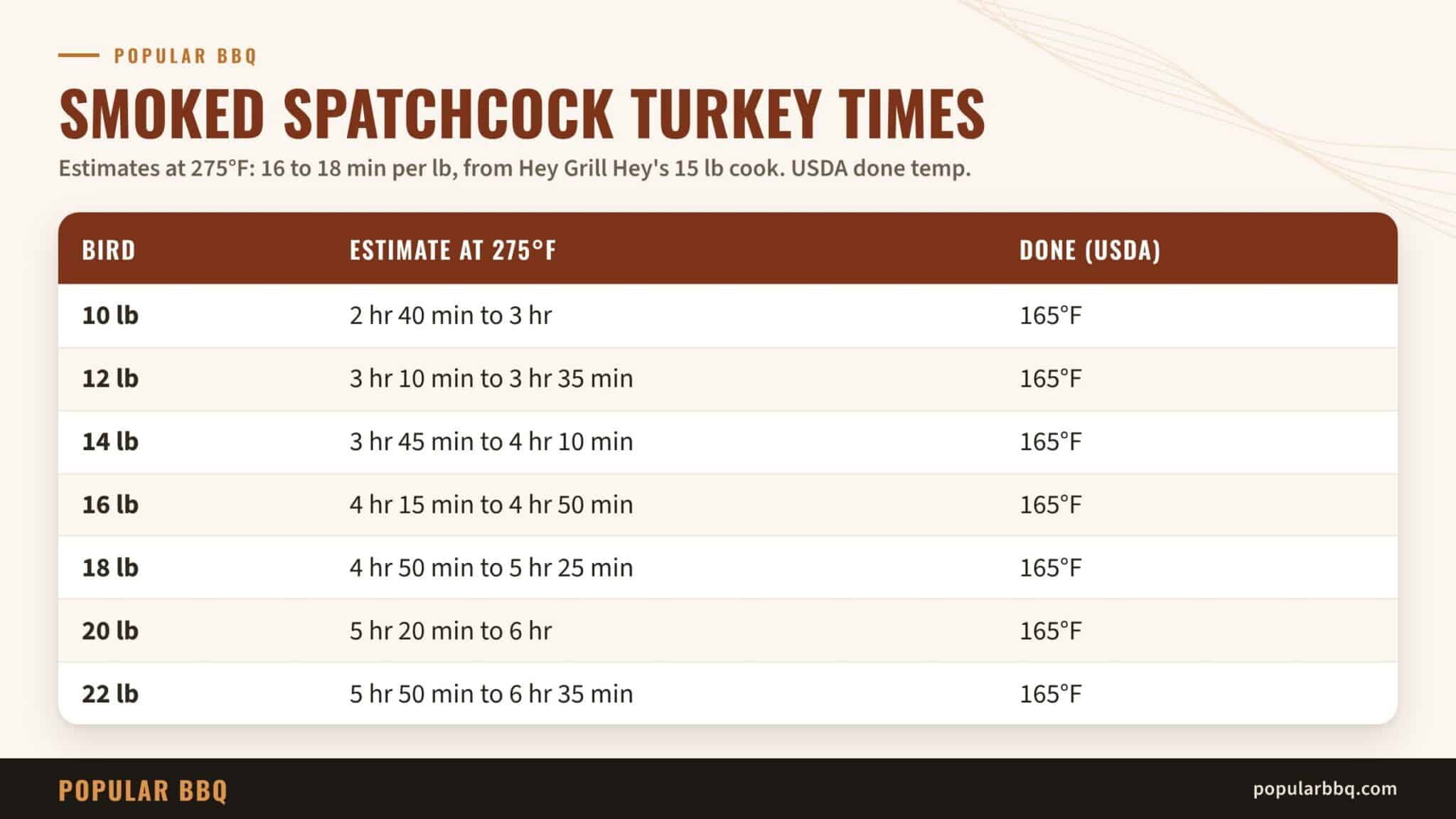
How Long to Smoke a Spatchcock Turkey, by Weight
The smoking times that follow are useful estimates based on typical results for a spatchcocked turkey at common smoker temperatures, but they should never replace a thermometer. Bird size, exact smoker temperature, outdoor conditions, and how steadily the heat holds can all shift the total cook time by 30 minutes or more. Always treat the listed times as a planning guide, not a guarantee.
For safe eating, the turkey itself must reach a minimum internal temperature of 165°F. Insert a reliable probe thermometer into the thickest part of the breast and the thickest part of the thigh, avoiding bone. When both spots hit at least 165°F and the juices run clear, the turkey is done, regardless of whether the estimated time has fully elapsed. Pulling the bird as soon as it reaches temperature (and letting it rest) is the most reliable way to keep it both safe and juicy.
| Bird | Estimate at 275°F | Done |
|---|---|---|
| 10 lb | 2 hr 40 min to 3 hr | 165°F |
| 12 lb | 3 hr 10 min to 3 hr 35 min | 165°F |
| 14 lb | 3 hr 45 min to 4 hr 10 min | 165°F |
| 16 lb | 4 hr 15 min to 4 hr 50 min | 165°F |
| 18 lb | 4 hr 50 min to 5 hr 25 min | 165°F |
| 20 lb | 5 hr 20 min to 6 hr | 165°F |
| 22 lb | 5 hr 50 min to 6 hr 35 min | 165°F |
Arithmetic: weight × 16 to 18 minutes, from Hey Grill Hey’s 15 lb cook at 275°F, rounded to 5 minutes. Done temperature from the USDA. Real cooks vary with wind, weather and how steady your pit runs.
Smoking times are only rough estimates because the actual cook depends heavily on two variables you control: the heat of your smoker and the size of the turkey. A steady 225°F smoker will take noticeably longer than one held at 275°F, and a 10-pound spatchcocked bird will finish far sooner than a 16- or 18-pound one at the same temperature. Outdoor temperature, wind, how often you open the lid, and even how full the smoker is can shift the timeline further. That’s why the only reliable method is to watch the internal temperature with a probe thermometer rather than the clock, pull the turkey as soon as the thickest parts of the breast and thigh reach 165°F, no matter how much time has passed.
So plan to the long end of each row and start early. Our turkey cook time calculator covers round birds, ovens and other pit temperatures.
Breast and Thigh Temperatures

The USDA’s number is 165°F for the whole bird. Check it in three places: the thickest part of the breast, the innermost part of the thigh, and the innermost part of the wing. The USDA also says you can choose to cook it higher for personal preference.
The recipes split on how to get there. Hey Grill Hey takes the breast to 165°F and expects the thighs to land around 175°F to 185°F. Smoking-Meat.com pulls the breast at about 160°F and lets carryover heat take it to 163°F to 165°F during the rest. If you pull early, check it again after the rest and make sure it reached 165°F.
Not sure where the probe goes? Aim for the center of the thickest meat without touching bone. Then double-check the other two spots.
Rest and Carve
Resting the turkey after it comes off the smoker is one of the simplest steps that makes a big difference in the final result. While the bird cooks, heat causes the muscle fibers to tighten and push moisture toward the center. If you carve right away, those juices run out onto the cutting board and the meat tastes drier. Letting the turkey rest gives the fibers time to relax so the juices can redistribute evenly throughout the meat.
A 15- to 30-minute rest is usually enough for a spatchcocked turkey. Tent it loosely with foil so it stays warm without trapping too much steam, which can soften the skin. During this time the internal temperature often rises a few more degrees, and the meat finishes its carryover cooking while becoming noticeably juicier and more tender. Once the rest is done, the turkey is ready to carve and serve.
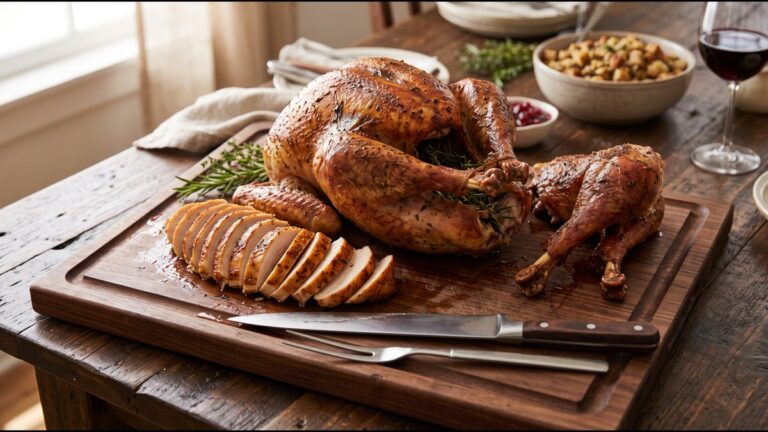
Carving a flat bird is the easy part of the whole deal. Pull the legs and thighs off at the joint, then the wings. Next, run the knife down one side of the breastbone and lift each breast half off in one piece. Slice the breast across the grain on the board, not on the bird. There is no back to wrestle with, because you already took it out and made gravy with it.
Spatchcock Mistakes to Avoid
Most smoked spatchcock turkey problems trace back to five habits.
- Smoking it partly frozen. The USDA says thaw completely first.
- Trusting the lid gauge. Use a grate thermometer and a meat thermometer.
- Checking only the breast. Check the thigh and wing too.
- Brining a pre-brined bird. Read the label before you add salt.
- Leaving it out after dinner. The USDA says refrigerate within 2 hours and use it within 4 days.
Leftovers
The USDA’s smoking guide says to refrigerate smoked poultry within 2 hours of taking it off the smoker. Cut it into smaller portions or slices, put it in shallow covered containers, and use it within 4 days or freeze it. Leftover smoked spatchcock turkey gets reheated to 165°F, per FoodSafety.gov. Our Thanksgiving dinner planner can help you plan the rest of the day, so the bird is not the only thing on time.
A whole turkey won easily, with turkey breasts and not smoking tied for second.
Frequently Asked Questions
How long does a 20 lb spatchcock turkey take to smoke?
About 5 hours 20 minutes to 6 hours at 275°F, by the 16 to 18 minutes per pound math above. Jeff Phillips of Smoking-Meat.com plans 6 to 7 hours for a 22 pounder at his lower temperature. Cook to 165°F, not to the clock.
Is it better to smoke a turkey at 225 or 250°F?
For a flat bird, I would go hotter. The USDA allows 225°F to 300°F, and the popular spatchcock recipes run 240°F to 275°F.
Should you spatchcock a turkey for the smoker?
Yes. Smoking-Meat.com says it cooks faster and more evenly and lets a large bird cook more safely at smoking temperatures.
How do you keep a smoked spatchcock turkey moist?
Brine or dry brine it, run the pit at a steady temperature, and pull it by thermometer. Overcooking the breast while waiting on the clock is what dries it out.
What do you do with the turkey backbone?
Make broth or gravy with it. The National Turkey Federation lists that as one of the perks of spatchcocking, and it is the only part of the bird that works while you nap.
Cut the backbone, run the pit at 275°F, and let the thermometer call it. That is a smoked spatchcock turkey with crisp skin and a breast that is not dry. And if Thanksgiving is the real deadline, Current Homesteading has a two-weeks-out Thanksgiving prep checklist for everything else on the table.
Sources: USDA FSIS, “Smoking Meat and Poultry”; USDA FSIS, “Let’s Talk Turkey: Roasting”; USDA FSIS, “Poultry: Basting, Brining, and Marinating”; FoodSafety.gov, “Safe Minimum Internal Temperatures”; National Turkey Federation, “How to Spatchcock a Turkey”; Hey Grill Hey, “Spatchcock Smoked Turkey”; Smoking-Meat.com, “Spatchcocked Turkey with Herbed Butter”.
Reader Favorites
- Creative BBQ Recipes: Fire Up A Unique BBQ Menu Now
- Easy BBQ Foods: Grill Like a Pro with These 10 Recipes
- Grilling Crispy Hot Wings: Master Crunchy Perfection Now
- Spicy Jamaican Jerk Chicken: Unleash Fiery Flavor Now
- Dr Pepper BBQ Wings: Add an Awesome Twist to Your Wings Now
- Smoky Red Chicken Wings: Flavor-Packed Adventure Starts Now
BBQ Temperature Charts & Guides
Four quick-reference tools every cook bookmarks — target temps, pull temps, and how long leftovers keep, plus the full BBQ glossary.
| Cut | Pull | Time |
|---|---|---|
| Brisket | 203°F | 12–16h |
| Spare ribs | 195–203°F | ~6h |
| Pork butt | 203°F | 12–14h |
Target temps & times for 17 cuts, sortable by meat, weight and doneness.
View full chart →| Doneness | Target |
|---|---|
| Rare | 125–130°F |
| Medium-rare | 130–135°F |
| Well-done | 160°F+ |
Rare to well-done, burger safety (160°F) and resting times.
View full chart →| Food | Fridge | Freezer |
|---|---|---|
| Brisket, ribs | 3–4 days | 2–3 mo |
| Smoked sausage | 1 week | 1–2 mo |
| Potato salad | 3–4 days | no freeze |
How long smoked meats & sides keep — fridge and freezer, USDA-based.
View full chart →Every pit term decoded — cooking methods, gear, cuts, wood, and technique, A to Z.
Open the glossary →