
Turkey Brine for Smoking: Ratio, Time and Cooler Method
A turkey brine for smoking is ¾ cup of table salt per gallon of water, about 216 grams. Brine overnight, kept at 40°F or below.
Last updated: October 17, 2026 · Originally published October 16, 2026
A smoked turkey stays juicy only if the bird goes into the cooker already seasoned and protected from drying out, and a simple brine is the most reliable way to get there. Salt water, a measured ratio, and enough time let the meat take on moisture and flavor before smoke ever touches it. The cooler method makes that step practical for a whole bird: ice keeps the brine food-safe, the turkey stays submerged, and cooks who have never brined before still pull a moist bird off the smoker.
Food safety note. Start with a fresh or completely thawed turkey. The USDA says to brine poultry covered in the refrigerator. Illinois Extension also allows a cooler with 5 to 6 ice packs, as long as the bird and brine stay at 40°F or below. Throw the brine out after one use. Smoke the turkey to 165°F, checked in the thigh, the wing and the thickest part of the breast.
The parts that matter
- Ratio: ¾ cup table salt per gallon of water, or 216 grams, per the USDA.
- Same salt, other brands: about 15 tablespoons of Morton kosher, or about 1⅝ cups of Diamond Crystal kosher.
- Time: at least overnight, and no more than 2 days in the refrigerator after thawing.
- Cold: 40°F or below, in the fridge or a cooler with 5 to 6 ice packs.
- Rinse: no. Pat it dry instead.

The One Ratio
The USDA Food Safety and Inspection Service gives the ratio plainly: ¾ cup of salt per gallon of water, or 3 tablespoons per quart. It names table salt as the salt to use, and that ratio is the backbone of every turkey brine for smoking on this page. Add a sweetener if you want one; FSIS says sugar, molasses, honey or corn syrup can go in for flavor and browning.
Turn that into grams, since a scale does not care what brand you bought. Morton’s nutrition label puts table salt at 1.5 grams per ¼ teaspoon, which is 6.0 grams per teaspoon. A ¾ cup is 36 teaspoons, so 36 x 6.0 = 216 grams of salt per gallon. A gallon of water weighs about 3,785 grams, so the finished brine is 216 ÷ (3,785 + 216) = about 5.4 percent salt by weight. Smoking-Meat.com, for comparison, builds all of its turkey brines to about 6 percent.

Salt Brands Are Not Equal
This is the part that ruins turkeys. Illinois Extension points out that table salt is very finely ground, and its own brine calls for 2 cups of table salt where it uses 4 cups of kosher. The nutrition panels tell the story: Morton table salt is 1.5 grams per ¼ teaspoon, Morton coarse kosher is 1.2 grams, and Diamond Crystal kosher is 0.7 grams. Multiply by 192 quarter-teaspoons in a cup and you get the weights below.

So a recipe written for Morton kosher and made with Diamond Crystal comes out at a little more than half the salt. Go the other way, and you have a salt lick. To hit the USDA’s 216 grams per gallon, you need ¾ cup of table salt, 15 tablespoons of Morton coarse kosher, just under 1 cup, or about 25¾ tablespoons of Diamond Crystal kosher, about 1⅝ cups.
Turkey Brine Recipe by the Gallon
Here is the batch table. First, find out how much brine your bird needs with the water test. Set the turkey in your container, cover it with water, then lift the turkey out and measure the water. That is your gallon count. Illinois Extension brines a 12 to 14 pound turkey in 2 gallons, which is a good starting guess.
| Water | Salt by weight | Table salt | Morton kosher | Diamond Crystal |
|---|---|---|---|---|
| 1 gal | 216 g | ¾ cup | 15 Tbsp | 1⅝ cups |
| 1½ gal | 324 g | 1 cup + 2 Tbsp | 1 cup + 6½ Tbsp | 2⅜ cups |
| 2 gal | 432 g | 1½ cups | 1⅞ cups | 3¼ cups |
| 2½ gal | 540 g | 1⅞ cups | 2⅓ cups | 4 cups |
| 3 gal | 648 g | 2¼ cups | 2¾ cups + 1 Tbsp | 4¾ cups + 1 Tbsp |
USDA FSIS ratio of ¾ cup table salt per gallon, or 216 g. Conversions from the manufacturers’ nutrition panels: table salt 6.0 g, Morton coarse kosher 4.8 g, Diamond Crystal kosher 2.8 g per teaspoon. Cups rounded to the nearest common fraction; the grams column is exact.
Want to go a different direction? An equilibrium brine salts the bird and the water together to a set percentage, and our Equilibrium Brine Calculator works out the grams. Its own worked example, a 12 pound turkey in 1 gallon at 1 percent, comes to 92.3 grams of salt.
How Long to Brine a Turkey
At least overnight. FSIS says to refrigerate the bird in the brine at least overnight for best results, and that poultry can stay in the refrigerator up to 2 days after it is thawed or bought fresh. That 2-day limit counts the brine time, so do not let a thawed bird sit around and then start a long brine on top of it.
Other published methods use different strengths, which is why their times disagree. Illinois Extension brines 6 to 8 hours in a stronger mix of 4 cups kosher or 2 cups table salt in 2 gallons, and cuts the salt in half for an overnight brine. Smoking-Meat.com goes 10 to 12 hours at about 6 percent. This article uses the USDA’s ratio and the USDA’s timing, and nothing else, so the numbers match each other.
When to Start Thawing
Brining needs a thawed bird, so the clock really starts in the freezer. FSIS allows about 24 hours of refrigerator thawing for every 4 to 5 pounds. Count back from smoke day with this table, adding one night for the brine.
| Bird weight | Fridge thaw (FSIS) | Move to the fridge | Into the brine |
|---|---|---|---|
| 10 to 12 lb | 1 to 3 days | 4 days before | Night before |
| 13 to 16 lb | 3 to 4 days | 5 days before | Night before |
| 17 to 20 lb | 4 to 5 days | 6 days before | Night before |
| 21 to 24 lb | 5 to 6 days | 7 days before | Night before |
Thaw times from the USDA FSIS refrigerator thawing table for 4 to 12, 12 to 16, 16 to 20 and 20 to 24 pounds. “Move to the fridge” is the longest thaw time plus one night of brining, counted back from smoke day.
Running late? Our guide on how long to thaw a turkey covers the cold-water method, which runs about 30 minutes per pound.
The Cooler Method
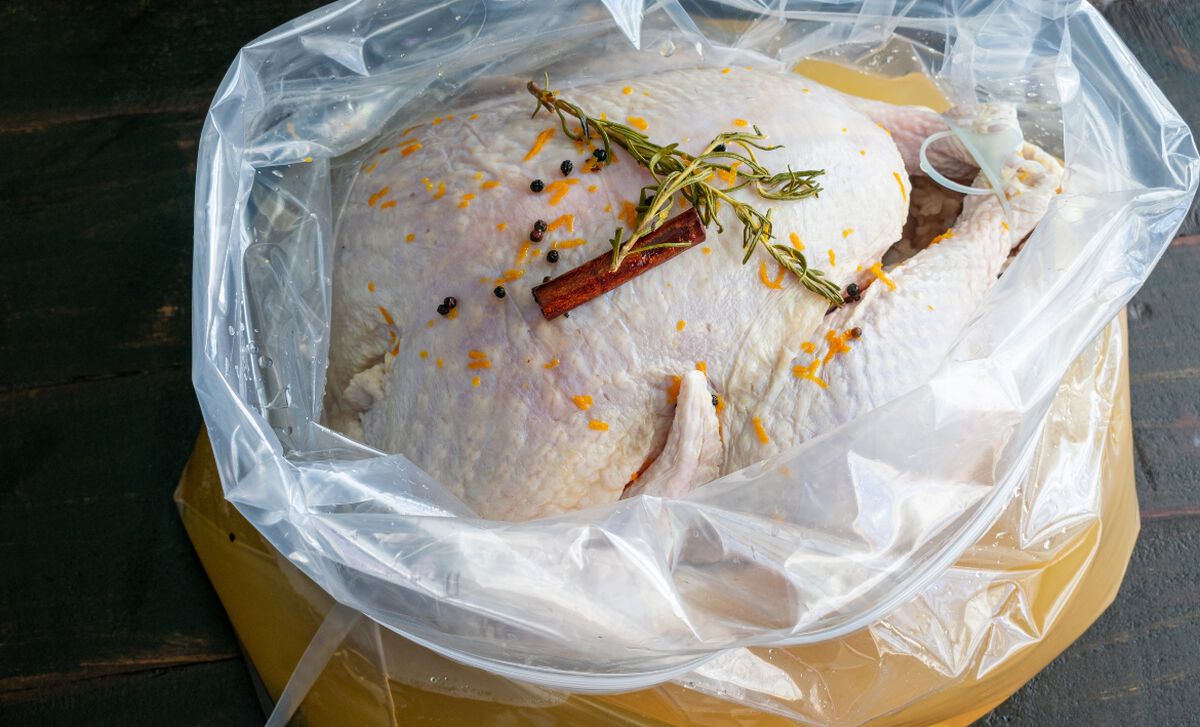
Most refrigerators do not have room for a turkey in a bucket the week of Thanksgiving. Illinois Extension allows a cooler, with 5 to 6 ice packs to keep the turkey and brine at 40°F or below for the entire brine. Here is how to run a turkey brine for smoking in a cooler and keep it safe:
- Use ice packs, not loose ice. Loose ice melts into the brine and waters down your salt.
- Put a thermometer in the brine. Check it at bedtime and first thing in the morning. If it reads above 40°F, add packs.
- Keep the cooler where you can watch it. FSIS warns against leaving even a frozen turkey on the back porch, in a car trunk or in a basement, anywhere the temperature cannot be constantly monitored. A brining turkey deserves the same.
- Use a food-safe container. FSIS lists food-grade plastic, stainless steel or glass, and Butterball adds a brining bag.
Turkey Brine for Smoking, Step by Step

Makes: 2 gallons, enough for a 12 to 14 pound turkey. Brine time: overnight.
Ingredients
- 2 gallons cold water
- 432 grams salt: 1½ cups table salt, 1⅞ cups Morton coarse kosher, or 3¼ cups Diamond Crystal kosher
- 1 cup sugar, optional, from Illinois Extension’s brine
- A few crushed bay leaves and sprigs of dried thyme, optional, from Illinois Extension
Steps
- Dissolve. Stir the salt and sugar into the cold water until it looks clear, not cloudy.
- Prep the bird. Remove the giblets and neck from the thawed turkey.
- Submerge. Set the turkey in breast down, the way Illinois Extension and Butterball both do it. Weigh it down so the whole bird stays under.
- Chill overnight. Cover and refrigerate, or close it in a cooler with 5 to 6 ice packs and a thermometer, at 40°F or below.
- Drain and dry. Lift the turkey out, pat it dry with paper towels, and pour the brine down the drain.
- Air-dry the skin if you have the time. Illinois Extension refrigerates the brined bird overnight on a shallow pan so the skin dries out and crisps.
Should You Rinse a Brined Turkey?
No. The USDA says washing or rinsing raw poultry raises the risk of spreading bacteria around your kitchen and is not necessary for safety. FSIS also says that very little salt comes off when you rinse or soak meat. Illinois Extension does rinse its brined bird, but Smoking-Meat.com skips the rinse and pats the turkey dry, and so should you. Then clean and sanitize the sink and everything the brine touched.
Pre-Brined Birds: Skip This Whole Article
Check the label before you mix a drop. Butterball says its whole turkeys are individually pre-brined, so that bird already went swimming. FSIS explains that terms like “self-basting,” “marinated” or “for flavoring” on a raw poultry label mean a solution was added during processing, up to 3 percent by weight for bone-in poultry. Smoking-Meat.com recommends cutting the salt or buying a turkey that has not been enhanced. Since a second brine stacks salt on salt, the easiest answer is to buy a plain bird if you want to brine it.
What Is the Downside of Brining?
Three of them, and none are dealbreakers. First, it eats refrigerator or cooler space, and the bird has to stay at 40°F or below the whole time. Second, the used brine is raw poultry juice: FSIS says to discard it and clean up carefully. Third, it does nothing for safety. FSIS calls soaking in a brine a personal preference that “serves no purpose for food safety,” so you still cook it to 165°F like any other bird.
On to the Smoker
Here is the hand-off the brine recipes never give you. FSIS says to keep the smoker between 225°F and 300°F and to use two thermometers, one for the pit and one for the bird. Plan on anywhere from 4 to 8 hours to smoke meat or poultry. The turkey is done at 165°F, checked in the innermost part of the thigh and wing and the thickest part of the breast. Our smoked turkey guide walks through the cook, and our turkey cooking time calculator helps you plan the day. If you would rather salt it dry, our dry brining guide does the same job without the bucket. Cooking only a breast? Our smoked turkey breast recipe brines it first, too.
Frequently Asked Questions
Can I reuse a turkey brine for smoking a second bird?
No. FSIS says to discard brine after use, and Smoking-Meat.com agrees: once raw poultry has been in it, it goes down the drain.
Can I brine a turkey that is still partly frozen?
Illinois Extension starts with a fresh or completely thawed turkey, and FSIS says to thaw poultry completely before smoking. Finish the thaw first.
Do I need sugar in a turkey brine recipe?
No. FSIS lists sweetener as optional, for flavor and browning. Illinois Extension uses 1 cup of sugar in its 2-gallon brine.
Can I use iodized salt?
Yes. FSIS names table salt for brining poultry. Illinois Extension prefers kosher salt because table salt carries additives and is finely ground, so you need the brand conversion above either way.
Weigh the salt, keep it cold, and pat it dry. Do those three things and your turkey brine for smoking will do its job. Feeding a crowd this year? Current Homesteading’s two-week Thanksgiving prep checklist puts the brine night on the calendar next to everything else. Our Thanksgiving dinner planner lines up the sides.
How this guide was made. USDA FSIS, “Poultry: Basting, Brining, and Marinating”; USDA FSIS, “Smoking Meat and Poultry”; USDA FSIS, “Turkey Basics: Safe Thawing”; USDA FSIS, “Let’s Talk Turkey Roasting”; USDA FSIS, “Washing Food: Does It Promote Food Safety?”; Illinois Extension, “Brine Method”; Morton Salt, iodized salt nutrition facts; Morton Salt, coarse kosher salt nutrition facts; USDA FoodData Central, Diamond Crystal Kosher Salt label data; Butterball, “Whole Turkeys”; Butterball, “How to Brine a Turkey”; Smoking-Meat.com, “Favorite Turkey Brines”.

Reader Favorites
- Creative BBQ Recipes: Fire Up A Unique BBQ Menu Now
- Easy BBQ Foods: Grill Like a Pro with These 10 Recipes
- Grilling Crispy Hot Wings: Master Crunchy Perfection Now
- Spicy Jamaican Jerk Chicken: Unleash Fiery Flavor Now
- Dr Pepper BBQ Wings: Add an Awesome Twist to Your Wings Now
- Smoky Red Chicken Wings: Flavor-Packed Adventure Starts Now
BBQ Temperature Charts & Guides
Four quick-reference tools every cook bookmarks — target temps, pull temps, and how long leftovers keep, plus the full BBQ glossary.
| Cut | Pull | Time |
|---|---|---|
| Brisket | 203°F | 12–16h |
| Spare ribs | 195–203°F | ~6h |
| Pork butt | 203°F | 12–14h |
Target temps & times for 17 cuts, sortable by meat, weight and doneness.
View full chart →| Doneness | Target |
|---|---|
| Rare | 125–130°F |
| Medium-rare | 130–135°F |
| Well-done | 160°F+ |
Rare to well-done, burger safety (160°F) and resting times.
View full chart →| Food | Fridge | Freezer |
|---|---|---|
| Brisket, ribs | 3–4 days | 2–3 mo |
| Smoked sausage | 1 week | 1–2 mo |
| Potato salad | 3–4 days | no freeze |
How long smoked meats & sides keep — fridge and freezer, USDA-based.
View full chart →Every pit term decoded — cooking methods, gear, cuts, wood, and technique, A to Z.
Open the glossary →