What Is Barbecue, Really? The Definition, the History, and What USDA Actually Says
Last verified: August 19, 2026. Every legal, temperature, and historical claim below links to the primary source it came from.
Barbecue is meat cooked slowly by the heat and smoke of a wood or charcoal fire. That is the working definition almost everyone uses — but no U.S. government agency, university, or sanctioning body has ever defined it by temperature. The only binding federal definition, 9 CFR 319.80, regulates fuel and yield, not degrees. The famous “225 to 275°F” range that the internet treats as a standard has no authoritative source behind it at all.
The parts that matter
- There is no legal temperature definition of barbecue. The one federal regulation on the books, 9 CFR 319.80, requires hardwood fuel, a browned crust, and a maximum 70% cooked yield — and never mentions a temperature.
- USDA contradicts itself. One current FSIS page says a smoker should run 225–300°F. Another current FSIS page says 250–300°F. Both are live right now.
- The word came from a rack, not a recipe. The earliest English uses of barbacoa and barbycu describe a maize storehouse (1625) and a sugarcane platform (1657) — not cooking.
- “Barbe à queue” is not the origin. The Oxford English Dictionary dismissed it in its very first edition — the 1888 B volume, published as A New English Dictionary on Historical Principles and edited by James A. H. Murray — which calls it “an absurd conjecture suggested merely by the sound of the word.”
- Santa Maria breaks the tidy definition. It is hot, fast, direct-heat, and unsauced — and nobody disputes that it is barbecue.
What is barbecue?
In everyday American usage, barbecue means three different things depending on the sentence it appears in: a cooking method (slow, indirect, wood-fired), the food that method produces (a plate of brisket or pulled pork), and a social event (an outdoor gathering built around that food). All three senses are old, and all three are documented in print by the 1700s.
What barbecue is not is a defined technical term. The University of Arkansas System Division of Agriculture put the practical distinction plainly in a May 20, 2026 extension piece. Janeal Yancey, an Extension animal science instructor, described the line the way cooks actually draw it: “I would never say I’m ‘barbecuing’ a hamburger. If I was going to cook a hamburger on a grill for Memorial Day, I’d say I’m grilling it.”
That is a usage rule, not a thermometer reading. And as the next section shows, a usage rule is actually all anyone has.
Does the U.S. government define barbecue?
Once — and not the way you would expect.
The only binding federal definition regulates fuel and weight loss
9 CFR § 319.80, “Barbecued meats,” is a USDA standard of identity — a labeling rule that governs what a company may legally call barbecue on a package. It sets four conditions:
| Requirement in 9 CFR 319.80 | What it actually says |
|---|---|
| Heat source | Cooked by the direct action of dry heat resulting from the burning of hard wood or the hot coals from it |
| Surface result | Cooked long enough to develop a brown crust and render surface fat |
| Sauce | May be applied during cooking |
| Yield | Finished weight must not exceed 70% of the fresh uncooked weight |
| Temperature | Not specified anywhere in the regulation |
Two things jump out. First, there is no temperature — the regulation cares about fuel and moisture loss, not degrees. Second, it says direct heat, which sits awkwardly against the near-universal modern definition of barbecue as indirect cooking. The regulation was written to stop a processor from labeling a steam-cooked, liquid-smoke-flavored product “barbecued beef.” It was never written to settle a pit argument.
USDA’s two consumer pages disagree with each other
This is the part nobody has flagged. FSIS publishes smoker-temperature guidance on two separate consumer pages, and the numbers do not match:
| FSIS page | Last updated | Smoker temperature it gives |
|---|---|---|
| Smoking Meat and Poultry | Aug 13, 2024 | 225 to 300°F throughout cooking |
| Grilling Food Safely | current | “maintained at 250 to 300°F (121 to 149°C) for safety” |
A 25-degree gap on the low end, from the same agency, on the same subject, on two pages that never reference one another. Neither page defines “barbecue” or “barbecuing” at all — FSIS defines smoking (“slowly cooking food indirectly over a fire”) and leaves barbecue alone entirely.
Where the “225 to 275°F” number comes from: nowhere. We searched USDA, FSIS, the Code of Federal Regulations, and land-grant extension publications for an authoritative source for the temperature band every barbecue site publishes as if it were a standard. There isn’t one. It is convention — useful, widely agreed, and completely unofficial. Any page that presents it as a rule is presenting a custom as a law.
The safety numbers, by contrast, are real and unambiguous. FSIS gives the same minimums on every page: 145°F with a 3-minute rest for beef, pork, lamb and veal steaks, chops and roasts; 160°F for ground meats; 165°F for all poultry. The danger zone is 40–140°F. Those you can take to the bank — and our guide to using a meat thermometer covers exactly how to verify them, including the calibration mistake that makes high-altitude cooks undercook everything.
Barbecue vs. grilling vs. smoking vs. roasting
Here is the honest version of the comparison table every barbecue site publishes — with a column marking which distinctions come from an authority and which are convention.
| Method | Heat position | Typical pit temp | Time scale | Source status | |||
|---|---|---|---|---|---|---|---|
| Barbecue | Indirect (by convention); 9 CFR 319.80 says direct | No authoritative figure exists | Hours | Convention. | |||
| No federal, state, or academic temperature definition. | |||||||
| Arkansas Extension describes it as high-heat cooking producing surface char via the Maillard reaction. | |||||||
If you want actual numbers you can cook by, they live one layer down — at the level of the specific cut, not the category. That is what our smoking times and temperatures chart is for: eighteen cuts, pit temperature, time per pound, pull temperature, and the USDA safe minimum alongside each one.
Where does the word “barbecue” come from?
From the Caribbean, through Spanish, into English. The consensus chain is barbacoa, a word Spanish chroniclers recorded from the Taíno people of Hispaniola, borrowed into English in the 1600s.
But here is the detail that gets flattened everywhere else: the original word named a structure, not a technique. The receipts are unusually good on this point.
The attestation timeline
| Year | Source | Spelling | What it described | ||||
|---|---|---|---|---|---|---|---|
| 1526 | Gonzalo Fernández de Oviedo y Valdés (Spanish) | barbacoa | Widely cited as the first appearance in print — see the source audit below | ||||
| 1555 | Alvar Núñez Cabeza de Vaca, The Commentaries | barbacoas | Venison and wild boar roasted on barbacoas, glossed as gridiron-like frames standing two palms above the ground | ||||
| 1625 | Samuel Purchas, Purchas His Pilgrimes | barbacoas | A maize storehouse — “an house set vp in the aire vpon foure stakes.” | ||||
| No cooking involved. | |||||||
| Again, no cooking. | |||||||
| 1661 | Edmund Hickeringill, Jamaica Viewed | Barbacu’d | First verb use: flesh “forthwith Barbacu’d and eat” | ||||
| 1690 | Aphra Behn, The Widow Ranter | barbicu | Figurative — “Let’s barbicu this fat rogue.” The word was common enough to joke with. | ||||
Attestations compiled from Wordorigins.org, Barry Popik’s etymology files, Michael Quinion’s World Wide Words, and Merriam-Webster’s dated first-use entries. Merriam-Webster independently dates the verb to c. 1689 and the “social gathering” noun to 1733; Etymonline dates the verb to the 1660s.
The Spanish dictionary settles it
If barbacoa had been a cooking word, Spanish would show it. It doesn’t. The Real Academia Española — the governing authority on the Spanish language — lists eight senses for barbacoa, and only two of them involve cooking. The rest are all platforms: a scaffold for watching over cornfields, a small house built high on stakes or trees, a rough loft in a roof for storing grain, a props-supported platform used as a bed.
The RAE also hedges the origin itself. Its etymology reads “Quizá del taíno barbacoa” — perhaps from Taíno. Even the Spanish Royal Academy will not state it flatly, and no other page covering this subject mentions that.
This matters because it supports a live scholarly argument. Joseph R. Haynes, in From Barbycu to Barbecue: The Untold History of an American Tradition (University of South Carolina Press), challenges what he calls the Caribbean Origins Theory: barbacoa was a generic word for raised platforms and was never used as a verb for cooking, so the Caribbean supplied the root word but not the practice. He dates American barbecue instead to the creolization of African, European, and Native American traditions in Virginia after 1619. The 1625 grain-storehouse citation and the 1657 sugarcane-platform citation both independently point the same direction.
A source audit worth publishing
Everyone cites 1526. Almost nobody can show you the page. The claim that Oviedo first put barbacoa in print in 1526 is repeated by Wikipedia, NPR, and every major barbecue site. We could not locate the passage in a digitized primary text or a peer-reviewed citation confirming which Oviedo work it appears in — his Sumario de la natural historia de las Indias was published in Toledo in 1526, while the Historia general y natural de las Indias began publication in 1535. One widely read barbecue history page attributes the 1526 first use to the Diccionario de la Lengua Española, which is simply an error: Oviedo did not write the RAE dictionary. The earliest Spanish usage that etymology databases actually quote is Cabeza de Vaca in 1555 — and that via an 1891 English translation. We are treating 1526 as well-attested but not personally verified, and we will update this page if we can put eyes on the Spanish text.
Is “barbe à queue” the real origin? No.
The story goes that French colonists watched whole animals cooked “barbe à queue” — beard to tail — and the phrase became “barbecue.” It is charming, it is everywhere, and it is wrong.
The Oxford English Dictionary said so in 1888. Its first edition, published as A New English Dictionary on Historical Principles (Vol. I, ed. James A. H. Murray, Oxford: Clarendon Press), traces barbecue to Spanish barbacoa and then adds, inside the etymology bracket: “The alleged Fr. barbe à queue ‘beard to tail,’ is an absurd conjecture suggested merely by the sound of the word.” The volume is public domain and readable at archive.org; the same passage is reproduced by Texas Monthly, food historian Robert F. Moss and etymology researcher Barry Popik. Etymologist Michael Quinion adds the detail that finishes it: the image only works for a goat, because pigs do not have beards — and early American barbecue was pork.
Two more folk etymologies deserve the same treatment:
| Claim | Why it fails | ||||||
|---|---|---|---|---|---|---|---|
| “Barbe à queue” — French for beard-to-tail | OED calls it an absurd conjecture based on sound alone. | ||||||
| Pigs have no beards. | |||||||
Folk-etymology refutations sourced to Texas Monthly, Robert F. Moss, Barry Popik, and Michael Quinion. The OED wording is reproduced from those three secondary sources; we have not verified it against a current OED subscription and have flagged it for direct confirmation.
Who actually invented American barbecue?
Two groups of people, neither of whom got the credit, and the documentary record on this is far better than the vagueness in most barbecue writing suggests.
Indigenous foundation
The technology and the word both come from Indigenous Caribbean people. The Taíno were Arawak-descended, migrating from Venezuela through the Antilles from roughly 400 BC, with social stratification and complex kinship systems — a point made by Michelle J. LeFebvre, associate curator of archaeology at the Florida Museum of Natural History, in NPR’s 2025 account. On the mainland, the Texas Historical Commission notes Caddo peoples roasting game over open fires long before European contact.
Enslaved African Americans did the cooking, and the record names them
Adrian Miller’s Black Smoke: African Americans and the United States of Barbecue (University of North Carolina Press, April 2021) is the standard modern treatment: Black pitmasters, restaurateurs and innovators built this cornerstone American culinary art and were pushed to the margins of its story. Jim Auchmutey’s Smokelore: A Short History of Barbecue in America (University of Georgia Press, 2019) documents that at plantation barbecues from the colonial era through the Civil War, enslaved African Americans almost always did the cooking — and that formerly enslaved people later reclaimed the tradition with Emancipation Day barbecues of their own.
Robert F. Moss’s revised Barbecue: The History of an American Institution (University of Alabama Press) restores specific erased individuals, including Henry Pettus, the African American man who actually managed the cooking that earned a Georgia establishment national fame.
The erasure is documentable rather than merely asserted. The Atlanta History Center points to a 1955 mural of the 1793 U.S. Capitol cornerstone barbecue that shows only white men and women — erasing both the enslaved labor that built the cornerstone and the enslaved cooks who made the food.
Kansas City is the case study with names and dates
The Kansas City Public Library documents the lineage precisely. Henry Perry (1875–1940) arrived in Kansas City in 1907 and by 1911 was cooking from a tent at 18th and Vine over a brick-lined pit dug into the ground, serving a thin, vinegar-based, cayenne-heavy sauce. Arthur Bryant arrived in 1931 to work under Perry, took over in 1946, cut the cayenne, sweetened it, and later added tomato.
The most “classic” American barbecue sauce is younger than the electric refrigerator. Kansas City’s sweet tomato style — the flavor most Americans picture when they hear “barbecue sauce” — was invented in the 1940s and 50s by Black entrepreneurs, not handed down from antiquity. Perry’s original was thin, sour, and hot.
What are the regional barbecue styles?
Every style below is sourced to a state agency, state encyclopedia, university project, or public library — not to another barbecue blog. Where only weak sourcing exists, we say so.
| Style | Meat | Wood | Sauce | Source |
|---|---|---|---|---|
| North Carolina — Eastern | Whole hog | Coals | Cider vinegar, red pepper, salt | NCpedia (UNC Press, Encyclopedia of North Carolina) |
| North Carolina — Lexington/Piedmont | Pork shoulder | Wood-fired | Thin tomato “dip”; red slaw | NCpedia; Visit NC |
| South Carolina — Mustard | Pork | — | Mustard (center of the state) | Discover South Carolina (state tourism) |
| Memphis | Pork shoulder | Hickory, oak, apple, barrel staves | Dark red, sticky-sweet | Southern Foodways Alliance (Univ. of Mississippi) |
| Kansas City | Multiple meats | — | Sweet tomato (a 1940s–50s invention) | Kansas City Public Library |
| Texas — Central / meat-market | Beef, by the pound | — | None | Texas Historical Commission |
| Texas — East | Beef brisket | — | Sauced | Texas Historical Commission |
| Texas — South | Barbacoa, pit-cooked | Coal pit | — | Texas Historical Commission |
| Texas — West / cowboy | Lesser cuts | Open pit, hot coals | Oil-and-vinegar mop | Texas Historical Commission |
| Alabama white | Smoked chicken | Hickory | Mayonnaise, vinegar, black pepper | Encyclopedia of Alabama |
| Kentucky mutton (Owensboro) | Mutton | — | Vinegar mop | Kentucky Dept. of Tourism; Visit Owensboro |
| Santa Maria, California | Top block sirloin, later tri-tip | Red oak | None — salt, pepper, garlic | Santa Maria Valley Chamber of Commerce |
Three of these deserve more than a table row.
South Carolina has four sauce regions, not one. The state’s own tourism agency documents mustard in the center, vinegar-and-pepper on the coast (which it calls perhaps the oldest style in the nation), light tomato in the Pee Dee, and heavy tomato in the northwestern corner. The state attributes the mustard tradition to German families who settled the midlands in the 1700s — that is the state’s own account, offered without a citation, so treat it as tradition rather than established scholarship.
Kentucky mutton has an economic explanation with numbers. Daviess County agricultural records for 1860 show 11,000 sheep against 6,750 beef cattle. When sheep stopped producing quality wool, farmers around Owensboro were left with tough old mutton — so they smoked it for hours. The earliest documented local barbecue there is 1834, and the tradition expanded through political gatherings from 1844.
Alabama white sauce has the best-documented origin of any regional style. The Encyclopedia of Alabama records that Bob “Big Bob” Gibson, a railroad worker, founded his Decatur restaurant in 1925 selling barbecued chickens from a makeshift shack: split chickens, roasted over hickory smoke for three hours, then dunked in mayonnaise, vinegar and black pepper. A named founder, a date, a wood, and a technique — from a state encyclopedia.
Two honest gaps. We could not find any state agency, university, or museum source that defines Memphis’s famous dry-rub-versus-wet-rib distinction, or Owensboro’s “black dip.” Both are real and both are documented only by commercial food media. We are not going to launder blog sourcing into a citation, so those two details appear here as tradition without an institutional source.
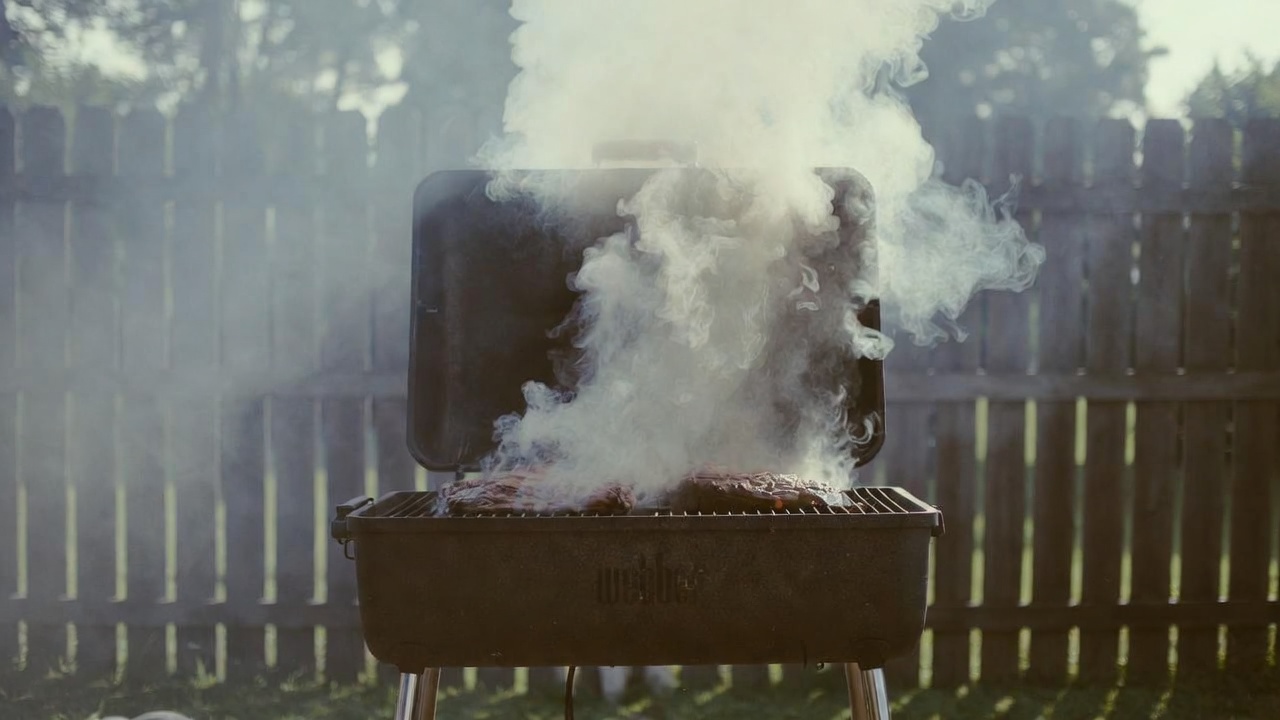
Why Santa Maria breaks every definition
If barbecue means low, slow, indirect, smoky and sauced, then Santa Maria barbecue is not barbecue. It is hot, fast, cooked directly over red oak coals on a grate above an open pit, seasoned with nothing but salt, pepper and garlic, and served without sauce.
And it is unambiguously barbecue. The Santa Maria Valley Chamber of Commerce runs a “Santa Maria Style Certified” designation. The tradition traces to mid-1800s ranch practice and was formalized around 1931 with the Santa Maria Club’s monthly Stag Barbecues. Traditionally the cut was top block sirloin; tri-tip rose after the 1950s, when local butcher Bob Schutz perfected it. Sides are pinquito beans, salsa, green salad and garlic bread.
This is the load-bearing counterexample. Any definition of barbecue built on temperature, smoke, sauce or cooking time excludes a 175-year-old American regional tradition with its own certification program. That is a bad definition. We wrote about the style’s recent return to prominence separately — but its real significance is definitional.
When did “BBQ” become an abbreviation?
Later than most people assume, and it did not start on a menu.
- 1886 — “Bar B Q” appears in a letter to the Charleston Enterprise about a Missouri barbecue (documented by food historian Robert F. Moss).
- 1930 — the earliest “BBQ” Moss located appears in the Cleveland Plain Dealer, in bowling league standings.
- 1936 — a Breckenridge American grocery ad offers “Hot B-B-Q” at 25 cents a pound; the OED’s own entry is dated 1939.
Lexicographer Grant Barrett notes that BBQ is an unusual clipping: the letters happen to match the syllables of “barbecue,” which is why it reads as a spelling rather than an abbreviation.
So what is barbecue, really?
After all of it, here is what the evidence actually supports:
- Barbecue is defined by usage, not by measurement. No authority sets a temperature. The people who cook it draw the line by intent and time scale — you barbecue a brisket, you grill a burger.
- The one federal definition is about fuel and yield. Hardwood or its coals, a rendered crust, no more than 70% of raw weight. That is the whole legal test.
- The word predates the American tradition and originally named a rack. A Taíno platform word, borrowed through Spanish, still meaning “grain storehouse” in English as late as 1625.
- The tradition is African American and Indigenous in origin, with named people and dated records — Perry, Bryant, Pettus, Gibson — not an anonymous folk inheritance.
- The regional styles are actually different cuisines, and at least one of them (Santa Maria) violates every element of the popular definition while remaining unquestionably barbecue.
The most useful definition is the loosest one: barbecue is meat cooked with the heat and smoke of a wood or charcoal fire, for long enough that the fire changes the meat’s texture and not just its surface. Everything narrower excludes somebody’s grandmother.
Frequently Asked Questions
Is there a legal temperature definition of barbecue?
No. The only binding federal definition, 9 CFR 319.80, requires hardwood fuel, a browned crust, and a maximum 70% cooked yield — it never specifies a temperature. The famous “225 to 275 °F” range that gets treated as a standard has no authoritative source behind it at all.
Does USDA agree on what temperature a smoker should run?
No, USDA contradicts itself. One current FSIS page says a smoker should run 225–300 °F. Another current FSIS page says 250–300 °F. Both pages are live at the same time.
What is the simplest definition of barbecue?
Meat cooked slowly by the heat and smoke of a wood or charcoal fire. That is the working definition almost everyone uses, even though no U.S. government agency, university, or sanctioning body has ever defined it by temperature.
Does the word “barbecue” come from the French “barbe à queue”?
No, that origin story is false. The Oxford English Dictionary dismissed it as far back as its first edition in 1888, calling it “an absurd conjecture suggested merely by the sound of the word.” The word’s earliest English uses, from the 1600s, describe a storehouse platform, not a cooking method.
Sources
- USDA, 9 CFR § 319.80, Barbecued meats (eCFR, current).
- USDA FSIS, Smoking Meat and Poultry, last updated Aug 13, 2024.
- USDA FSIS, Grilling Food Safely.
- University of Arkansas System Division of Agriculture, The science of barbecuing: grilling, smoking and beyond, May 20, 2026.
- Real Academia Española, barbacoa.
- Merriam-Webster, barbecue; Etymonline, barbecue.
- Michael Quinion, World Wide Words: Barbecue.
- Robert F. Moss, Putting the Q in Barbecue.
- NCpedia, Barbecue (Encyclopedia of North Carolina, UNC Press, 2006).
- Discover South Carolina, South Carolina’s Four Barbecue Sauces.
- Texas Historical Commission, Bringing Texas Barbecue History to the Table.
- Encyclopedia of Alabama, Big Bob Gibson Bar-B-Q.
- Southern Foodways Alliance, Tennessee BBQ oral history.
- Kansas City Public Library, KC Black History: the pioneers who made it the BBQ capital.
- Santa Maria Valley Chamber of Commerce, Santa Maria Style Barbeque Association.
- Atlanta History Center, From Pit to Plate: A Brief History of American Barbecue.
- Adrian Miller, Black Smoke, University of North Carolina Press, 2021.
- Jim Auchmutey, Smokelore: A Short History of Barbecue in America, University of Georgia Press, 2019.
- NPR, The history of barbecue, explained, July 2, 2025.
Related reading
- Smoking Times and Temperatures Chart — 18 cuts, pit temp, time per pound, pull temp, and the USDA safe minimum for each.
- How to Use a Meat Thermometer — placement by cut, calibration, and the altitude error that makes mountain cooks undercook everything.
- American BBQ History: Pioneering Pitmasters and Restaurateurs
- The Santa Maria Grill Comeback
- Across the Brand Avalanche network: Current Homesteading’s home canning time and pressure chart — the same primary-source approach applied to food preservation.
How this guide was made. Research-based, not experience-based. We read the current top-ranked pages for “what is barbecue,” then went to the primary sources they cite and the ones they don’t: the Code of Federal Regulations, USDA FSIS consumer pages with their own last-updated dates, the Real Academia Española, dated etymological attestations, state agencies and encyclopedias, and university press histories. Where an authoritative source does not exist — the 225–275°F band, the Memphis dry-versus-wet distinction, Owensboro’s black dip — we say so rather than citing a blog. Written and edited by a human; every source above is linked so you can check us.
Reader Favorites
- Budget-Friendly BBQ Tips: Master Savings Now!
- Cleaning Your Gas Grill Cooking Grate: Make it Great Again
- Stainless Steel BBQ Grill Cleaning: Master Maintenance Now
- Best Beef Breeds: Pick The Best For Smoking Now
- Lid Open or Closed: Master Your Grill Heat Now
- Different Cuts of Pork: Elevate BBQ Mastery Now
BBQ Temperature Charts & Guides
Four quick-reference tools every cook bookmarks — target temps, pull temps, and how long leftovers keep, plus the full BBQ glossary.
| Cut | Pull | Time |
|---|---|---|
| Brisket | 203°F | 12–16h |
| Spare ribs | 195–203°F | ~6h |
| Pork butt | 203°F | 12–14h |
Target temps & times for 17 cuts, sortable by meat, weight and doneness.
View full chart →| Doneness | Target |
|---|---|
| Rare | 125–130°F |
| Medium-rare | 130–135°F |
| Well-done | 160°F+ |
Rare to well-done, burger safety (160°F) and resting times.
View full chart →| Food | Fridge | Freezer |
|---|---|---|
| Brisket, ribs | 3–4 days | 2–3 mo |
| Smoked sausage | 1 week | 1–2 mo |
| Potato salad | 3–4 days | no freeze |
How long smoked meats & sides keep — fridge and freezer, USDA-based.
View full chart →Every pit term decoded — cooking methods, gear, cuts, wood, and technique, A to Z.
Open the glossary →