Santa Maria Grills Are Coming for Your Kettle: Inside the 2026 Adjustable-Grate Boom
The Santa Maria grill is the grill of 2026. The open-top, crank-adjustable design that fed California cattle ranches for 170 years is now the fastest-moving category in barbecue: Derek Wolf’s Fyr grill keeps selling out, Yoder just entered the market with a 780-pound Kansas-built flagship, and the hall-of-fame voices of the craft say the backyard kettle’s long reign is finally being challenged.
Last updated: October 10, 2026 · Originally published July 18, 2026
A Santa Maria grill is an open charcoal or wood-fired grill with a cooking grate you raise and lower over the fire using a crank or flywheel. Developed in California’s Santa Maria Valley in the 1800s, the design controls temperature by moving the meat instead of the flame — and in 2026 it is barbecue’s fastest-growing grill category.
Updated July 18, 2026.
Why the adjustable grate is taking over in 2026
Steven Raichlen — five-time James Beard Award winner and Barbecue Hall of Famer — put it flatly in his 2026 trend forecast: Santa Maria-style grills, “charcoal and wood burners with adjustable grates,” are positioned to replace the traditional kettle. His reasoning is mechanical, not romantic. A pulley or chain system that raises and lowers the grate with the turn of a crank gives you finer heat control over steaks, chops, seafood, and vegetables than any vent ever will. In the same 2026 trends report, Raichlen noted that influencer Derek Wolf “can’t keep” his Fyr grill in stock and called Kalamazoo’s Gaucho “magisterial.”
The demand signal is bigger than one forecast. Live-fire cooking has gone mainstream — The Smoke Sheet’s 2026 outlook points to live-fire events expanding globally, blurring the line between barbecue, chef culture, and entertainment. And with beef prices pushing cooks toward cheaper, faster cuts like tri-tip — the Santa Maria grill’s signature protein — the hardware and the economics arrived at the same moment.
Sold-out live-fire gear is now a pattern, not a fluke. It mirrors what happened in the carry world this month when the Leatherman Adapter sold out in hours: when a category catches a cultural wave, inventory is the first casualty.


Where the Santa Maria grill comes from
The design is older than the state fair. In the mid-1800s, ranchos in the Santa Maria Valley threw spring feasts where vaqueros barbecued beef over pits of native coast live oak — the “red oak” that still defines the style’s smoke profile. Top-block sirloin seasoned with salt, pepper, and garlic was the original cut. The Santa Maria Club formalized the tradition with monthly Stag Barbecues beginning in 1931, drawing crowds of up to 700.
Tri-tip joined the canon in the 1950s, when local butcher Bob Schutz started cutting the triangular bottom sirloin as a roast instead of grinding it. The cut and the grill have been inseparable since — if you have ever run a reverse-sear tri-tip, you have been cooking Santa Maria food on non-Santa Maria hardware.

The three grills driving the boom

Three brands at three price points are pulling the Santa Maria grill category in three directions. Each earns its lane.
Fyr grill: the one you can move — when you can get one
Derek Wolf built his audience at Over the Fire Cooking on exactly this style of live-fire work, and the Fyr grill is his answer to the category’s biggest barrier: mass. It is a modular, portable 304 stainless steel platform with 480 square inches of cooking surface and a patent-pending crank-lift system that accepts a drop-in Santa Maria attachment. It is best for the cook who wants adjustable-grate fire control at a tailgate, a campsite, or a small patio — and its repeated stock-outs are the loudest single demand signal in the category — the brand’s own storefront showed unavailable when we checked on July 18, 2026.
Yoder El Dorado: the pit-room build
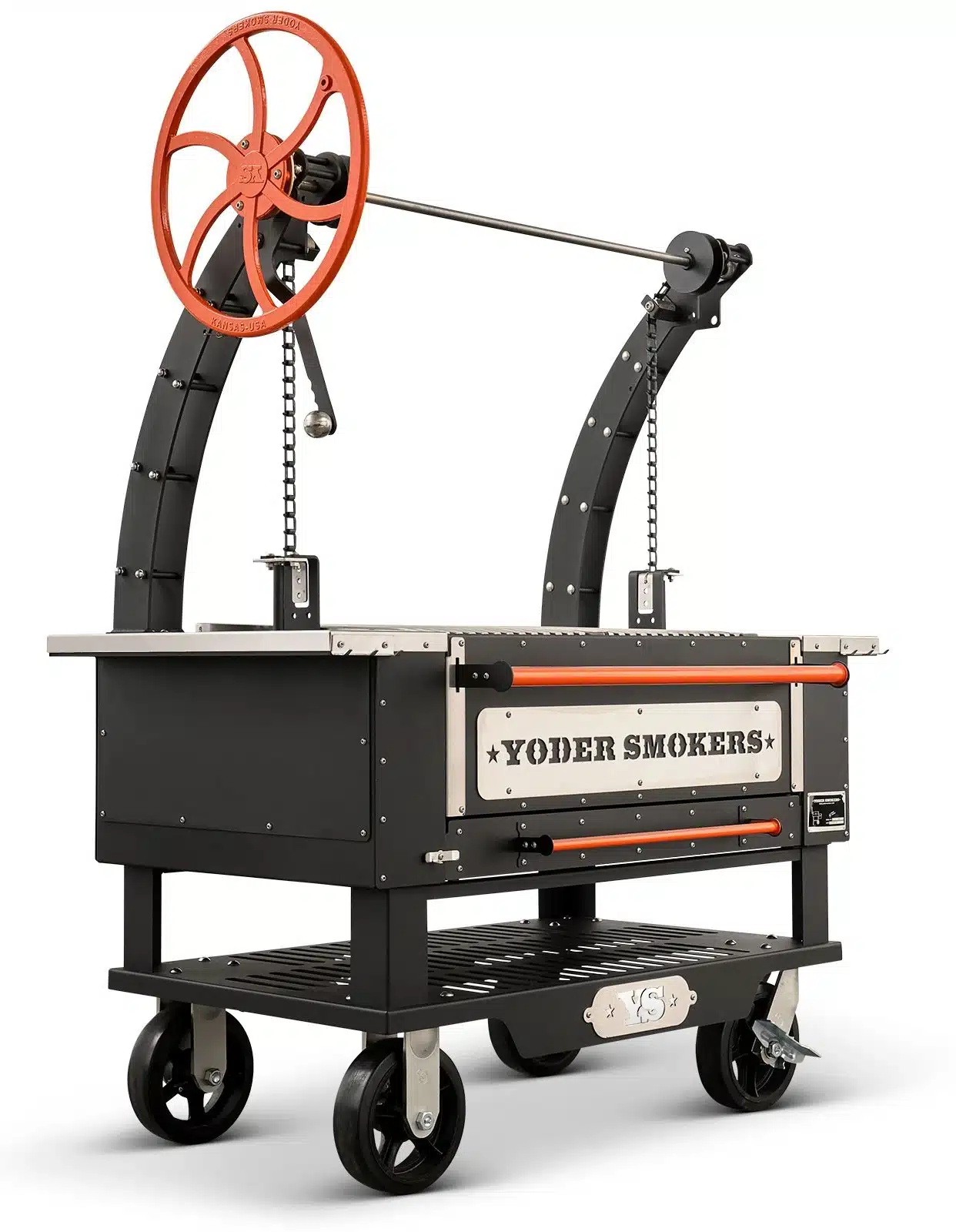
Yoder Smokers came at the category from the opposite direction. The 36-inch El Dorado, built in Hutchinson, Kansas, is a 780-pound firebrick-lined tank: 10-gauge steel firebox, 810 square inches of grate, and a chain-drive lift on a cast-iron hand wheel with an auto-stop ratchet giving 15 inches of vertical travel. It starts at $5,595, per Yoder’s published spec sheet. It is best for the serious backyard pitmaster who wants competition-grade steel and doesn’t plan to move it — ever.
Kalamazoo Gaucho: the magisterial one
At the top of the market sits the wood-fired Kalamazoo Gaucho, from $32,995 for the built-in model. Its signature spoked wheel raises and lowers the cooking surface with ratchetless, one-handed control, and a gas-starter system lights the wood fire without kindling drama. This is the outdoor-kitchen centerpiece — best for the buyer designing a permanent live-fire station where the grill is also the architecture.
How the field compares
The three headline grills are not the whole market. A kettle attachment gets you into the style for the price of a bag of ribeyes, and the Santa Maria Valley’s own fabricators and the Argentine-tradition builders fill out the middle. Every entry below earns a different cook.
| Model | Price (July 2026) | Cooking surface | Grate lift | Fuel | Best for |
|---|---|---|---|---|---|
| Onlyfire Santa Maria kettle attachment | $145.99 | 21.5″ grate (fits Weber 22″ kettle) | Hand crank, removable rotisserie | Charcoal | Trying the style on the kettle you already own |
| Fyr grill | Frequently sold out — storefront dark as of Jul 18, 2026 | 480 sq in | Crank lift, modular attachment | Charcoal / wood | Portable live-fire, first adjustable-grate grill |
| JD Fabrications 36″ Santa Maria | From $2,924 | 36″ × 24″ (48″ version same price) | Single crank, side hand wheel | Wood / charcoal | Central Coast authenticity — handmade to order in the style’s hometown, 1/4″ steel firebox |
| Yoder 36″ El Dorado | From $5,595 | 810 sq in | Chain drive, cast-iron hand wheel, 15″ travel | Charcoal / wood splits | Permanent backyard pit, heavy-gauge build |
| Tagwood BBQ03SS | $5,750 | 710 sq in, dual grates | Front or side elevation, auto-locking | Wood / charcoal | Argentine gaucho-style cooking — hooks, griddle, and multi-zone fire |
| Kalamazoo Gaucho | From $32,995 | Laser-cut multi-surface grates | Spoked wheel, ratchetless | Wood with gas starter | Outdoor-kitchen centerpiece |
How to cook on an adjustable-grate grill

The technique inverts everything a kettle taught you. On a kettle, the fire is fixed and you manage air. On a Santa Maria grill, the fire just burns — you manage elevation.
Start the grate high while the coals establish, about 18 to 24 inches over the fire. Drop it low for the sear — the last few inches are your cast-iron-pan moment, and thin cuts finish there start to finish. For a tri-tip or thick steak, run the middle heights the way you’d run a two-zone fire: crank down to build crust, crank up to coast to temperature. An instant-read thermometer still makes the final call; the wheel just replaces the lid, the vents, and the guesswork between readings.
Two practical notes. Burn real hardwood or lump — an open grate gives briquette smoke nowhere to hide. And keep a landing zone: because there is no lid, wind matters, so position the grill with the fire face out of a crosswind and expect to feed it more often than a closed cooker.
Do you really need one?
If your cooking runs to low-and-slow shoulders and briskets, keep your smoker — an open grate is the wrong tool for a 12-hour cook. If your weekends look like steaks, tri-tip, chicken halves, vegetables, and a crowd standing around the fire, a Santa Maria grill is the most fun you can buy in barbecue right now, and the theater is part of the value.
Buy on steel and mechanism, not on trend. The lift system is the part you will touch every minute of every cook, so crank it in person if you can. And the usual sale-season rules apply — the same discount math we ran on grill sales holds for this category too: a real deal discounts the current model, not a stripped-down special. One more honest cost to plan for: a grill this social produces leftovers, and smoked leftovers were born to become jerky — a food dehydrator closes that loop.
Frequently asked questions
What is a Santa Maria grill?
A Santa Maria grill is an open-top grill fired by charcoal or wood, with a cooking grate that raises and lowers over the fire via a crank, flywheel, or chain lift. The style originated in California’s Santa Maria Valley in the mid-1800s and traditionally burns red oak under sirloin or tri-tip.
Why are Santa Maria grills so popular in 2026?
Three forces converged: live-fire cooking went mainstream through events and creators, hall-of-fame authorities like Steven Raichlen forecast the adjustable grate as the kettle’s successor, and record beef prices pushed cooks toward tri-tip — the cut the Santa Maria grill was practically built for. New launches from Fyr and Yoder turned the momentum into a product race.
How much does a Santa Maria grill cost?
As of July 2026, entry starts around $146 for a crank-lift kettle attachment like Onlyfire’s. Dedicated grills run from roughly $2,924 for a handmade JD Fabrications pit, through the $5,500–$5,800 tier (Yoder El Dorado, Tagwood BBQ03SS), up to $32,995-plus for the luxury Kalamazoo Gaucho. Portable modular units like the Fyr grill sit at the lower-middle when in stock.
What do you cook on a Santa Maria grill?
Tri-tip is the signature, seasoned Santa Maria-style with salt, pepper, and garlic over red oak. The adjustable grate also excels at thick steaks, chicken halves, chops, seafood, and vegetables — anything that benefits from moving between searing heat and gentle finishing heat during a single cook.
Is a Santa Maria grill better than a kettle grill?
It depends on how you cook. A kettle is better for lid-on roasting, smoking, and windy-day consistency at a fraction of the price. A Santa Maria grill is better for direct-fire searing and precise, visual heat control — you adjust elevation instead of airflow. Serious live-fire cooks increasingly run both.
The wheel turns
Every barbecue era gets the grill it deserves. The suburbs got the kettle, the pellet decade got an app, and the live-fire era gets a crank handle and an open flame you can see. The ranchos had it right the whole time — it just took 170 years and a sold-out sign for the rest of the country to notice.
Methodology and sourcing note: specifications and prices cited here were pulled from manufacturer-published spec pages (Yoder Smokers, Kalamazoo Outdoor Gourmet, Over the Fire Cooking/Fyr, JD Fabrications, Tagwood BBQ, Onlyfire) on July 18, 2026, and from Steven Raichlen’s published 2026 trend forecast at BarbecueBible.com. Santa Maria historical detail is sourced to the Santa Maria Valley visitors bureau’s published history. Prices and stock status change; verify with the manufacturer before purchase. We have not yet field-tested these grills head-to-head and make no tested-performance claims.

Reader Favorites
- Essential BBQ Tools: Get The Tools Pros Recommend Now
- Cleaning Your Gas Grill Cooking Grate: Make it Great Again
- Stainless Steel BBQ Grill Cleaning: Master Maintenance Now
- Grill Baskets: Smoky Veggies & Fish Made Easy
- How to Grill Pizza: Stone or Grates? Tips & Tricks
- The Best Way to Use a Pizza Oven for Amazing Results
BBQ Temperature Charts & Guides
Four quick-reference tools every cook bookmarks — target temps, pull temps, and how long leftovers keep, plus the full BBQ glossary.
| Cut | Pull | Time |
|---|---|---|
| Brisket | 203°F | 12–16h |
| Spare ribs | 195–203°F | ~6h |
| Pork butt | 203°F | 12–14h |
Target temps & times for 17 cuts, sortable by meat, weight and doneness.
View full chart →| Doneness | Target |
|---|---|
| Rare | 125–130°F |
| Medium-rare | 130–135°F |
| Well-done | 160°F+ |
Rare to well-done, burger safety (160°F) and resting times.
View full chart →| Food | Fridge | Freezer |
|---|---|---|
| Brisket, ribs | 3–4 days | 2–3 mo |
| Smoked sausage | 1 week | 1–2 mo |
| Potato salad | 3–4 days | no freeze |
How long smoked meats & sides keep — fridge and freezer, USDA-based.
View full chart →Every pit term decoded — cooking methods, gear, cuts, wood, and technique, A to Z.
Open the glossary →