Beer Can Chicken: the Tasty Southern Party Trick
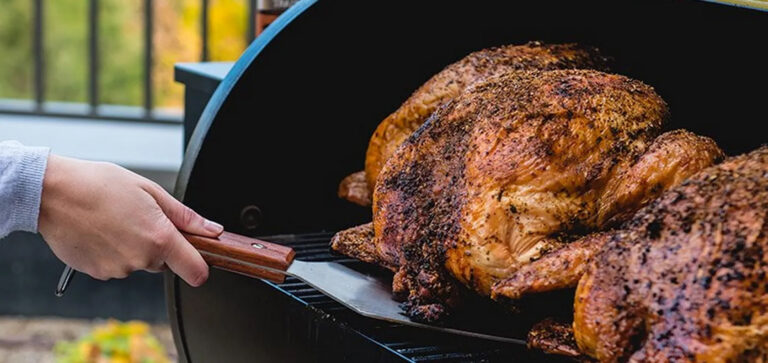
Beer can chicken is a whole bird roasted upright on an open can. The upright pose crisps the skin evenly; the beer adds little flavor.
Last updated: September 5, 2026 · Originally published September 3, 2026

What the Heck is Beer Can Chicken?
Beer can chicken, also called beer-butt chicken, chicken on a throne, dancing chicken, or, if you are feeling French about it, coq au can, is a whole chicken cooked vertically with a partially filled open can of beer wedged into the cavity. The can and the bird’s two legs form a three-point stand. Most people cook it on a grill over indirect heat; the same method works in an oven or a smoker. The usual ritual is simple:
- Open a 12-ounce can (or a tallboy), drink or pour off about half.
- Season the bird generously, inside and out.
- Slide the can into the cavity.
- Set the chicken upright over indirect heat and cook until the thickest part of the thigh hits a safe temperature.
Fans say the beer steams the meat from the inside while the upright position drains fat and crisps the skin all the way around. That second claim is the more reliable one. Fat runs off instead of pooling under the bird, so the skin browns more evenly than it does in a roasting pan. The first claim, that beer vapor seasons the chicken from within is the part food scientists are still debating.
Beer does not boil until 212°F. Inside a roasting bird, the liquid in the can often stays well below that. You get warm vapor, not a rolling steam bath. Blind tastings by barbecue writer Steven Raichlen found it hard to tell Budweiser from Guinness from cola once the rub and smoke do their work. The posture does more than the brew.
That does not make the method useless. Vertical roasting is a real technique. Rotisserie chickens around the world cook standing or spinning for the same reason: even heat, draining fat, crackling skin.

A Southern party trick with no single inventor
Nobody can name the first person who looked at a half-finished beer and a raw chicken and thought, yes. Most food researchers place the idea in the American South in the 1980s or early 1990s. Recipes show up around the same time in Louisiana, Texas, Mississippi, and Kansas. Barbecue judge Ardie Davis basically said “It just happened everywhere at once.”
The rest is folklore: a pitmaster sets a beer down, absently parks a chicken on it, opens the lid an hour later, and finds dinner standing at attention. Whether that story is true matters less than what it captures. This is improvisational American cooking, beer on the grate, bird in the cooler, heat already going.
Why it became popular
WARNING! The science is contested. The popularity is not.
Basically it’s cooking theater and a food spectacle. A chicken standing on a can is funny before it is food. the first time you see it in real life people photograph it and post on social media.
It is also forgiving in the ways home cooks care about. The vertical stance helps the skin crisp on the back and sides, not just the breast. Indirect heat is gentler than a screaming-hot grate. A well-seasoned bird comes off looking like it required more skill than it did and basically it’s all due to the posture of the bird allowing an even roasting heat.
And it travels well as an idea. You can do it on charcoal, gas, pellets, or in the oven. You can swap beer for cider, wine, soda, or broth. Popeyes even sold a beer-can-chicken-inspired fried item in 2014 that contained no beer at all, which is either heresy or proof that the name had become the product.
Critics such as Meathead Goldwyn of AmazingRibs argue that the method is a gimmick, that the can can cool the cavity, and that a spatchcocked chicken or a proper vertical roaster is simply better cooking. Even though they are not wrong about the physics none the less people swear by the method and it has not killed the ritual. People keep making beer can chicken because it is festive, because the skin can be excellent, and because a cookout is allowed to be a little stupid.

If you want the honest answer first: the rub, salt, smoke, and cook matter more than the brand in the can. Use beer you would drink. Do not sacrifice a rare barrel-aged stout to a cavity that will barely taste it.
Best everyday choice: clean lagers and pilsners.
American lagers, Mexican lagers, helles, and Czech-style pilsners are the classic move. They are low in bitterness, lightly malty, and disappear into the background. Budweiser is the historical default. Modelo Especial, Coors Banquet, Pilsner Urquell, Tsingtao, and similar beers do the same job. If the beer is only a prop and a little steam, these are the least likely to fight the chicken.
When the rub is herby or citrusy: wheat beers and light ales.
A hefeweizen, American wheat, or Belgian-style white can echo orange, coriander, thyme, or lemon in the seasoning. Blue Moon with an orange-forward rub is a common backyard pairing. Keep it gentle. Banana-bomb hefeweizens can get cartoonish next to poultry.
When the rub is darker or sweeter: mild brown ales, amber lagers, soft porters.
A little toast and caramel can sit next to paprika, molasses, or brown-sugar barbecue rubs. Use these more as a baste or a sauce beer than as a hope that the cavity will taste like dessert. Very sweet pastry stouts tend to taste odd against savory skin.
Match the cuisine
Jerk seasoning and Red Stripe. Lime-heavy marinades and a crisp Mexican lager. Mediterranean herbs and a soft wheat beer. Soy-garlic birds and a clean Japanese lager. The pairing logic is the same as at the table: complement, don’t drown.
Usually skip for the can itself: big IPAs and dessert beers.
West Coast IPAs and double IPAs get louder and more bitter with heat. If you love hops, drink the IPA beside the chicken and put a lager in the can. Save the imperial stout for the glass.
A practical rule: pour half the can into a glass for the cook, put the rest in the bird, and put aromatics where they actually work for example lemon, garlic, onion, or herbs in the neck cavity or under the skin. That is where flavor transfer is real.
Craft breweries have leaned into the joke. Perdue even collaborated on a “Beer Can Chicken Beer,” a honey citrus ale built as much for the grill as for sipping. Fun, not mandatory. A $3 lager still makes a $20 chicken taste like Saturday.
What the thermometers actually measured
Two people stopped arguing about this and put probes in the bird instead. Their numbers are the reason this page keeps saying the posture does the work and the beer does not.
Prof. Greg Blonder ran thermocouples into the cavity. Above an open can, the air peaked at about 165°F (74°C). He then roasted a bird the same way with nothing in the cavity, and that air reached 212°F (100°C). Boiling. So the can is not steaming the chicken from the inside. It is a cold object parked in the middle of it, holding the cavity roughly 47°F below where an empty cavity runs.
ThermoWorks came at it with four probes and got the same story from another angle. The liquid in the can peaked at 178°F (81°C). Beer at about 4.8% alcohol boils near 196°F (91°C) at the elevation they tested, so it never got close. And then the detail that settles it: they weighed the can. It went on at about 7 ounces and came off at 7.4 ounces (198 to 211 grams). The can finished the cook heavier than it started. It was catching drippings, not giving up steam.
| What was measured | Reading | Who measured it |
|---|---|---|
| Cavity air above an open can | peaked ~165°F (74°C) | Blonder, thermocouple runs |
| Cavity air, same method, no can | ~212°F (100°C) | Blonder |
| Difference the can makes | ~47°F cooler cavity | Blonder |
| Liquid in the can | peaked 178°F (81°C) | ThermoWorks, four-probe test |
| Boiling point of 4.8% beer at that elevation | ~196°F (91°C) | ThermoWorks |
| Weight of the can, before and after | 7 oz → 7.4 oz (198 → 211 g) | ThermoWorks |
Lower cavity air is not a safety problem on its own — you are cooking to the thigh, not to the cavity. It is a speed and browning problem.
So, plainly: does the beer boil? No. Does it flavor the meat? Not measurably. Does the cavity cook cooler with a can in it? Yes, by about 47°F of air temperature. Everything good about the dish is happening on the outside of the bird.
Safety: the part that is not a joke
There are three separate questions people mash together: chemicals from the can, burns and spills, and undercooked poultry. They are not the same problem.
Beverage cans are made for drinking, not roasting. Germany’s Federal Institute for Risk Assessment advised against the method in 2014, arguing that heat, fat, and alcohol vapor can pull substances from printing inks and interior coatings into food. That is a real regulatory caution, not internet folklore.America’s Test Kitchen tested chickens cooked on beer cans versus stainless vertical roasters and found BPA in the meat at less than 20 micrograms per kilogram which is far below the FDA’s then-cited adult exposure standard. Raichlen has said lab tests for his book did not find residue from metal, liner, or label ink in the meat. Those tests are reassuring to many home cooks. They are not a government endorsement of cooking on printed aluminum.

The can and the drippings are hot. Birds tip. Hot beer and fat on bare legs is the actual emergency-room scenario, not a cartoon explosion. Use tongs and insulated gloves. Set the bird on a sheet pan or in a roasting pan with a drip tray. Open the grill lid away from your face. Do not cook if you are too drunk to move a four-pound chicken without dropping it.
This is the safety issue that matters most. Raw poultry can carry Salmonella and Campylobacter. Color is a bad guide. Use a thermometer. The USDA says all poultry including whole bird, breast, thigh, wing, ground, should reach 165°F (73.9°C). Check the innermost thigh, the wing joint, and the thickest part of the breast. Because a can occupies the cavity, do not treat the very center as your only reading. Probe the meat, not the beer.
- Thaw in the refrigerator, not on the counter.
- Don’t wash raw chicken; you splash bacteria around the sink.
- Use separate boards and platters for raw and cooked birds.
- Never leave the finished chicken sitting in the danger zone. Rest it briefly, then carve or hold it hot.
- Discard the liquid in the can. It is not gravy and it is not a second drink.
Some writers worry that a cool can slows cooking near the cavity and stretches time in the 40–140°F range. The fix is not vibes. It is indirect heat around 350°F, enough time, and a thermometer you trust.Alcohol in the finished meat is not a serious concern for most eaters. Much of it cooks off, and very little of the beer is absorbed. People avoiding alcohol entirely can use stock, cider, or water in a roaster instead.
Exploding cans
We found no documented case of a can exploding during beer can chicken. Even AmazingRibs, the most aggressive critic of the technique, makes no such claim. The exploding-can stories that do exist are product recalls for over-carbonation and secondary fermentation, nothing to do with cooking. And an open can cannot pressurize; that is the whole reason it is open.
There is a real hazard, and it is mundane. Blonder describes the can sticking in the cavity and dumping hot liquid and grease when you try to extract it. That is a scald and a mess, and it happens routinely. If you are going to do this anyway, take the bird off with tongs and a folded towel, over a sheet pan, and let the whole assembly cool for a few minutes first.

How to cook it so it is more than a gag
Pat the chicken dry. Salt it early if you can. A dry surface browns; a wet one steams.
Use indirect heat. On a gas grill, light one side and park the bird on the other. On charcoal, bank the coals to the sides and put a drip pan in the middle. Add a little wood like apple, pecan, oak THIS does more for flavor than the beer ever will.Expect about an hour to an hour and a quarter for a 3.5- to 4-pound bird, but cook to temperature, not to the clock. Rest 10 minutes before you try to extract the can. The skin will be less likely to tear, and the juices will settle.
If the whole upright circus feels unstable, spatchcock the chicken instead: backbone out, bird flattened, same rub, same grill. You lose the photograph and keep the eating quality. Or buy the $15 vertical stand and stop balancing dinner on a cylinder of aluminum.
The honest verdict
Beer can chicken is not the most efficient way to roast a bird. It is not a flavor delivery system on par with a brine or a good spice paste. It is a vertical roast with a punchline.
What made it last is the combination of crisp skin, low effort, and communal silliness. The history is Southern, messy, and shared rather than patented. The best beer is usually a lager you already like. The real precautions are a thermometer, a stable setup, and a willingness to use a proper roaster if printed cans make you uneasy.
If you want dinner that looks like a dare and eats like a cookout, stand the chicken up. Just remember which part of the recipe is science and which part is the show.
What official guidance says
None exists. We searched FSIS and FDA and found no guidance addressing beer can chicken, or heating a beverage can as a cooking vessel, at all. That is itself worth stating, because several popular pages imply an official concern that is not there.
So how should you cook a whole chicken?
Here is the constructive half, and it is where the real gains are.
Salt it a day ahead
This is the single biggest improvement available, and it costs nothing. Salting a whole bird in advance draws out moisture that dissolves the salt and is reabsorbed as seasoning, and it dries the skin so it crisps. America’s Test Kitchen’s ratio is 1 teaspoon of kosher salt per pound for a whole chicken, applied in the cavity and under the skin, resting 6 to 24 hours in the refrigerator.
One critical caveat that ratio hides: which kosher salt. A teaspoon of Diamond Crystal is 2.8 grams and a teaspoon of Morton is 4.8 – a 71% difference at the same spoon volume. Our dry brining guide gives the weights, the brand-conversion table, and USDA’s own protocol.
Consider losing the cavity entirely
Spatchcocking, removing the backbone and flattening the bird — makes thickness roughly uniform, so the breast and the thighs finish closer together. We want to flag the sourcing honestly: we could not find a citable, measured cook-time comparison for spatchcocked versus whole birds. The mechanism is sound reasoning, and Blonder’s data supports the underlying principle indirectly (he found orientation alone made no difference to cook time, which points at thickness uniformity as the real lever). But if someone quotes you a percentage, ask where it came from.
If you want it vertical, use a stand
The vertical position has genuine defenders: even browning, and fat draining away from the skin. Blonder measured a vertical wire frame as performing as well as horizontal roasting — because unlike a can, an open frame does not chill the cavity. ATK used a stainless steel vertical roaster as its control. If you like the look and the drainage, buy a purpose-built stand. You get every benefit anyone has ever credited to beer can chicken, and none of the 47°F cavity penalty.
Sources
- Greg Blonder, Genuine Ideas, beer can chicken thermocouple study, June 2012
- Meathead Goldwyn with Prof. Greg Blonder, AmazingRibs, beer can chicken, published August 2, 2012, last modified July 20, 2026
- ThermoWorks, beer can chicken four-probe test, Martin Earl, April 20, 2021
- Steven Raichlen, Beer Can Chicken Revisited, Barbecue Bible, July 26, 2019
- America’s Test Kitchen, BPA and Beer Can Chicken laboratory test; Marinating Myths; How to Salt Chicken and How to Brine Chicken, April 10, 2017
- U.S. Food and Drug Administration, Bisphenol A (BPA): Use in Food Contact Application, content updated April 20, 2023; Questions and Answers on BPA Use in Food Contact Applications
- Food Packaging Forum, Can Coatings dossier, published September 15, 2025, modified February 20, 2026 (DOI 10.5281/zenodo.200633)
- Takao Y., Lee H.C., Kohra S., Arizono K. (2002), “Release of Bisphenol A from Food Can Lining upon Heating,” Journal of Health Science 48(4):331
- Goodson et al. (2004), on migration during can processing and sterilization, via the Food Packaging Forum dossier
- USDA FSIS, Chicken from Farm to Table; Safe Minimum Internal Temperature Chart


Reader Favorites
- Easy BBQ Foods: Grill Like a Pro with These 10 Recipes
- Best Beef Breeds: Pick The Best For Smoking Now
- Grilling Crispy Hot Wings: Master Crunchy Perfection Now
- Different Cuts of Pork: Elevate BBQ Mastery Now
- Spicy Jamaican Jerk Chicken: Unleash Fiery Flavor Now
- Dr Pepper BBQ Wings: Add an Awesome Twist to Your Wings Now
BBQ Temperature Charts & Guides
Four quick-reference tools every cook bookmarks — target temps, pull temps, and how long leftovers keep, plus the full BBQ glossary.
| Cut | Pull | Time |
|---|---|---|
| Brisket | 203°F | 12–16h |
| Spare ribs | 195–203°F | ~6h |
| Pork butt | 203°F | 12–14h |
Target temps & times for 17 cuts, sortable by meat, weight and doneness.
View full chart →| Doneness | Target |
|---|---|
| Rare | 125–130°F |
| Medium-rare | 130–135°F |
| Well-done | 160°F+ |
Rare to well-done, burger safety (160°F) and resting times.
View full chart →| Food | Fridge | Freezer |
|---|---|---|
| Brisket, ribs | 3–4 days | 2–3 mo |
| Smoked sausage | 1 week | 1–2 mo |
| Potato salad | 3–4 days | no freeze |
How long smoked meats & sides keep — fridge and freezer, USDA-based.
View full chart →Every pit term decoded — cooking methods, gear, cuts, wood, and technique, A to Z.
Open the glossary →