How to Use a Charcoal Grill: Two-Zone Setup, Vent Control, and What Medium-High Actually Means
Two-zone setup, vent control, and what published sources actually mean by medium-high heat, compared against the hand test most books use.
By James Nicholas · Researched from CPSC and NFPA data, federal labeling regulations, USDA FSIS, the National Cancer Institute, Cooperative Extension publications and manufacturer specifications · Last verified August 19, 2026
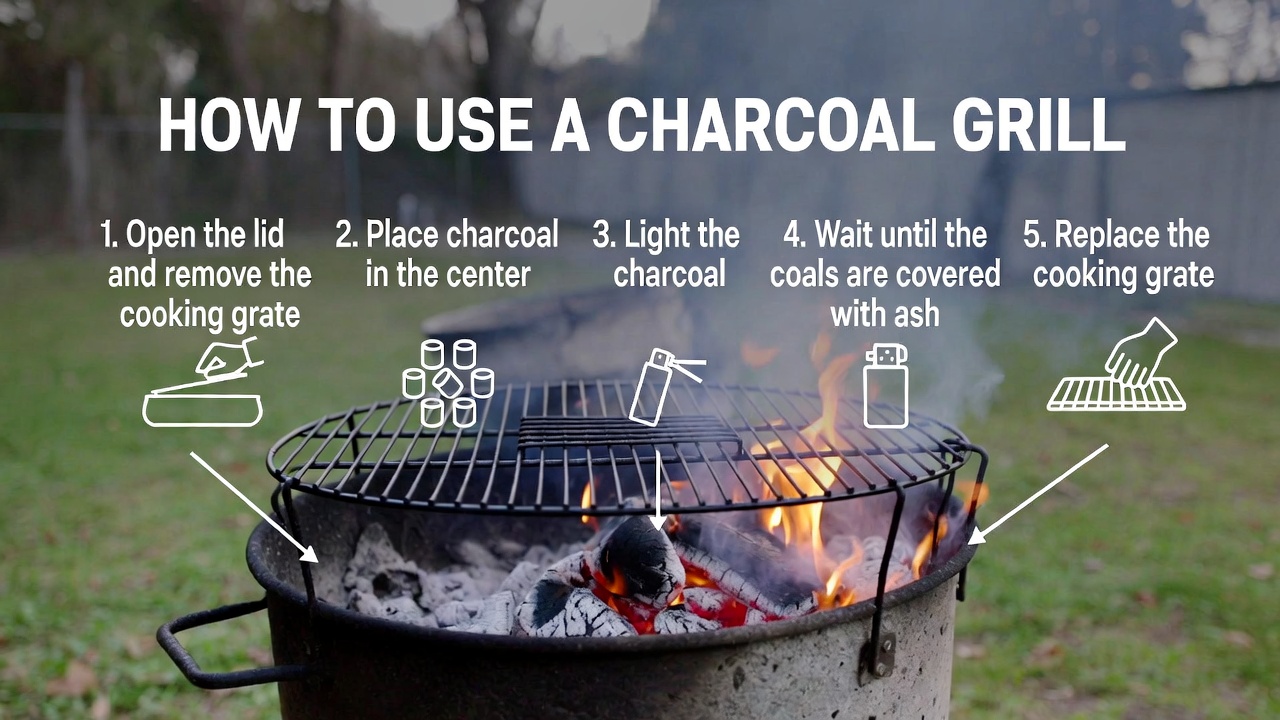
Light a full chimney of charcoal — about 100 briquettes or 4 pounds — and when the coals ash over, pour them onto one half of the grate. That gives you a two-zone fire: a hot side to sear over and a cool side to finish on. Leave one vent wide open and control temperature with the other. Then check the food with a thermometer, not the lid gauge, which typically reads 35–50 °F off the grate.
The parts that matter
- “Medium-high heat” means anywhere from 350 °F to 500 °F depending on which chart you read. We put seven published charts side by side below. No federal or standards body defines grilling heat levels at all.
- The hand test is not one test. Published versions use three different hand heights, and at the same two-second count they report anything from 375 °F to 550 °F.
- Weber and AmazingRibs give opposite vent instructions. One says control with the top vent, the other says control with the bottom. Both are partly right, and we explain why.
- The safety layer is missing from every guide we checked. CPSC estimates 18 charcoal carbon-monoxide deaths in 2022 — the highest in an eleven-year series — and a CO warning is federally required on the bag you just opened.
- “Lump burns hotter than briquettes” is contradicted by the only thermocouple test we could find.
How do you set up a two-zone fire?
Two-zone cooking is the technique the rest of grilling is built on. You put all the burning charcoal under one half of the cooking grate and leave the other half empty. The hot side sears. The cool side — which is really an oven, heated by convection with the lid down — brings the interior up to temperature without burning the outside.
- Fill a chimney starter. A full standard chimney holds roughly 100 briquettes, about 4 pounds, about 6–7 quarts. Four independent sources agree on that figure — a rare point of consensus in this category.
- Light it with paper or a paraffin cube under the chimney and leave it. Coals are ready when the top layer is ashed over gray, typically 15–20 minutes.
- Pour onto one side. For a standard 22-inch kettle, a half chimney (50–60 briquettes) banked to one side gives a hot zone around 450–550 °F and a cool zone around 350–450 °F, per Kingsford’s published figures.
- Set the grate, close the lid, open both vents, and let it preheat 5–10 minutes so the grate itself gets hot.
- Sear over the coals, then slide to the empty side and close the lid to finish. That is the whole technique.
| Setup | Charcoal | Target temperature | Use it for |
|---|---|---|---|
| Direct, full bed | 1 full chimney — ~100 briquettes / ~4 lb | 450–550 °F | Thin steaks, burgers, vegetables, anything under 20 minutes |
| Two-zone, banked to one side | ½–1 chimney — 50–100 briquettes | Hot 450–550 °F, cool 350–450 °F | Thick steaks, bone-in chicken, chops — the default |
| Two-zone parallel, coals both sides, pan in the middle | 1 chimney | 250–350 °F | Whole birds, roasts, ribs |
| Snake / fuse | ~100 unlit briquettes plus 6–8 lit | 225–250 °F claimed | Long low-and-slow cooks on a kettle |
Charcoal quantities and target temperatures as published by Kingsford; chimney capacity cross-checked against America’s Test Kitchen (115 briquettes for a heaping chimney), Home Depot (100) and Weber (50–60 for a half chimney).
What does “medium-high heat” actually mean?
This is the question underneath most grilling failures, and it has no answer. We pulled every published grill-heat chart we could source. They do not agree, and two of them are from the same manufacturer.
| Source | Date | Low | Medium-low | Medium | Medium-high | High |
|---|---|---|---|---|---|---|
| Weber, two-zone guide | undated | — | 325–375 | 375–425 | 450–500 | 500–550 (550+ “very high”) |
| Weber, temperature-control guide | undated | 250–350 | — | 350–450 | — | 450–550 |
| Steven Raichlen, Barbecue Bible | Mar 3, 2026 | 225–250 | 275–300 | 325–350 | 375–400 | 450–600 |
| A Couple Cooks | May 18, 2026 | 300–350 | — | 350–375 | 375–450 | 450–650 |
| America’s Test Kitchen | May 27, 2019 | 250–300 | — | 300–400 | — | ~500 |
| Old Farmer’s Almanac | undated | 250–300 | 300–350 | 350–400 | 400–450 | 450–500 |
| NDSU Extension, FN1412 | rev. July 2021 | 200–300 | — | 300–350 | 350–375 | 375+ |
All temperatures in °F, as published by each source.
“Medium-high” spans 350 °F to 500 °F — a 150-degree disagreement. NDSU Extension’s “hot” starts at 375 °F, which is below Raichlen’s medium-high and 175 degrees below Weber’s “high.” Weber contradicts itself across two of its own pages: medium is 375–425 on one and 350–450 on the other.
And there is no authority to appeal to. USDA FSIS publishes no grill-surface temperature definitions at all — only safe internal temperatures for food. There is no federal standard, no ASTM standard, and no industry standard for what “medium-high” means on a grill.
What to do with this. Stop cooking to adjectives. When a recipe says “medium-high,” it means the author’s fire, not yours. Put an instant-read or a leave-in probe an inch above the grate, learn what your own grill does at a given vent setting, and cook to numbers. For what it is worth, our working convention on this site is medium-high = 425–475 °F at the grate — and we are labeling that as our editorial convention, not a standard, because no standard exists.
Download the grill-heat comparison dataset (CSV)
Every published grill-heat definition and hand-test mapping we could source, side by side with its source and date, plus charcoal setup targets and thermocouple fuel-test results. Free to reuse with attribution (CC BY 4.0).
Does the hand test work?
The hand test — hold your palm over the grate and count how many seconds you can stand it — is the most-repeated grilling heuristic in existence. It is also three incompatible tests wearing the same name.
| Source | Hand height | 2 seconds | 4–5 seconds | 8–10 seconds |
|---|---|---|---|---|
| Weber | 5 inches | 2–4 s = 450–550 °F | 5–7 s = 350–450 °F | 8–10 s = 250–350 °F |
| NDSU Extension | not stated | 2 s = 375 °F and up | 4 s = 300–350 °F | 5 s = 200–300 °F |
| Old Farmer’s Almanac | 3 inches | 2–3 s = 400–450 °F | 4–5 s = 350–400 °F | 7–9 s = 250–300 °F |
| Steven Raichlen | 3 inches | 2–3 s = “hot” | 5–6 s = “medium” | 10–12 s = “low” — no °F given |
| America’s Test Kitchen (2019) | 5 inches | 2 s = “hot,” ~500 °F | 5–6 s = “medium” | 8 s = “low” |
| America’s Test Kitchen (2023 book) | 2 inches | 2 s = “hot” | 4 s med-hot, 6 s medium | 10 s = “cool” — no °F given |
Three things are wrong here at once.
- The hand height varies from 2 inches to 5 inches and nobody reconciles it. Radiant heat falls off steeply with distance, so a “four-second fire” at 2 inches and a “four-second fire” at 5 inches are physically different fires.
- At the same two-second count, published temperatures run from 375 °F to 550 °F — a 175-degree disagreement on the single most-cited data point in charcoal grilling.
- America’s Test Kitchen publishes two different versions of its own test — 5 inches in 2019, 2 inches in its 2023 outdoor cookbook, with different mappings. And Weber’s hand test (2–4 s = 450–550 °F = “high”) is inconsistent with Weber’s own temperature chart, which calls 450–500 medium-high.
Raichlen’s own page is honest about it: the hand test is a quick estimate, not a precision measurement. Use it to tell a roaring fire from a dying one. Do not use it to hit a number.
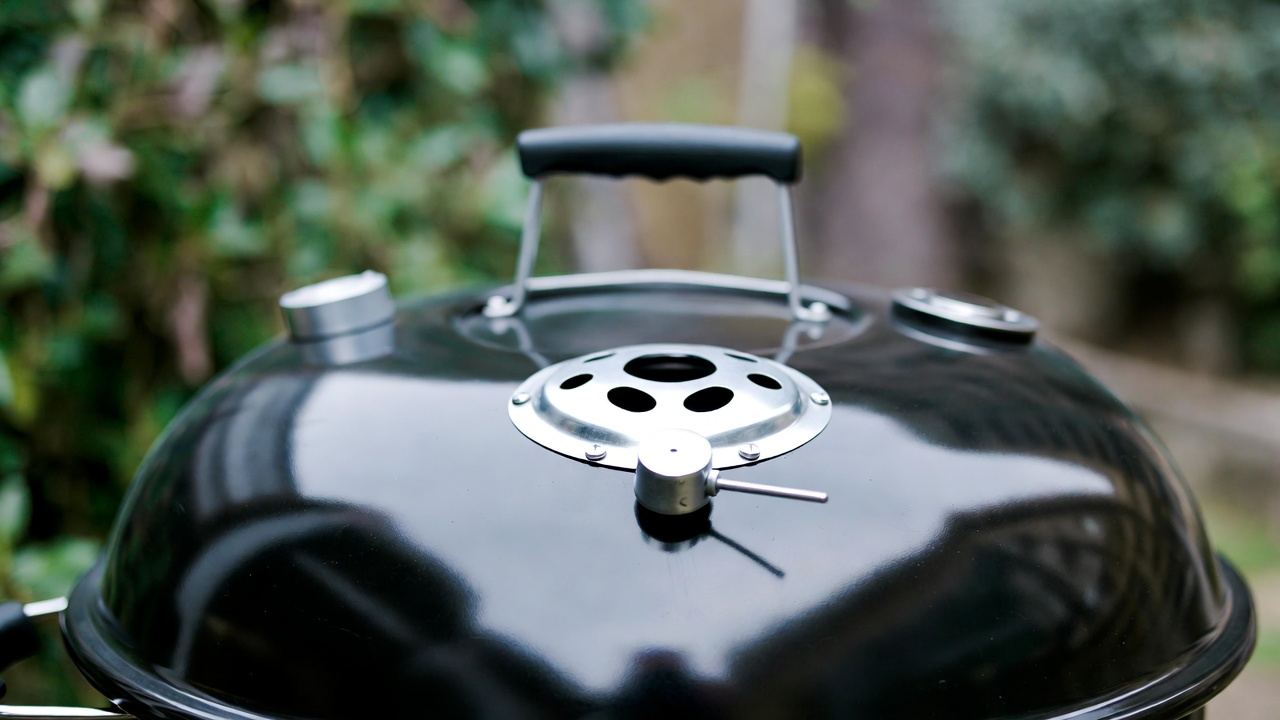
Which vent controls the temperature?
Here two of the most-cited authorities in barbecue give flatly opposite instructions, and nobody seems to have noticed.
| Source | Instruction |
|---|---|
| Weber | Leave the bottom dampers fully open and use the top lid damper to control temperature. Published settings: fully open 450–550 °F; half open 350–450; quarter open 250–350; an eighth to a quarter 225–275. Weber explicitly rejects fuel quantity as the control variable. |
| AmazingRibs (Meathead Goldwyn) | Control temperature mainly with the intake damper and leave the exhaust damper open all the way. Uses the analogy that playing with both vents at once is like controlling a car’s speed with the gas and the brake simultaneously. Last modified March 14, 2026. |
How to reconcile them. Notice what the two camps actually agree on: pin one vent wide open and vary the other one only. That is the real instruction, and both sources give it. They differ on which vent to pin.
Physically, the intake damper meters oxygen to the fuel bed, which sets how fast the fuel burns; the exhaust damper sets the draft that pulls air through the system. Either one can throttle the fire, because the system is a chimney and restricting it anywhere reduces flow. What you must not do is adjust both at once, because then you have two variables and no way to learn what either one does.
Our recommendation: pick one convention and stay with it. On a kettle, we would follow AmazingRibs — exhaust wide open, bottom intake as the throttle — because leaving the exhaust open keeps smoke moving through and off the food rather than stalling it in the dome. On a Weber with a one-touch bottom damper that is fiddly to reach, Weber’s method is perfectly workable. Either way: change one vent, wait 10–15 minutes, then read the temperature. A charcoal fire responds slowly and most over-corrections come from impatience.
Why is the lid thermometer wrong?
Because it is measuring the wrong air. The dome gauge sits several inches above the food in a different part of the airflow, and different zones of the same grill can differ by as much as 50 °F.
ThermoWorks — a thermometer manufacturer, so an interested party, and we will say so plainly — publishes the most specific figures we could locate: relying on the dome thermometer puts your heat setting 35 °F to 50 °F too high or too low, and they show a case where the grate read 25 °F higher than the dome. Their recommendation is an air probe about an inch above the cooking surface, near the food. We could find no university or Extension study quantifying the dome-to-grate offset, so treat the specific numbers as manufacturer data rather than independent science.
Put that next to the 150-degree disagreement about what “medium-high” means and the conclusion is unavoidable: the published charts cannot be executed as precisely as they are written. Cook to the food’s internal temperature, which is the only number that is actually about your dinner.
Briquettes or lump charcoal?
The universal claim is that lump burns hotter and briquettes burn longer. The only thermocouple test we could source says otherwise on both counts.
| Fuel | Type | Peak temperature | Burn duration |
|---|---|---|---|
| Kingsford Original | Briquette | 728.8 °F | 2 h 21 min |
| B&B Competition Oak | Briquette | 665.8 °F | 3 h 27 min |
| Cowboy Hardwood | Lump | 664.0 °F | 2 h 1 min |
| FOGO Premium | Lump | 590.1 °F | 1 h 13 min |
| Royal Oak | Lump | 545.6 °F | 49 min |
America’s Test Kitchen equipment testing, 6-quart chimney, fully ashed, thermocouple-instrumented; ATK states it consulted USDA Forest Products Laboratory scientists.
In that test the two briquettes were the two hottest fuels and also the two longest-burning — the exact inverse of the folk wisdom. One test is not the last word, and lump has real advantages (it lights faster, and ATK observed it produces less ash, though nobody has quantified that). But anyone telling you flatly that lump burns hotter is repeating a claim that the only available measurement contradicts.
What is in a briquette?
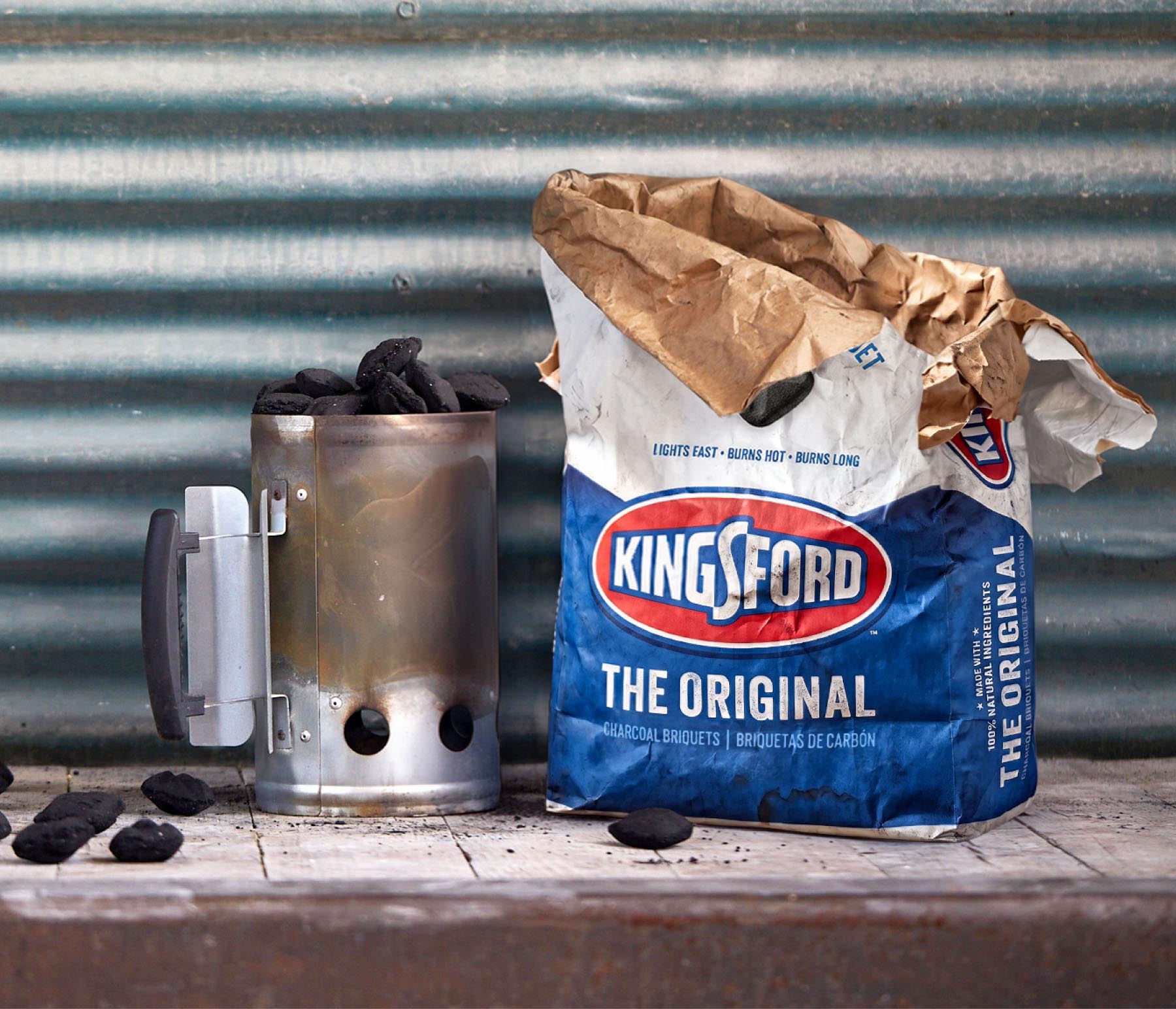
Kingsford’s consumer FAQ discloses only “locally sourced wood and other natural ingredients” and “natural binders.” A 2014 safety data sheet for the Singapore market lists actual components: charcoal, ashes and residues, anthracite coal, maize starch as binder, limestone, sodium nitrate, and a trace of borax. Two caveats we will not paper over: those are overlapping disclosure bands, not a recipe, and the sheet is a 2014 document for another market. There is also a sourced claim that sodium nitrate was dropped from briquettes around 2005–2006, which the 2014 sheet contradicts. We could not resolve it, so we are reporting both.
Charcoal grill safety: the part every other guide skips
We checked eight top-ranking charcoal grilling guides. Not one mentions carbon monoxide. Not one mentions grill fire statistics. This is the most consequential thing on this page.
Never burn charcoal indoors, in a garage, in a tent, in a camper, or in a vehicle — not even with ventilation.
The Consumer Product Safety Commission’s most recent published estimates attribute 18 carbon-monoxide deaths to charcoal in 2022, seven percent of all consumer-product CO deaths that year, and the highest figure in the eleven-year series CPSC publishes. The 2020–2022 average is 14 deaths a year. CPSC notes most involved charcoal used, or suspected of being used, for heating — in homes, vehicles and temporary shelters.
Carbon monoxide has no odor and no color. Charcoal keeps producing it until it is completely extinguished, which is why you must not bring fresh or spent coals indoors to cool.
This is not a matter of opinion or house policy. Since November 1997, federal regulation 16 CFR 1500.14(b)(6)(ii)(A) has required a carbon-monoxide warning on charcoal packaging. As CPSC quotes the required language: “Burning charcoal inside can kill you. It gives off carbon monoxide, which has no odor. NEVER burn charcoal inside homes, vehicles or tents.”
Note what changed. The pre-1997 label permitted indoor use if ventilation was provided. The current one says never. That is a deliberate regulatory reversal, and it means older advice you may have absorbed is not just outdated, it is the thing the rule was rewritten to stop.
Grill fires, in numbers
| Measure | Annual average, 2014–2018 |
|---|---|
| Home grill fires | 10,600 (4,900 structure, 5,700 outside) |
| Civilian deaths | 10 |
| Civilian injuries | 160 |
| Direct property damage | $149 million |
| Fuel involved | Gas 84%; charcoal and other solid fuel 12% |
| Peak month | July — 18% of the annual total |
| Leading cause, structure fires | Failure to clean, 29%, then heat too close to combustibles 16%, then equipment left unattended 16% |
| Emergency-room grill injuries | ~19,700, of which ~9,500 thermal burns |
| Children under 5 | Two-fifths of all grill contact burns |
National Fire Protection Association, Home Grill Fires, published May 2020, covering 2014–2018. We could not verify a more recent NFPA grill report, so the data years are stated rather than implied.
The single most actionable line in that table is the leading cause: failure to clean. Grease and food residue in the bottom of a kettle is fuel. Empty the ash catcher and scrape the bowl.
Practical safety rules
- Outdoors only, on a stable non-combustible surface, well clear of the house, deck rails, eaves and fences. Heat too close to combustibles is the second leading cause of structure fires.
- Never leave a lit grill unattended — the third leading cause, and the one with children nearby.
- Establish a three-foot zone around the grill for children and pets. Kettle exteriors reach burn temperature.
- Lighter fluid: never add it to hot or lit coals. NDSU Extension and manufacturers are unanimous on this. A chimney starter removes the question entirely. To be accurate about it: we found no health authority that bans lighter fluid. It is regulated for air quality — California’s standard, adopted by other states, caps it at 0.02 pounds of volatile organic compounds per start — and Weber advises against it on flavor grounds. That is an emissions rule and a taste preference, not a safety prohibition, and we are not going to inflate it into one.
- Dispose of ash only when it is completely cold — up to two days — into a metal container, never a plastic or paper one.
Food safety on the grill
USDA FSIS safe minimum internal temperatures, which are the numbers that actually matter:
| Food | Safe minimum internal temperature |
|---|---|
| Beef, pork, veal, lamb — steaks, roasts, chops | 145 °F, then rest at least 3 minutes |
| Ground beef, pork, veal, lamb | 160 °F |
| All poultry, including ground and breasts | 165 °F |
| Fully cooked meats and hot dogs | 165 °F, or until steaming hot |
| Leftovers left out | Discard after 2 hours — 1 hour above 90 °F |
A widely-garbled FSIS rule, stated correctly. FSIS says both of these, and they are usually collapsed into one flat prohibition:
“Precooking food partially in the microwave, oven, or stove is a good way of reducing grilling time. Just make sure that the food goes immediately on the preheated grill to complete cooking.”
“NEVER partially grill meat or poultry and finish cooking later.”
They are consistent. Precooking and finishing immediately is fine and is a legitimate technique. Precooking and holding is prohibited, because you have moved food through the bacterial growth range and then parked it there.
What about the cancer question?
Grilling meat at high temperature forms two families of compounds: heterocyclic amines, from the reaction of amino acids, sugars and creatine, and polycyclic aromatic hydrocarbons, from fat dripping onto the fire and returning in the smoke. This is real chemistry, and it is worth being precise rather than either alarmed or dismissive.
The National Cancer Institute’s fact sheet on the subject — last reviewed July 11, 2017 — says heterocyclic amines form especially above 300 °F, which is below every published definition of “medium” grilling heat. So the compounds are routine, not exotic.
What NCI also says, and what almost never gets quoted:
- Animal studies used doses “equivalent to thousands of times the doses that a person would consume in a normal diet.”
- “Population studies have not established a definitive link between HCA and PAH exposure from cooked meats and cancer in humans.”
- The International Agency for Research on Cancer “did not conclude that HCAs and PAHs were associated with cancer incidence.”
- “Currently, no Federal guidelines address the consumption of foods containing HCAs and PAHs.”
The mitigations NCI does list are simple and free: keep meat off direct flame, avoid prolonged high-temperature cooking, precook in the microwave before finishing hot, flip frequently, trim charred portions, and skip gravy made from drippings. Every one of those is good grilling practice anyway — and a two-zone fire is itself the single most effective version of “avoid direct exposure to flame.”
Marinating also reduces heterocyclic amine formation measurably; Kansas State work found reductions of 57–88% depending on the marinade. That has an important catch involving sugar, which we cover in our guide to how long to marinate meat.
Does the snake method actually hold 225 °F?
Kingsford publishes the snake method as a clean 225–250 °F technique. The only quantified test we could find is messier than that.
Barbecue Bible’s test kitchen director ran three configurations in June 2020. A two-by-three-briquette partial snake with four lit coals reached only 200 °F over three hours — too cool. A two-by-five snake with eight lit coals recorded 248 °F, then 290 °F, then 263 °F at one, two and three hours. A full four-wide snake with a 5 lb pork butt hit 250 °F in 30 minutes and 337 °F at the one-hour mark, needed reloading at six and seven hours, and finished in 7 hours 45 minutes. His conclusion: the snake lasted a solid six hours, “not long enough for a whole brisket.”
Measured swing: 200 °F to 337 °F. The snake works, but treat the published 225–250 as a target you steer toward with the vents, not a temperature the arrangement delivers on its own. The related minion method is described everywhere and, as far as we can find, has never been published with measured temperatures at all.
Charcoal grill setup mistakes
- Cooking before the coals ash over. Gray ash is the signal; black coals are still off-gassing.
- Spreading coals evenly across the whole grate. You have thrown away the escape hatch. Bank them.
- Adjusting both vents at once. Two variables, no learning.
- Chasing the dome thermometer. It is off by 35–50 °F and it is not measuring your food.
- Lifting the lid constantly. Each look dumps the convection oven you built.
- Never cleaning the bowl. Failure to clean is the leading cause of grill structure fires.
- Squirting lighter fluid on lit coals. Flashback. Use a chimney.
Where to go from here
Two-zone fire management is the foundation; everything else is what you put on it. Once you can hold a temperature, the next variable is knowing when food is done — start with how to use a meat thermometer, including how to calibrate one for your altitude, and the smoking times and temperatures chart for time and target temperature by cut. For seasoning, dry brining does more for a thick steak or a whole bird than anything you can do over the fire. Two-zone cooking is also the backbone of the reverse sear, and it is how a whole chicken gets crisp skin without a burnt exterior. For the longer story of how direct fire, indirect heat and hardwood smoke became American barbecue, see what barbecue actually is. We also covered NFPA grill fire safety in more depth ahead of the summer season.
Elsewhere in the Brand Avalanche network, the same fire-management principles apply away from the patio: our sister site Popular Outdoorsman covers how to build a campfire and the campfire cooking equipment worth carrying.
What we refused to publish
- A single authoritative temperature for “medium-high.” No such authority exists. We published the disagreement instead.
- Any ash-production comparison with a number. No quantified data exists in any source we found.
- “Lump burns hotter than briquettes” as settled fact. The only measured test contradicts it.
- “Marinating cuts carcinogens by more than 90%.” That figure, as usually quoted, is specific to one compound and omits an important reversal. We cover it properly on the marinating page rather than repeating the headline here.
- Any NFPA grill statistic newer than the May 2020 report. We could not verify one, so we printed the data years alongside the numbers.
- “Lighter fluid is unsafe” or “banned.” It is VOC-regulated, not prohibited.
- Minion-method temperature or duration figures. Enthusiast sources only, no published measurements.
Frequently Asked Questions
Why is it dangerous to burn charcoal indoors?
Carbon monoxide. Charcoal keeps producing it until fully extinguished, and CO has no odor or color. CPSC’s most recent estimates attribute 18 carbon-monoxide deaths to charcoal in 2022, and federal regulation 16 CFR 1500.14(b)(6)(ii)(A) has required a CO warning on charcoal packaging since November 1997 — the current label says never to burn charcoal inside homes, vehicles or tents, a tightening from the pre-1997 label that allowed indoor use with ventilation.
Does the snake method actually hold 225–250 °F?
Not reliably. Kingsford publishes 225–250 °F as the target, but the only quantified test we could find measured a swing from 200 °F up to 337 °F depending on how the snake was built. Treat the published range as a target to steer toward with the vents, not a number the arrangement delivers on its own.
Can I partially grill meat and finish cooking it later?
No — not if there’s a gap. USDA FSIS allows precooking in a microwave or oven as long as the food goes immediately onto the preheated grill to finish; it explicitly prohibits partially grilling meat or poultry and finishing later, because holding partially cooked food moves it through the bacterial growth range and parks it there.
What internal temperature is safe for grilled meat?
145 °F with at least a 3-minute rest for whole cuts of beef, pork, veal and lamb; 160 °F for ground versions of those meats; and 165 °F for all poultry, per USDA FSIS’s safe minimum internal temperature chart.
Sources
- U.S. Consumer Product Safety Commission, Non-Fire Carbon Monoxide Deaths Associated with the Use of Consumer Products, 2022 Annual Estimates, published May 2026; CPSC news releases, 1986, 1996 and January 15, 1999
- 16 CFR 1500.14(b)(6)(ii)(A), charcoal carbon-monoxide warning, effective November 1997
- National Fire Protection Association, Home Grill Fires, published May 2020 (2014–2018 data)
- USDA FSIS, Grilling and Food Safety; Grilling Food Safely; Safe Minimum Internal Temperature Chart
- National Cancer Institute, Chemicals in Meat Cooked at High Temperatures and Cancer Risk, reviewed July 11, 2017
- North Dakota State University Extension, FN1412, Quick Facts: Becoming a Grill Master, revised July 2021
- Weber: Grilling Basics; Mastering Direct, Indirect, and 2-Zone Grilling; How to Control the Temperature of Your Charcoal Grill; Measuring Heat: The Hand Test
- AmazingRibs (Meathead Goldwyn), Vents Control Temperature, last modified March 14, 2026
- Kingsford, How to Arrange Charcoal in a Grill; Kingsford consumer FAQ; Kingsford Charcoal Briquets safety data sheet, revised October 10, 2014
- America’s Test Kitchen, All About Charcoal equipment testing; grill-temperature articles, May 27, 2019 and 2023
- Barbecue Bible / Steve Nestor, Testing the Snake Method, June 9, 2020; Steven Raichlen, 6 Key Temperatures to Know Before You Grill, March 3, 2026
- ThermoWorks, Dome Temperature vs Grill Temperature
- Old Farmer’s Almanac, How to Check the Temperature of Your Grill; A Couple Cooks, Grill Temperature Cheat Sheet, updated May 18, 2026
- California Air Resources Board charcoal lighter material program, 17 CCR §94509(h); Maryland COMAR 26.11.32.05 and Virginia 9VAC5-45-430 as adopting states
How this guide was made. We collected every published grill-heat chart and hand-test mapping we could source and set them side by side rather than picking one and presenting it as fact — the disagreement is the finding. Safety figures come from CPSC and NFPA primary reports with their data years stated, and the charcoal warning label is quoted from CPSC alongside its regulatory citation. Where a number came from an interested party, such as a thermometer manufacturer or a charcoal brand, we said so. Where no measurement exists — ash production, the minion method — we said that too. Researched, sourced, and human-edited.
Reader Favorites
- Budget-Friendly BBQ Tips: Master Savings Now!
- Essential BBQ Tools: Get The Tools Pros Recommend Now
- Cleaning Your Gas Grill Cooking Grate: Make it Great Again
- Stainless Steel BBQ Grill Cleaning: Master Maintenance Now
- Lid Open or Closed: Master Your Grill Heat Now
- Grill Baskets: Smoky Veggies & Fish Made Easy
BBQ Temperature Charts & Guides
Four quick-reference tools every cook bookmarks — target temps, pull temps, and how long leftovers keep, plus the full BBQ glossary.
| Cut | Pull | Time |
|---|---|---|
| Brisket | 203°F | 12–16h |
| Spare ribs | 195–203°F | ~6h |
| Pork butt | 203°F | 12–14h |
Target temps & times for 17 cuts, sortable by meat, weight and doneness.
View full chart →| Doneness | Target |
|---|---|
| Rare | 125–130°F |
| Medium-rare | 130–135°F |
| Well-done | 160°F+ |
Rare to well-done, burger safety (160°F) and resting times.
View full chart →| Food | Fridge | Freezer |
|---|---|---|
| Brisket, ribs | 3–4 days | 2–3 mo |
| Smoked sausage | 1 week | 1–2 mo |
| Potato salad | 3–4 days | no freeze |
How long smoked meats & sides keep — fridge and freezer, USDA-based.
View full chart →Every pit term decoded — cooking methods, gear, cuts, wood, and technique, A to Z.
Open the glossary →