

Smoked Venison Backstrap: The Pull Temp for Every Doneness
Smoked venison backstrap comes off the heat at about 128°F for medium-rare and rests to 130°F to 135°F. USDA lists venison at 160°F.
Originally published: October 23, 2026
Smoked venison backstrap is the deer’s loin, the long strip of meat along each side of the spine, smoked low at 225°F and finished with a hard sear. For medium-rare, pull it at about 128°F and let it rest up to 130°F to 135°F, a warm red center by our doneness chart. USDA’s safe minimum for venison is 160°F, so every pink number here is a doneness choice, not a safety number.

Food safety note. FoodSafety.gov lists 160°F as the safe minimum for venison, wild or farm-raised, and the rare, medium-rare and medium temperatures here are doneness preferences below it. Cook venison to 160°F for anyone pregnant, 65 or older, younger than 5 or with a weakened immune system. CDC says do not eat meat from a deer that tests positive for chronic wasting disease.
Every deer season, somebody takes the best cut on the animal, cooks it gray all the way through and serves the family two pounds of shoe leather. Venison has almost no fat to cover that mistake. What do you do about it? Cook to a number, and the table below has every one.
The parts that matter
- Pull temperature: about 128°F for medium-rare, resting to 130°F to 135°F, per our steak doneness chart.
- USDA’s number: 160°F for venison, not the 145°F that FoodSafety.gov gives beef steaks and roasts.
- Smoker: 225°F until the center is 10°F to 15°F short of the doneness you want, then a hard sear.
- Time: about 45 minutes for a 1½- to 2-pound backstrap in one published recipe, and thickness moves it from there.
- Chronic wasting disease: CDC says do not eat meat from a deer that tests positive.
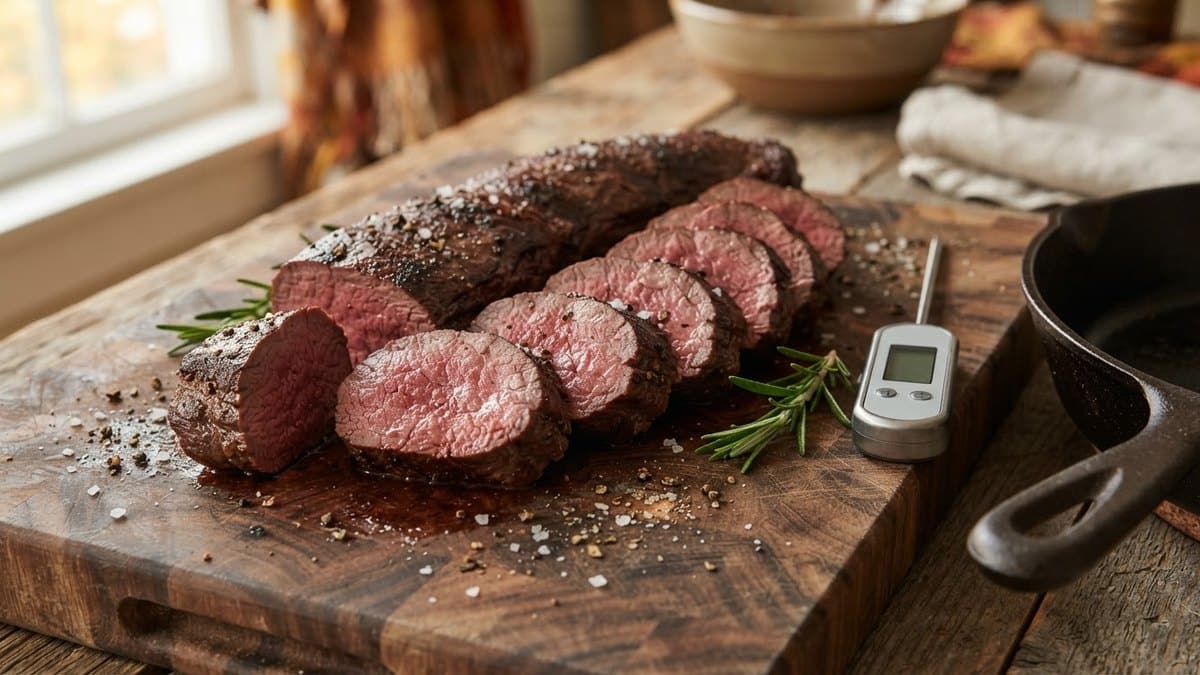
Smoked Venison Backstrap Temperatures by Doneness
The pull temperature matters most, because a backstrap keeps climbing after it leaves the heat. These rows match our steak doneness chart, with USDA’s venison line as its own row so nobody mistakes one for the other.
| Doneness | Pull temperature | Temperature after rest | What it looks like | Source |
|---|---|---|---|---|
| Rare | About 122°F | 125°F to 130°F | Cool-to-warm red center | Our steak doneness chart, a doneness preference |
| Medium-rare | About 128°F | 130°F to 135°F | Warm red center | Our steak doneness chart, a doneness preference |
| Medium | About 137°F | 140°F to 145°F | Warm pink center, firmer bite | Our steak doneness chart, a doneness preference |
| USDA safe minimum | 160°F before it leaves the heat | 160°F or higher | No pink, fully gray-brown | FoodSafety.gov, venison, wild or farm-raised |
Pull temperature is the center reading at the thickest part when the backstrap leaves the heat for good, after the sear. The first three rows are doneness preferences from our steak doneness chart, and all three sit below USDA’s line. The USDA row is the safe minimum FoodSafety.gov lists for venison. It gives beef a 3-minute rest but lists none for venison, so the probe should read 160°F before the meat comes off.

The venison recipes land in the same place. MeatEater pulls its smoked backstrap at 128°F to 132°F, and Wild Game & Fish pulls at 125°F. I would pull mine at 128°F and let the rest finish the job.
What USDA Says About Venison Temperature
The beef number does not carry over to deer. FoodSafety.gov gives beef, bison, veal, goat and lamb steaks and roasts 145°F with a 3-minute rest, then lists rabbit and venison at 160°F. The FSIS holiday roasting chart agrees: a venison loin roast gets 160°F, a beef rib roast 145°F.
The same FSIS page explains why game needs extra care. It says wild game killed by hunters has not been federally or state inspected, and that parasites such as Trichinella and Toxoplasma may be present. It wants the meat kept below 40°F until it is cooked or frozen.
My rule is short. If anyone at the table is pregnant, 65 or older, younger than 5 or has a weakened immune system, the groups FoodSafety.gov says are more likely to get food poisoning, the backstrap goes to 160°F. Healthy adults who want it pink are choosing with their eyes open. The FAQ below covers the one step CDC says greatly reduces the chance of toxoplasma infection.

Why Venison Backstrap Dries Out
Fat hides mistakes, and a backstrap has little to hide behind. USDA’s FoodData Central puts raw venison at 2.42 grams of fat per 100 grams. A choice New York strip from the beef loin, trimmed of its outside fat, carries 9.16 grams, nearly four times as much. A choice boneless ribeye trimmed the same way carries 18.4.
That is the short answer to how to cook venison backstrap without drying it out: every degree counts. MeatEater’s Danielle Prewett says a dry smoked backstrap usually comes from a smoker set too hot, skipping the seasoning ahead of time, or both. Deer & Deer Hunting‘s Jack Hennessy says a backstrap started and finished on a hot grill turns gray and dry at the edges by the time the center hits medium-rare.
The reverse sear fixes both. The smoke does the slow part and the sear only browns the outside, the method in the recipe below and in our reverse sear steak guide.
Smoked Venison Backstrap Recipe
Yield: serves 4 from a 1½- to 2-pound backstrap. Total time: about 1 to 1½ hours, plus an optional 12 to 24 hours with the rub on in the refrigerator. The rub is Wild Game & Fish’s salt, pepper and garlic for the same size backstrap.
Ingredients
- 1 venison backstrap, 1½ to 2 pounds, in one piece
- 1 teaspoon kosher salt
- ½ teaspoon black pepper
- ½ teaspoon garlic powder
- 1 tablespoon avocado oil, canola oil or beef tallow
Steps
- Trim. Peel off the silver skin and any fat, the first step in Realtree’s reverse-seared backstrap. Penn State Extension says the heavy ligament along the top can go too, as long as you do not trim away too much meat. Smoke the centermost piece, where MeatEater says width and thickness are about even, and save the ends for steaks.
- Season. Mix the salt, pepper and garlic powder and coat every side. If you have time, cover it tightly and refrigerate it 12 to 24 hours, because MeatEater says a salty rub put on ahead works like a dry brine that keeps the meat juicy. Our dry brining guide covers the salt math.
- Smoke. Run the smoker at 225°F, the bottom of the 225°F to 300°F range in FSIS smoking guidance, with a probe in the center of the thickest part. Pull it off the smoke 10°F to 15°F under the doneness you want, which our reverse sear steak guide puts at 115°F to 120°F for medium-rare and 125°F to 130°F for medium.
- Sear. Oil the backstrap and sear it in a cast-iron skillet or on a grill as hot as it will go, 45 to 60 seconds a side, until it is browned all the way around. The sear should add only about 5°F to 10°F, so take it off when the center reads the pull temperature in the table.
- Rest. Give it 5 to 10 minutes, the rest our doneness chart gives steaks 1.5 inches and thicker, while it coasts to the after-rest number in the table. Slice across the grain and serve.
Time follows thickness, NOT the clock. Wild Game & Fish smokes a 1½- to 2-pound backstrap at 225°F for about 45 minutes to reach 125°F. A reverse sear leaves the smoke at a lower number than that, so start checking well before the 45-minute mark. Our smoking times chart says it in four words: time predicts, temperature decides.

Backstrap vs Tenderloin
They are two different muscles, one along the top of the back and one underneath the spine. Penn State Extension takes a deer backstrap off with one long cut along each side of the spine, from near the tail to the base of the neck. The tenderloins sit along the underside of the spine, inside the carcass.
Pork has the same layout. Our pork loin temp guide puts the loin along the top of a hog’s back and the tenderloin underneath it.
Both cuts are lean. FoodData Central lists broiled deer loin at 2.38 grams of fat per 100 grams and broiled deer tenderloin at 2.35, so one doneness table covers both. I would sear the tenderloins hot and fast and save the smoker for the backstrap.
Bacon Wrap or Not
I would leave the bacon in the refrigerator. Our bacon-wrapped jalapeño poppers need 1.5 to 2 hours at 250°F to 275°F before the bacon renders, and Wild Game & Fish has a backstrap done at 225°F in about 45 minutes. Those clocks do not match, and the venison pays for it.
If you want fat on the outside, put it there in the skillet. MeatEater sears its backstrap in beef tallow and covers the top with the melted tallow from the pan, and tallow can replace the oil in the sear step above.
Best Wood for Venison
Our smoking woods guide has no venison row, so read the closest one, steak: post oak and mesquite are the best matches, hickory and pecan are acceptable, and alder is the one to skip. The guide limits mesquite to cooks under 4 hours, and a backstrap finishes well inside that.
The venison recipes agree. MeatEater’s Danielle Prewett says she loves oak, with hickory, pecan or cherry working too, and Wild Game & Fish recommends hickory. My pick is oak.
Thawing a Frozen Backstrap
FSIS gives three safe ways to thaw a frozen backstrap: the refrigerator, cold water or the microwave. The refrigerator is the slow one. FSIS says even a pound of ground meat needs a full day at 40°F or below, so give a backstrap at least that. Thawed that way, steaks and roasts keep 3 to 5 days and can be refrozen, with some loss of quality.
Cold water is faster. Seal the backstrap in a leak-proof bag, submerge it in cold tap water and change the water every 30 minutes. FSIS says about a pound may thaw in an hour or less and a 3- to 4-pound package in 2 to 3 hours. Anything thawed in cold water or the microwave gets cooked right away.
Never thaw it on the counter or in hot water. FSIS says the outside can sit between 40°F and 140°F, where bacteria multiply fast, while the center is still frozen.
Chronic Wasting Disease and Your Backstrap
Chronic wasting disease is fatal in deer, elk and moose, and CDC says it has been reported in wild deer in 36 U.S. states. CDC also says CWD infections in people have never been reported, and that so far it is not known if people could get infected.
If you hunt where CWD has turned up in your local area, CDC says to strongly consider testing the deer before you eat the meat, and not to eat meat from an animal that tests positive. It also says to wear latex or rubber gloves, avoid handling internal organs, especially the brain or spine, and keep your kitchen knives and tools off the carcass. Popular Outdoorsman covers how testing works, from dropping off a sample to handling the meat while you wait, in its guide to chronic wasting disease testing.
More than two out of three of you are putting the turkey on the smoker this year.
Frequently Asked Questions
What temperature should venison backstrap be cooked to?
USDA’s answer is 160°F, the safe minimum FoodSafety.gov lists for venison. For pink, pull at about 128°F for medium-rare and rest to 130°F to 135°F. Either way, probe the thickest part, as our meat thermometer guide shows, because CDC says you cannot tell whether food is safely cooked by its color or texture.
Can you eat venison rare?
People do, and it carries a documented risk. In a report in CDC’s Emerging Infectious Diseases journal, six of 10 Quebec hunters who shared a hunting retreat in Illinois in 2018 came down with similar symptoms. Blood tests showed recent toxoplasmosis in every hunter with symptoms, and investigators tied it to undercooked deer meat. If you still want it rare, CDC says freezing meat for several days at 0°F before cooking greatly reduces the chance of toxoplasma infection. The same CDC page warns that freezing does not reliably kill certain species of Trichinella, a parasite FSIS says wild game can carry, or harmful bacteria.
How long does it take to smoke a backstrap at 225°F?
Plan on less than an hour for a 1½- to 2-pound backstrap, and start probing early. Thickness moves the clock: in Deer & Deer Hunting’s reverse-sear backstrap, cooked low in an oven, the thick half took about 50 minutes and the narrow neck end 35 to 40. On a pellet grill, set it to 225°F and go by the probe the same way.
Should you marinate venison backstrap?
You can, but I would rather salt it the night before, as the recipe does. If you marinate, FSIS’s rules for beef make a good guide: marinate in the refrigerator, boil used marinade before it touches cooked meat and throw out any uncooked leftover marinade.
Can you smoke a backstrap ahead and sear it later?
No. FSIS’s rule for beef is never to brown or partially cook it, refrigerate it and finish cooking later, and it allows partial cooking only right before the meat goes onto a hot grill. I hold venison to the same rule: smoke and sear in one session.
The backstrap is the best cut on the deer, and it only gets one shot at the table. Pick your row, pull it on time, sear it hard and let it rest, and the only thing left on the cutting board will be the thermometer.
Sources: FoodSafety.gov, “Safe Minimum Internal Temperatures”; FoodSafety.gov, “People at Risk of Food Poisoning”; USDA FSIS, “Roasting Those ‘Other’ Holiday Meats”; USDA FSIS, “Smoking Meat and Poultry”; USDA FSIS, “The Big Thaw — Safe Defrosting Methods”; USDA FSIS, “Beef From Farm to Table”; CDC, “About Chronic Wasting Disease”; CDC, “Preventing Toxoplasmosis”; Emerging Infectious Diseases, “Acute Toxoplasmosis among Canadian Deer Hunters Associated with Consumption of Undercooked Deer Meat Hunted in the United States”; FoodData Central, “Game meat, deer, raw”; FoodData Central, “Beef, loin, top loin steak”; FoodData Central, “Beef, rib eye steak”; FoodData Central, “Game meat, deer, loin”; FoodData Central, “Game meat, deer, tenderloin”; Penn State Extension, “How Do You Break Down Your Venison Carcass?”; MeatEater, “Smoked Venison Backstrap”; Wild Game & Fish, “Smoked Venison Backstrap”; Deer & Deer Hunting, “Reverse-Seared Backstrap With Jalapeño Cilantro Drizzle”; Realtree, “Reverse Seared Smoked Venison Backstrap”.
Reader Favorites
- Creative BBQ Recipes: Fire Up A Unique BBQ Menu Now
- Smoke on a Gas Grill: BBQ Made Simple
- Trimming Beef Brisket: Learn What the Pros Know Now
- Beef Cuts: Master BBQ Perfection with These Essential Tips Now
- The Ultimate BBQ Guide: Best BBQ Tips for Ribs & More
- BBQ Wings and Beer Pairings: What to Pour With Each Sauce
BBQ Temperature Charts & Guides
Four quick-reference tools every cook bookmarks — target temps, pull temps, and how long leftovers keep, plus the full BBQ glossary.
| Cut | Pull | Time |
|---|---|---|
| Brisket | 203°F | 12–16h |
| Spare ribs | 195–203°F | ~6h |
| Pork butt | 203°F | 12–14h |
Target temps & times for 17 cuts, sortable by meat, weight and doneness.
View full chart →| Doneness | Target |
|---|---|
| Rare | 125–130°F |
| Medium-rare | 130–135°F |
| Well-done | 160°F+ |
Rare to well-done, burger safety (160°F) and resting times.
View full chart →| Food | Fridge | Freezer |
|---|---|---|
| Brisket, ribs | 3–4 days | 2–3 mo |
| Smoked sausage | 1 week | 1–2 mo |
| Potato salad | 3–4 days | no freeze |
How long smoked meats & sides keep — fridge and freezer, USDA-based.
View full chart →Every pit term decoded — cooking methods, gear, cuts, wood, and technique, A to Z.
Open the glossary →